
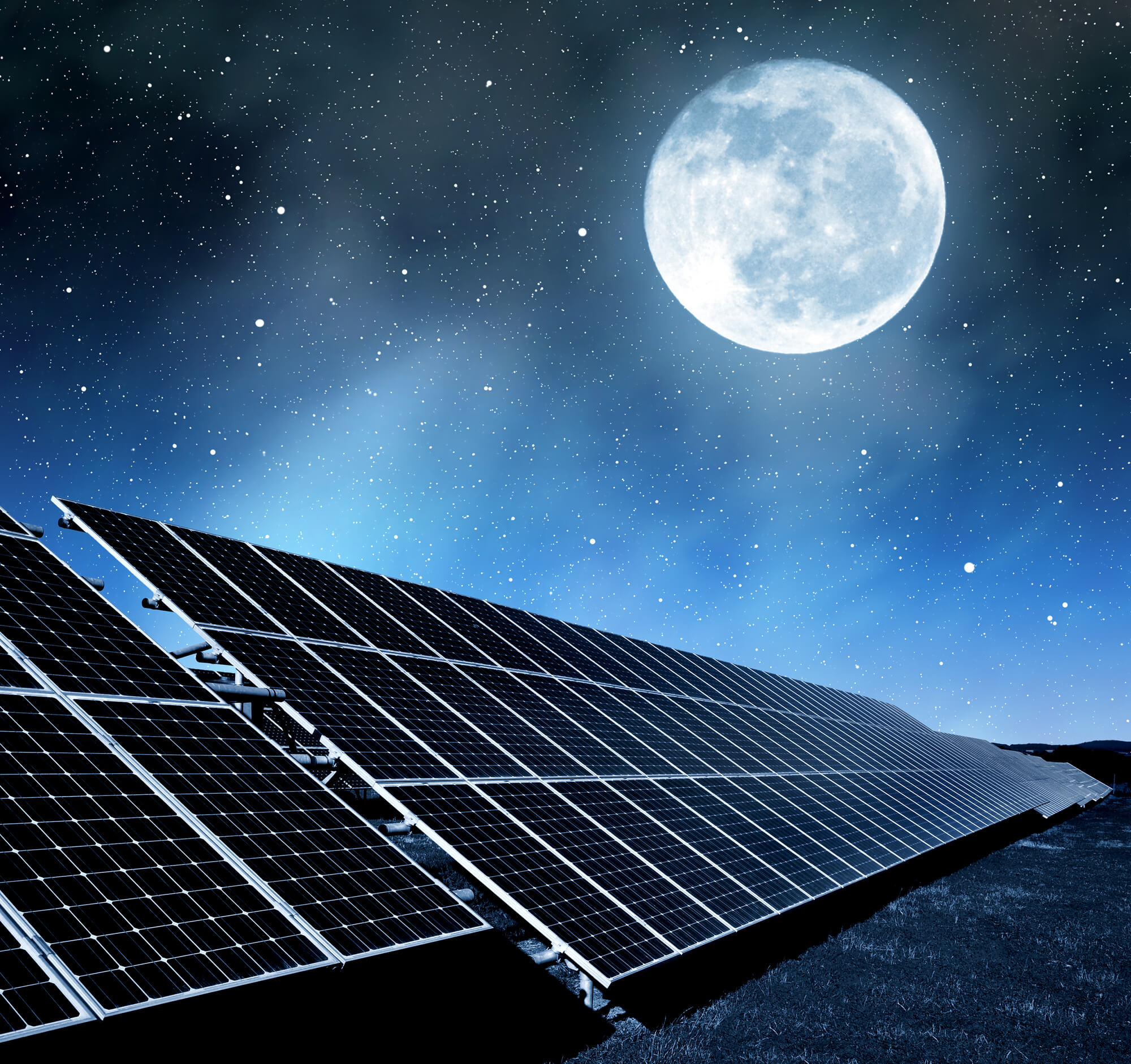
It’s a fun question, but the physics answer is disappointing for moonlight fans. Moonlight is simply reflected sunlight at roughly 0.1% of its original intensity — far too weak to meaningfully charge a solar panel.
Why Moonlight Is So Weak
The moon doesn’t produce its own light — it reflects sunlight, and lunar surface material (regolith) reflects only about 12% of the light that hits it. By the time reflected light reaches Earth, intensity is roughly 0.1% to 0.0001% of direct sunlight, depending on moon phase.
Solar Panel Output Under Moonlight
| Light Source | Approximate Intensity | Panel Output |
|---|---|---|
| Direct sunlight | 1,000 W/m² | 100% rated output |
| Overcast daylight | 100-300 W/m² | 10-30% output |
| Full moonlight | ~0.1-1 W/m² | Negligible, unmeasurable in practice |
Can Any Panel Detect Moonlight?
Highly sensitive lab-grade photovoltaic sensors can technically detect a minuscule current under a full moon, but the output is far too small to charge batteries or power any real device.
What Actually Charges Solar Devices at Night
Solar-powered devices that “work” at night rely entirely on batteries charged during the day — not on any nighttime light source, moonlight included.
Frequently Asked Questions
Can moonlight charge a solar panel?
Not meaningfully — moonlight is about 0.1% the intensity of direct sunlight.
Why is moonlight so much weaker than sunlight?
The moon reflects only about 12% of the sunlight hitting it, and that reflected light spreads out further by the time it reaches Earth.
Do any solar panels work at night?
No commercially available panels generate usable power from moonlight or starlight.
How do solar lights work at night then?
They run on batteries charged during daylight hours, not from nighttime light.
Can artificial light charge solar panels?
Weakly — household lighting is far less intense than sunlight and inefficient for charging.
Is there any light source besides the sun that can power panels?
No practical one — direct sunlight remains by far the most viable source.
Does a full moon produce more charge than a new moon?
Yes, marginally more reflected light, but still far too weak to matter practically.
Summing Up
Moonlight is simply too weak to power solar panels — direct sunlight remains essential. To learn about maximizing your home’s solar potential, call (855) 427-0058 or visit us.solarpanelsnetwork.com.
Updated