
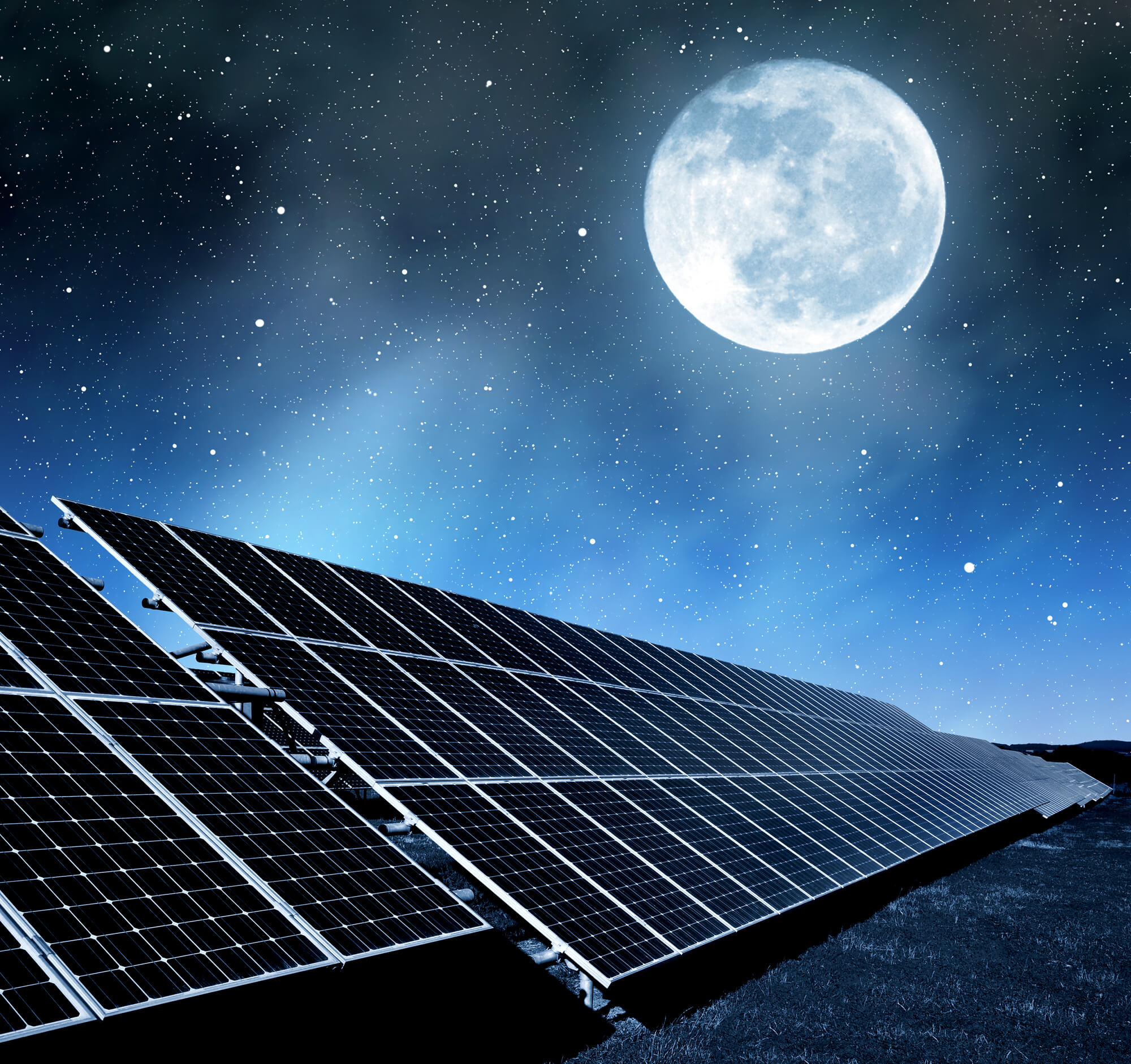
Moonlight is simply reflected sunlight, so the question of whether solar panels can generate power from the moon is a natural one. Unfortunately, the answer is straightforward: traditional solar panels cannot produce usable electricity from moonlight. Moonlight is roughly 400,000 to 1,000,000 times weaker than direct sunlight, which means the amount of energy generated is far too small for practical use. However, emerging research into specialized nighttime photovoltaic technology offers an intriguing glimpse into a future where this might change.
Understanding why moonlight fails as a power source—and what new technologies aim to solve this problem—helps explain the broader physics of solar power and the limitations homeowners face when planning solar systems.
Why Moonlight Cannot Power Traditional Solar Panels
The fundamental issue lies in light intensity. A full moon provides roughly 0.27 lux of illumination. By comparison, direct sunlight delivers approximately 100,000 lux. This massive difference explains why traditional solar panels, which require a certain voltage threshold to activate, simply cannot respond to moonlight.
A standard residential solar panel that produces 300 watts under full sunlight will generate only about 1 watt—or even less—under direct full moonlight. More importantly, most solar inverters (the devices that convert DC power to AC power) require a minimum voltage to operate. With moonlight, panels never reach this threshold, so the inverter remains in sleep mode and no power flows to your home or batteries.
The photons in moonlight are identical to those in sunlight, but there are simply too few of them hitting the panel surface. The photovoltaic effect still occurs, but on such a tiny scale that it’s negligible for any practical application.
What About a Full Moon Versus a Crescent?
Moon phase matters significantly. A full moon produces roughly 9 times more light than a half moon, and about 50 times more than a crescent moon. Even accounting for this variation, a full moon still falls far short of the light intensity needed to meaningfully charge batteries or power home systems.
Under a full moon, outdoor visibility is reasonable for human eyes, but this light level—around 0.27 lux—translates to virtually zero output from a grid-tied solar system. Off-grid systems using charge controllers might theoretically accumulate a tiny amount of energy, but the amount would be measured in milliwatts per hour, making it functionally useless for residential purposes.
Emerging Technology: Radiative Cooling and Nighttime Power
While traditional solar panels cannot harness moonlight, researchers have developed a different approach entirely. Professor Shanhui Fan’s team at Stanford University discovered a method using radiative cooling to generate small amounts of electricity at night.
This technology works by harvesting the temperature difference between modified solar panels and the night sky. By attaching thermoelectric generators to specially designed panels, the system exploits the natural cooling effect when heat radiates away from the panel surface into the cold void of space. Current prototypes generate approximately 50 milliwatts per square meter at night—far more than moonlight-powered panels, but still impractical for powering entire homes.
The technology remains experimental and is not yet commercially available for residential use. However, it represents the most promising direction for nighttime solar power generation, addressing the fundamental challenge that moonlight itself is too weak to power homes.
Can You Use Moon-Tracking Systems?
Some homeowners wonder if tracking systems—which follow the sun across the sky—could be modified to track the moon. This approach is theoretically possible but remains impractical. The same issue applies: moonlight intensity is simply too low. Even with perfect tracking, the power output would still be negligible, and the energy required to run tracking motors would exceed any power generated.
Tracking systems make sense for solar installations because they can increase daily output by 20-30% when following the sun. With moonlight, there is no practical benefit since output is already near zero.
Why Night Power Matters for Solar Homeowners
The limitation that solar panels don’t work at night highlights why energy storage is critical for off-grid and high-resilience solar systems. Battery storage—whether lithium-ion or lead-acid—allows homeowners to use daytime solar production throughout the night and during cloudy periods.
For grid-tied systems, net metering provides an equivalent benefit. During the day, excess solar production is credited to your account. At night, you draw from the grid using those credits, effectively allowing you to “use” your daytime solar output 24/7.
Until radiative cooling technology matures and becomes commercially viable, solar power generation remains a daytime activity. The solution to 24/7 energy independence is battery storage paired with appropriately sized solar arrays, not attempting to harness moonlight.
Frequently Asked Questions
How much power would a solar panel generate under a full moon?
Under direct full moonlight, a standard residential solar panel rated at 300 watts would generate approximately 0.5 to 1 watt of power—essentially negligible and far below the voltage threshold needed to activate most solar inverters. The actual usable output is zero for any practical application.
Could grow lights or artificial light charge solar panels instead of moonlight?
Artificial lights are slightly more effective than moonlight because they can produce higher intensity in specific spectra. However, the energy cost of running the lights typically far exceeds the electricity generated by the panels, creating a net energy loss. For small demonstration purposes, artificial lights can trigger a measurable response, but it’s impractical for powering systems.
Will future solar panels be more sensitive to moonlight?
Future silicon-based panels may achieve slightly higher sensitivity through better materials and designs, but the fundamental physics limits remain. A panel could theoretically be optimized for low-light conditions, but increasing sensitivity to moonlight would reduce efficiency under normal sunlight. The real breakthrough technology is radiative cooling, which works by a completely different mechanism.
What percentage of solar power could come from moonlight if it worked?
If moonlight could be efficiently captured (which it cannot be with current technology), it would represent less than 0.1% of daytime solar output. Even if radiative cooling technology becomes mature, nighttime generation will likely supplement rather than replace daytime solar production and battery storage.
Summing Up
Moonlight cannot power traditional solar panels because it is far too dim—roughly one millionth as intense as sunlight. While the concept is intriguing and moonlight-powered systems appear frequently in science fiction, the physics makes this impossible with current photovoltaic technology. Your solar panels will never generate meaningful electricity from the moon.
The practical path to 24-hour solar energy independence remains battery storage combined with daytime solar production. For grid-tied homes, net metering provides the same benefit by allowing nighttime grid draw backed by daytime solar credits.
Emerging radiative cooling technology may eventually enable modest nighttime power generation through a completely different mechanism, but this remains years away from commercial availability. For now, the solution to nighttime power needs is energy storage, not moonlight harvesting.
If you’re interested in maximizing your solar investment and understanding how to size a system that meets 24-hour energy needs, Solar Panels Network USA can help. Whether you need residential solar installation with battery storage or a grid-tied system optimized for your local net metering rules, our team provides expert guidance. Call us at (855) 427-0058 for a free consultation and custom solar proposal.
Updated