
Solar panels are engineered to withstand 25+ years of outdoor exposure, but they can be damaged by a range of physical, environmental, and electrical causes. Understanding what damages solar panels helps you identify issues early, assess whether warranty claims are applicable, and take preventive steps where possible.
This guide covers every significant cause of solar panel damage — from hail and installation errors to less obvious threats like potential-induced degradation and snail trails.
Hail Damage
Hail is the most common weather-related cause of solar panel damage. All residential solar panels must be tested and rated to withstand hailstones per IEC 61215, the international testing standard: 25mm (1 inch) diameter hailstones at 23 m/s (51 mph) impact velocity. This represents a significant hailstorm — most panels survive ordinary hail without damage.
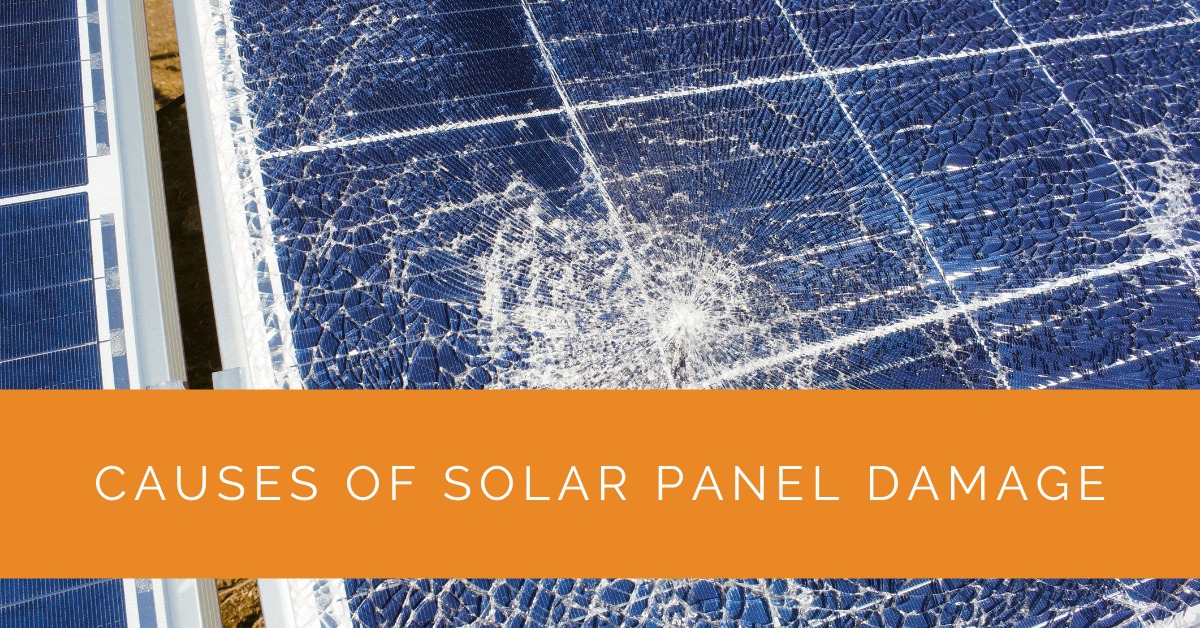
When hail causes damage: Large hailstones (golf ball size and larger, >40mm) at high velocity can crack the tempered glass front sheet. The pattern is typically a star-shaped crack radiating from the impact point. Internal cracks in silicon cells can also occur from sub-threshold impacts that don’t visibly crack the glass — these “microfractures” may not immediately reduce output but can propagate over time with thermal cycling.
Vulnerable points: Panel edges and corners are more susceptible to hail damage than the center — the aluminum frame provides some structural support near the frame, but the glass is relatively unsupported midway between frame and mounting points. Panels tilted toward the sky at steep angles receive higher-velocity impacts than low-tilt installations.
What to do after a large hailstorm: Visually inspect panels for visible cracks. Check your inverter monitoring for sudden production drops — a panel with cracked cells may show 20–40% reduced output. Take photos for insurance documentation. Most homeowners’ insurance policies cover hail damage to solar panels; some panel manufacturers offer product warranties against hail beyond the IEC minimum.
Physical Impact and Vandalism
Beyond hail, physical impact from falling tree branches, tools dropped during maintenance, and (less commonly) vandalism or theft attempts can crack glass or damage frames. Large tree branches falling from overhead can cause severe damage to entire sections of an array. A major cause of damage during maintenance is stepping on or leaning excessive weight on panels — despite common belief, solar panels are not designed to be walked on, though most can withstand a person’s weight when applied over the full panel area rather than on individual cells.
Cracked glass symptoms: Visible spider cracks, water ingress through cracked glass (causes visible corrosion or brown staining inside the module), increased series resistance due to cell damage. Cracked glass almost always requires panel replacement rather than repair.
Snail Trails
Snail trails are brown or gray discoloration lines visible on solar panels, typically following the pattern of cell busbars or cell cracks. They’re caused by silver paste from the front metallization (busbars) migrating into microcracks in the silicon, combined with chemical reaction from moisture ingress through the EVA encapsulant.
Snail trails are a symptom of microcracks (often caused by hail or mechanical stress during shipping or installation) combined with moisture permeation through the encapsulant. They indicate that moisture has entered the module and cells are degrading beyond their normal 0.3–0.5%/year rate. Heavily affected panels may lose 3–10% of output — warranty claims may apply.
Potential-Induced Degradation (PID)
Potential-induced degradation (PID) is an electrical phenomenon that occurs when the voltage potential between the solar cells and the grounded frame drives ionic drift through the module — leaking current through the glass, EVA, and anti-reflection coating rather than through the intended circuit. PID reduces cell efficiency and output, sometimes severely.
Risk factors: High-voltage string configurations (common in large systems with 1000V or 1500V DC strings), high temperatures and high humidity (accelerate ion migration), and poor grounding design or isolation from ground. Modern panels with PID-resistant designs (modified anti-reflection coatings, better EVA selection) and string inverters with isolation management features (Fronius “shadow mode,” SMA “PID recovery”) reduce PID risk significantly.
Detection and reversal: PID can sometimes be partially reversed by applying a reverse voltage to the affected string overnight (some inverters do this automatically). Persistent or severe PID typically requires panel replacement. PID is covered by quality manufacturers’ performance warranties.
Hot Spots
Hot spots are localized areas of a solar panel that become significantly hotter than surrounding areas during operation. They appear as bright spots on thermal imaging cameras (90°C+ vs 35–50°C for normal cells). Hot spots are caused by:
Partial shading: When one or more cells in a string are shaded, the shaded cells are forced to carry the full string current in reverse bias, generating heat rather than power. The bypass diodes in the junction box (typically three bypass diodes per panel, protecting groups of 20–24 cells) should activate to route current around shaded cell groups — but if a bypass diode fails, the entire cell group operates in reverse bias and generates intense heat.
Cell defects: Manufacturing defects (contamination, crystal dislocations) can create high-resistance points in individual cells that generate heat rather than produce power. These defects may not be detectable at initial installation but manifest as hot spots over time.
Damage: Physical damage (microcracks from hail or mechanical stress) creates high-resistance broken current paths that heat under current flow.
Hot spots cause EVA encapsulant to delaminate, backsheet to discolor, and can in severe cases cause fires (though panel fires are rare). Thermal imaging inspection identifies hot spots before they become critical — recommended during commissioning and periodically for older systems.
Water and Moisture Ingress
All solar panels have an IP68 environmental rating (fully dust-tight, immersion-resistant) but this protection depends on intact seals and undamaged glass. Water ingress causes:
Corrosion of silver busbars and copper conductors
EVA delamination (separation of the encapsulant from glass or cells)
Cell discoloration and efficiency loss (visible as yellow-brown browning inside the module)
Short circuits in the junction box if water reaches electrical connections
Water ingress is most commonly caused by cracked glass (providing a direct entry path), junction box seal failure (particularly in older panels), or frame seal degradation after many years of outdoor exposure. Panels with visible internal fogging (visible through inspection on a cloudy day against a bright background) have experienced moisture ingress and are degraded beyond repair.
Delamination
Delamination is the separation of the encapsulant (EVA) from the glass or solar cells, typically visible as bubbles or cloudy areas inside the panel. Causes include: manufacturing defects in EVA cure, excessive temperatures during operation, UV degradation of EVA, and water ingress. Delamination reduces light transmission to the cells (reducing output) and allows moisture to reach cell connections. Severely delaminated panels should be replaced — they are safety hazards if water reaches electrical components.
EVA Browning (Yellowing)
EVA encapsulant can yellow or brown over time from UV exposure — a process called “browning” or “discoloration” that reduces light transmission to the cells. Modern EVA formulations with UV stabilizers and anti-yellowing additives have largely solved this problem for panels made after approximately 2010, but older panels (especially some Chinese-manufactured panels from the early 2010s with lower-quality EVA) show significant yellowing. EVA browning causes a gradual, irreversible reduction in output beyond the normal degradation rate — warranty claims may apply for panels showing accelerated browning.
Installation Damage
A significant proportion of solar panel damage is caused during installation:
Frame overtorquing: Clamp bolts tightened beyond specification stress the glass at the mounting points, creating invisible microfractures that can propagate into cracks over time with thermal cycling.
Improper handling: Panels dropped or leaned at steep angles on corners, walked on during roof installation, or dragged across rough surfaces during installation can all cause microfractures or frame damage.
Poor electrical work: Incorrectly connected MC4 connectors (mismatched brands, incorrect polarity, or loose connections) create arc flash risks and connection resistance that causes heating and eventual failure. MC4 connectors from different manufacturers should not be mixed — they may not seal properly, allowing moisture infiltration.
Frequently Asked Questions
What is the most common cause of solar panel failure?
Inverter failure is statistically the most common system component failure (inverters last 10–15 years vs 25–30 years for panels). For panel-specific failures, the most common causes are: junction box failures (seal degradation, failed bypass diodes), microcracks from hail or mechanical stress, and potential-induced degradation in high-voltage arrays. Complete panel failure (producing near-zero output) is rare in quality panels from established manufacturers within the first 15–20 years.
Can solar panels be repaired if damaged?
Limited repair options exist. Cracked glass cannot be repaired — the panel must be replaced. Failed bypass diodes can be replaced by qualified technicians. EVA delamination cannot be reliably reversed in the field. Junction box seal failures can sometimes be repaired with UV-stable silicone sealant. In most cases, a significantly damaged panel is more cost-effectively replaced than repaired, particularly if the panel is under warranty. A replacement panel also restores full production from the affected string.
Does hail damage solar panels?
Most hailstorms do not damage panels — all panels are tested to IEC 61215 hail standards (25mm at 51 mph). Large, severe hail events (golf ball size and larger at high velocity) can crack glass, particularly at edges and corners. Sub-threshold hail impacts can cause internal microfractures that reduce long-term performance even without visible glass cracking. Most homeowners’ insurance policies cover solar panels for hail damage.
Can solar panels catch fire?
Solar panel fires are rare but do occur, typically from: DC arc faults (NEC 690.11 requires arc fault circuit interrupters for most new US installations); junction box failures with moisture ingress; or severe hot spots from bypassed bypass diodes under heavy shading. Modern installations with AFCI protection and rapid shutdown devices (NEC 690.12) significantly reduce fire risk. Regular thermal imaging inspections identify hot spots before they escalate.
How long do solar panels last before they get damaged?
Solar panels are designed for 25–30 year outdoor service. Physical damage from severe weather events or installation errors can occur at any time, but quality panels from Tier 1 manufacturers rarely develop manufacturing-related defects within their first 15–20 years. The primary age-related wear is gradual efficiency loss (0.3–0.5%/year), not catastrophic failure. Inverters are the most likely component to require replacement within a 25-year system life (typically at 12–15 years).
Summing Up
Solar panels can be damaged by hail, physical impact, electrical phenomena (hot spots, PID), moisture ingress, EVA degradation, and installation errors. Most quality panels from reputable Tier 1 manufacturers withstand routine environmental exposure without significant damage for 25+ years. The main risks are: severe hail events (consider hail insurance); hot spots from persistent shading or failed bypass diodes (addressable with microinverters or DC optimizers); and PID in high-voltage arrays (addressable with proper panel and inverter selection). Annual visual inspection and periodic thermal imaging catch most developing issues before they cause significant production losses.
If you suspect your solar panels are damaged or underperforming — call (855) 427-0058 for a professional diagnostic visit. Licensed solar technicians can perform Voc testing, thermal imaging, and production analysis to identify the cause of underperformance.
Updated