
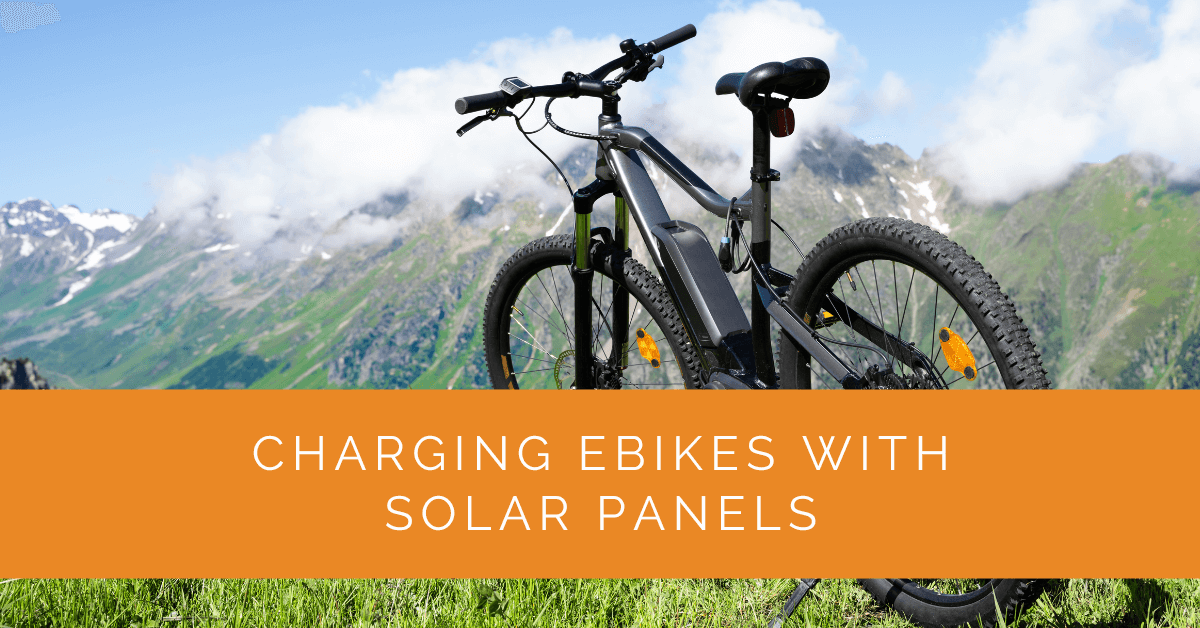
Electric bikes offer an eco-friendly transportation alternative to gas vehicles, but charging them from grid electricity still relies on fossil fuels in many regions. Charging your ebike with solar panels maximizes the environmental benefit and eliminates charging costs. You can add solar charging to an existing ebike in multiple ways: a portable solar panel with a charge controller, a solar power station with built-in battery and inverter, or a permanent solar array on your property. This guide explains ebike charging requirements, solar equipment sizing, charging speed, and practical methods for keeping your electric bike powered by the sun.
Understanding Ebike Battery Specifications
Voltage and Capacity
Most modern ebikes use lithium-ion battery packs with these specifications:
- Voltage: 24V, 36V, 48V, or 52V (higher voltage = more power)
- Capacity: 0.5–1.0 kWh (kilowatt-hours) typical for single bikes
- Examples: A 48V 20Ah battery = 0.96 kWh; a 36V 15Ah battery = 0.54 kWh
Check your ebike manual for battery specifications. This information determines the solar setup size needed.
Daily Energy Consumption
Energy usage depends on riding style, weight, terrain, and motor efficiency. A typical ebike uses 15–30 Wh per mile:
- Flat terrain, efficient pedaling: 15–20 Wh/mile
- Rolling hills, moderate assist: 20–25 Wh/mile
- Steep hills, full power: 30–40 Wh/mile
A 10-mile commute on flat terrain (20 Wh/mile) requires 200 Wh daily charging, or 0.2 kWh. A 30-mile weekend ride requires 600–900 Wh, or 0.6–0.9 kWh.
Solar Panel Sizing for Ebike Charging
Rule of Thumb
For typical daily commute charging (10–20 miles, 0.2–0.4 kWh daily), a 100–200W solar panel provides sufficient charging. For weekend riders or longer commutes (30–50 miles, 0.6–1.0 kWh daily), 200–400W panels are ideal.
Detailed Sizing Calculation
Step 1: Calculate Daily Energy Needed
Daily miles × Average Wh/mile = Daily energy
Example: 15 miles × 20 Wh/mile = 300 Wh = 0.3 kWh daily
Step 2: Account for System Losses
Solar panel output to battery includes losses from the charge controller (90–95% efficient) and weather conditions (60–80% on average days). Assume 70% overall efficiency.
Required solar output = 0.3 kWh / 0.70 = 0.43 kWh from solar panels
Step 3: Calculate Panel Size
Average solar production per watt is 3–5 Wh per day (varies by location, season, and orientation). Using 4 Wh per watt per day:
Required panel size = 0.43 kWh / 0.004 kWh per watt = 107W minimum
Recommendation: 150–200W panel for this scenario, accounting for cloudy days and seasonal variation.
Quick Reference Table
Daily Commute (10–15 miles): 100–150W panel
Daily Commute Plus Leisure (20–30 miles): 200–300W panel
Heavy Daily Use + Weekend Riding (40–50 miles): 400W+ panel or solar power station
Portable Solar Charging Setup
Method 1: Portable Solar Panel + Charge Controller + Battery
This is the most flexible approach for casual users.
Components:
- Portable solar panel: 100–400W crystalline or 60–200W amorphous (cost: $100–$400)
- MPPT charge controller: Essential to maximize charging speed (cost: $50–$150)
- Intermediate battery or power bank (optional): Stores solar energy for later charging (cost: $100–$300)
- Ebike charger: Original charger from ebike manufacturer
- Connectors and cables: MC4 to XT60/Anderson connectors (cost: $10–$20)
Setup:
- Set up the portable solar panel in direct sunlight, angled toward the sun
- Connect the panel to the MPPT charge controller via MC4 connectors
- Connect the controller output to a 48V intermediate battery or directly to the ebike charger (if voltage compatible)
- Plug the ebike charger into the battery or controller output
Charging Speed: A 200W panel in full sunlight (4 peak sun hours) generates 0.8 kWh daily. With 70% efficiency, it delivers 0.56 kWh to the ebike daily—sufficient for most commuters. A full 0.5 kWh ebike battery charges in 5–8 sunny hours.
Advantages: Portable, scalable (add more panels), works anywhere with sunlight
Disadvantages: Requires manual setup and monitoring; weather-dependent; intermediate components add cost
Method 2: Portable Solar Generator
An all-in-one solar generator includes solar panels, battery, charge controller, and inverter.
Popular Models:
- Jackery Explorer 500 (500Wh battery, 100W panel): $600–$700
- EcoFlow River 2 (256Wh, 100W panel): $400–$500
- Bluetti AC200L (2,048Wh, expandable): $1,500–$2,000
Setup: Simply plug your ebike charger into the generator’s AC outlet. The generator charges itself from the integrated or paired solar panels.
Charging Speed: A 500Wh solar generator with 100W panel takes roughly 8 hours to charge from a portable panel in direct sunlight. Once charged, it provides enough energy for 1–2 ebike charges before needing recharge from solar.
Advantages: Plug-and-play ease, battery backup for multiple charges between charges, useful for camping and emergencies
Disadvantages: More expensive upfront; lower solar charging rate than dedicated panels; battery capacity limits multiple recharges
Method 3: Home Solar Array
If you have a residential solar installation, your ebike can charge directly from your home’s solar generation. Charge during daylight hours when panels are producing.
Setup: Plug the ebike charger into any home outlet during sunny hours. Your home’s solar inverter converts panel DC power to AC, and the charger uses it directly.
Charging Speed: Unlimited; charge as fast as your charger supports (typically 500–2,000W input). A full 0.5 kWh battery charges in 15–60 minutes depending on charger power.
Advantages: Fastest charging; integrates seamlessly with home solar; no additional equipment needed
Disadvantages: Requires existing home solar installation; only works during daylight; doesn’t help renters or apartments without solar
Charging Speed Comparisons
Standard Grid Charging (2,000W household charger):
- 0.5 kWh battery: 15 minutes
- 1.0 kWh battery: 30 minutes
Portable 200W Solar Panel + MPPT Controller:
- 4 peak sun hours: 0.56 kWh generated → partial charge
- Full charge overnight or multi-day
Portable 400W Solar Panel + MPPT Controller:
- 4 peak sun hours: 1.12 kWh generated → full charge for 0.5 kWh battery
- Full charge in one sunny day
Home Solar Array (2,000W charger power):
- Full charge: 15–60 minutes (same as grid, but using free solar power)
Charge Controller Types: PWM vs. MPPT
PWM (Pulse Width Modulation)
Cost: $20–$50
Efficiency: 70–80%
Best for: Simple systems, budget-conscious users, 12V/24V panels
PWM controllers work but waste 20–30% of solar energy as heat. Acceptable for small portable setups.
MPPT (Maximum Power Point Tracking)
Cost: $50–$150
Efficiency: 90–98%
Best for: Serious solar users, larger panels (200W+), maximum charging speed
MPPT controllers actively optimize the voltage and current from solar panels to match the battery requirements, recovering 20–30% more energy than PWM. For ebike charging, MPPT is worth the investment if using 200W+ panels.
Practical Charging Tips
Optimal Panel Placement
Position panels facing true south (Northern Hemisphere) at an angle equal to your latitude. Rotate manually throughout the day for maximum sun exposure. A 10 AM to 3 PM window captures 60–70% of daily solar energy.
Battery Management
Keep your ebike battery between 20–80% charge when possible. Avoid deep discharge (0%) and full charge (100%) for extended lifespan. Most modern chargers have smart controllers preventing overcharge damage.
Seasonal Adjustments
Summer: 4–5 peak sun hours daily; charging is faster and easier
Winter: 2–3 peak sun hours daily; require larger panels or extended charging times
Cloudy Climates: Use 300–400W panels instead of 100–200W to maintain acceptable charging speed
Charging Schedule
Charge during peak sunlight hours (10 AM–3 PM) for fastest results. If using a portable system, leave the setup in place during the day and let solar power charge throughout daytime hours. Unplug at night.
Cost Analysis: Solar Charging vs. Grid Charging
Grid Charging Cost: National average electricity cost is $0.13/kWh. Charging a 0.5 kWh battery costs $0.065. Commuting 50 miles weekly (two 25-mile rides) requires 2.5 kWh charging = $0.33 weekly = $17 annually.
Solar Charging Setup (Portable 200W Panel + MPPT): Upfront cost $250–$400. Daily charging of 0.3 kWh costs effectively $0 after payback. Payback period: 15–20 years (minimal cost savings) OR immediately if environmental benefits matter.
Home Solar (Existing Installation): Marginal cost nearly $0. Ebike charging from home solar has zero incremental cost after the system is installed.
Payback Perspective
Portable solar ebike charging rarely pays for itself through grid-cost savings alone. However, the investment makes sense for:
- Minimizing carbon footprint
- Off-grid capability for emergencies or travel
- Combining with other solar uses (camping, outdoor work)
- Avoiding grid dependency (resilience)
Frequently Asked Questions
Can I charge my ebike directly from a solar panel without a controller?
Not safely. Direct panel voltage fluctuates (30–50V) and can damage the ebike charger. A charge controller stabilizes voltage and prevents overcharge. Always use a proper controller.
How long does it take to charge an ebike with a 100W solar panel?
A 100W panel generates ~0.4 kWh daily in good sun (4 peak hours). This charges a 0.4 kWh battery fully in one sunny day, or partially charges larger batteries. Charging speed: roughly 0.1 kWh per peak sun hour.
Can I use a solar power station to charge multiple ebikes?
Yes. A 500Wh solar generator charges one 0.5 kWh battery fully; a 1,000Wh generator charges two batteries. The generator recharges from solar panels or grid between charges. Larger capacity generators (5,000+ Wh) charge multiple bikes daily from adequate solar.
What if I live in a cloudy climate?
Use larger solar panels (300–400W instead of 100–200W) and accept slower charging times. Amorphous silicon panels perform slightly better in diffuse light than crystalline panels. Alternatively, rely on grid charging with a battery backup system.
Is ebike solar charging worth the investment?
Financially, payback is 15–30 years due to low grid electricity costs for ebikes. Environmentally and for resilience, solar charging is valuable if you value independence from the grid and minimizing carbon footprint.
Environmental and Lifestyle Benefits
The true value of solar-powered ebikes extends far beyond cost savings. An ebike reduces carbon emissions by 50–80% compared to car commuting. A typical 20-mile daily commute by car emits approximately 20–30 lbs of CO2 weekly; the same commute by ebike emits zero direct emissions. Adding solar charging makes the bike carbon-neutral from generation to operation, eliminating the small manufacturing and grid-electricity footprint.
Solar ebike charging appeals to environmentally conscious riders, creating a cohesive zero-emission transportation system. A household with home solar panels and solar-charged ebikes achieves energy independence in transportation and home electricity. This resilience means continued mobility even during grid outages, a significant advantage in areas with unreliable power.
For outdoor enthusiasts and travelers, portable solar charging enables extended trips without dependence on charging infrastructure. A camper or long-distance cyclist can maintain unlimited range by charging during daytime rest stops, transforming the ebike from a local commuter to a true long-distance adventure vehicle powered entirely by the sun.
Integration with Whole-Home Solar Systems
Homeowners with existing whole-home solar installations gain ebike charging essentially for free. The marginal cost of charging an ebike is negligible compared to the system’s total output. A typical 7 kW home solar system produces 25–30 kWh daily in summer. Adding ebike charging (0.3–0.5 kWh daily) requires less than 2% additional system output—effectively invisible to home energy budgets.
For households considering solar installation, including additional capacity to cover ebike, electric vehicle, or heat pump charging is more cost-effective than adding capacity later. A system sized for 9 kW instead of 7 kW (13% larger) adds only $3,000–$5,000 upfront but enables decades of free transportation and heating, dramatically improving overall system ROI.
The synergy between home solar, ebikes, and eventually electric vehicles creates a true zero-emission household. Energy independence at this level provides financial security (protection from rate increases), environmental benefits (zero carbon transportation), and resilience (continued mobility during outages). Many forward-thinking homeowners are designing comprehensive solar systems that power not just the home but the entire transportation ecosystem.
Summing Up
Charging ebikes with solar panels is feasible, scalable, and environmentally beneficial. A 200W portable solar panel with MPPT charge controller handles most daily commuting (10–20 miles). Solar generators offer all-in-one convenience for casual users. Home solar arrays provide the fastest, most convenient charging. Sizing depends on daily mileage and local sun exposure. While upfront costs are higher than grid charging, solar ebike charging provides energy independence, zero operating costs, and significant environmental benefits for eco-conscious riders.
For a comprehensive solar solution that covers your home energy needs plus ebike charging and transportation, call (855) 427-0058 to discuss whole-home solar installation and sustainable zero-emission lifestyle options tailored to your specific needs.
Updated