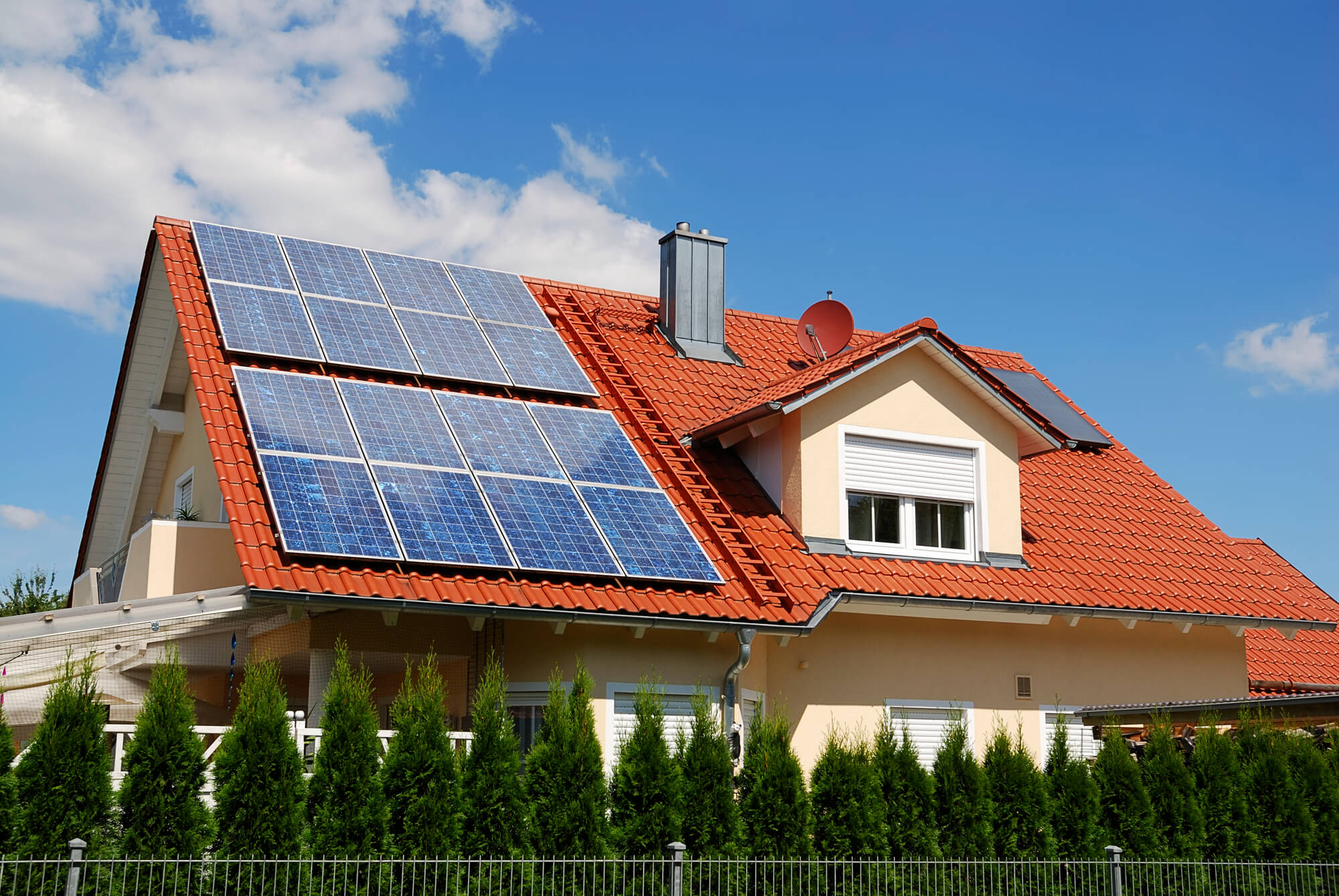
Solar panels do work in the shade — but not at full capacity. The extent of the output reduction depends on how much of the array is shaded, what type of inverter the system uses, and whether the panels have shade mitigation technology built in. For most homes, some degree of shading is unavoidable, and understanding how it affects production is essential to designing a system that performs as expected.

How Much Does Shading Reduce Solar Output?

The output reduction from shading varies widely depending on the shading type and inverter technology:

Shading ScenarioSystem with String InverterSystem with Microinverters / Optimizers
One panel 50% shaded (8-panel system)30–50% total system loss~6% total system loss
Two panels fully shaded50–75% total system loss~25% total system loss
Light diffuse shading (thin clouds, haze)5–20% loss5–20% loss
Morning / evening low-angle shading15–40% daily production loss10–25% daily production loss

The dramatic difference between string inverters and microinverters/optimizers under partial shading is the single most important factor in shaded site system design.

Why String Inverters Suffer So Much in Shade

A string inverter processes all panels in a series string together. It tracks the Maximum Power Point (MPP) of the entire string as a unit — meaning the string operates at whatever voltage and current the weakest panel dictates. This is the weakest link problem.

If one panel in a 10-panel series string is 80% shaded and producing only 20% of its rated output, the entire string’s current is dragged down toward that panel’s current. The other nine fully-producing panels cannot compensate — the string inverter clamps the whole string’s performance to the worst-performing panel’s operating point.

Modern string inverters include bypass diodes within each panel, which help by routing current around a severely shaded cell string within a panel (preventing hotspots), but they don’t solve the cross-panel string performance problem. A shaded panel still pulls down the entire string’s output significantly.

How Microinverters Solve the Shading Problem

Microinverters (Enphase is the dominant brand; Hoymiles and APsystems are alternatives) attach to each individual panel. Each panel operates independently, with its own Maximum Power Point Tracking. A shaded panel produces what it can, and the other panels continue operating at their own optimal points unaffected.

The practical result: in a partial-shade scenario where a string inverter might lose 40% of total system output, a microinverter system loses approximately what percentage of the array is actually shaded — far more proportional and predictable losses.

Microinverters also provide panel-level monitoring, making it easy to identify underperforming panels (whether from shading, soiling, or degradation) through the Enphase Enlighten app.

DC Power Optimizers: A Middle Ground

SolarEdge popularized DC power optimizers as an alternative to microinverters. An optimizer attaches to each panel and performs panel-level MPPT, then passes DC power at a fixed voltage to a central SolarEdge inverter. Each panel operates at its own optimal point, solving the shading problem while using a single central inverter (simpler than having an inverter per panel).

Optimizers are typically slightly cheaper than microinverters at the system level while achieving similar shade tolerance. The trade-off is that if the central inverter fails, the whole system goes down (microinverters allow partial generation even if some units fail). For shaded roofs, both solutions work well — the choice usually comes down to cost, installer preference, and monitoring features.

Half-Cut Cell Technology and Shading

Modern solar panels increasingly use half-cut cell technology, where each cell is laser-cut in half. A standard 60-cell panel becomes a 120-half-cell panel. This design change improves shade tolerance because the panel is divided into two independent halves — if the bottom row of cells is shaded, the top half continues producing at full output. A traditional full-cell panel would have all cells in series, meaning the bottom shading affects the whole panel.

Half-cut cell panels (standard on most panels from Q CELLS, REC, Jinko, and others) reduce — but don’t eliminate — shading losses on a string inverter system. They’re most effective for situations where shade hits one edge of the panel rather than diffuse partial shading across the whole surface.

Types of Shading and Their Impact

Hard shading from trees, chimneys, or adjacent buildings casts well-defined shadows that move across the array throughout the day. This is the most damaging type — it repeatedly interrupts full panel output during peak solar hours. A chimney shading two panels from 10 AM to 12 PM can cost more production than a full overcast day.

Soft shading from thin clouds, haze, or atmospheric diffusion reduces irradiance across the whole array proportionally. All panels are affected equally, so string inverter performance versus microinverter performance is similar. A 30% reduction in irradiance causes roughly a 30% reduction in output regardless of inverter type.

Horizon shading in the early morning and late evening is present on virtually every installation. Rooftops are typically above the horizon so this is minimal, but for ground mounts near trees or terrain features, it can meaningfully reduce morning and afternoon production.

Bird or debris shading (bird droppings, leaves on the panel surface) is a form of localized hard shading. A single bird dropping covering one cell of a full-cell panel can cause measurable output loss in a string inverter system. Regular cleaning addresses this.

Tools for Assessing Shade Before Installation

Before committing to a solar installation on a shaded roof, have your installer run a shading analysis using one of the industry-standard tools:

Aurora Solar: The professional standard for solar design. Uses satellite imagery and sun position algorithms to calculate shading losses hour by hour through the year, producing an estimated annual energy output that accounts for shade.

PVWatts (NREL): Free tool that estimates annual energy production. Allows manual entry of shading factors by hour and month, though less granular than Aurora.

Solmetric SunEye or Solais: Physical handheld tools that measure the actual sky dome from a point on the roof and calculate shading losses. Useful for complex shade situations where satellite imagery is insufficient.

Ask for a shading report before signing any installation contract. A reputable installer will provide this as part of the design process and will recommend microinverters or optimizers if shading is significant.

When Shading Makes Solar Unviable

Not every roof is suitable for solar, and excessive shading is a legitimate disqualifying factor. If the roof is shaded for more than 4–5 hours during peak solar hours (10 AM–3 PM) on a typical clear day, solar energy savings may not justify the installation cost even with microinverters.

In this situation, alternatives include ground-mounted systems (placed in a shading-free location on the property), community solar subscriptions (which allow you to benefit from solar without panels on your roof), or simply waiting until shading trees are removed or die.

Frequently Asked Questions

Do solar panels work in cloudy weather?

Yes. Clouds reduce solar irradiance but don’t eliminate it. On a moderately overcast day, panels typically produce 25–50% of their clear-sky output. On a heavily overcast day, 10–25%. Diffuse light on cloudy days still reaches the panels from the entire sky dome, not just the sun’s direct position. Germany — one of the world’s leading solar markets — has about as many sunny days per year as Seattle.

Can I put solar panels on a north-facing roof?

In the northern hemisphere, north-facing panels receive significantly less solar irradiance than south-facing panels — roughly 20–40% less, depending on latitude and tilt angle. This reduces system output proportionally. Some installers will still install on north-facing sections using east/west split orientation or simply acknowledge the lower output in the system design. Whether it’s worth it depends on how much south-facing area is available and the economics of the system.

Do microinverters really make a difference for shaded roofs?

Yes — the difference is substantial for hard (localized) shading. In a real-world test comparing a string inverter system to a microinverter system on the same partially shaded roof, microinverters consistently produce 10–25% more energy annually. The percentage gain depends on the severity and timing of shade. For unshaded roofs, the production difference is minimal (1–5%).

Should I cut down trees to install solar?

It depends on the shade impact analysis. If trees shading the roof are costing you 30%+ of potential solar production, the economic case for removal is often strong — particularly if the trees are otherwise ordinary landscaping rather than mature specimen trees. Get a shading analysis first to quantify the impact, then compare tree removal cost to the lifetime production gain.

Summing Up

Solar panels do produce electricity in shaded conditions, but the output reduction can be dramatic — especially with string inverters, where a single shaded panel can degrade an entire string’s performance. Microinverters and DC power optimizers solve this by allowing each panel to operate independently, limiting shading losses to approximately the proportion of the array that’s actually shaded. Half-cut cell technology and bypass diodes provide additional shade tolerance at the panel level. For any site with significant shade, a professional shading analysis before installation is not optional — it determines whether solar makes economic sense and which inverter technology to specify.

Considering solar but concerned about shade on your roof? Call Solar Panels Network USA at (855) 427-0058 for a free assessment. Our installers use professional shading analysis tools to determine exactly how shade will affect your system’s production and can recommend the right technology for your specific roof.

Updated