how-do-you-choose-the-right-solar-lights

Selecting the right outdoor solar lights for your home involves matching the light type, brightness level, and features to your specific needs and site conditions. Solar lighting options range from subtle landscape path lights to bright security floodlights, and from decorative garden accents to functional task lighting. Understanding the differences between types, identifying your lighting goals, and evaluating site conditions ensures you choose lights that deliver both performance and aesthetic value.

This guide walks through the key considerations for choosing solar lights, common light types and their applications, and practical tips for ensuring purchased lights perform as expected.

Define Your Lighting Purpose and Goals

The first step in choosing solar lights is identifying what you want them to do. Different applications require different specifications and light types.

Security and Safety Lighting: Security lights deter intruders and illuminate dark areas around your home’s perimeter, doors, and entryways. Security lights should be bright (200+ lumens), have a cool-white color temperature (5000K+), and cover a wide area. Motion-sensor activation is valuable, as it draws attention and saves battery. Position security lights at entry points, near garage doors, and around the perimeter of your property.

Pathway and Navigation Lighting: Path lights guide pedestrians safely along walkways, steps, and driveways. These typically require lower brightness (20–100 lumens) since their purpose is marking a path rather than illuminating an area for work. Spacing lights 3–5 feet apart creates a clear visual guide. Path lights are aesthetic as well as functional.

Accent and Decorative Lighting: These lights highlight landscape features, architectural elements, or garden focal points. They’re chosen primarily for aesthetic appeal. Brightness (20–80 lumens) varies depending on what you’re highlighting. Warm color temperatures (2700–3000K) create cozy, inviting atmospheres. These lights are lower priority for function and higher priority for visual design.

Ambient or Patio Lighting: Lights that create general illumination over a seating area or outdoor entertaining space. These might be string lights, lanterns, or uplighting that provides enough light for movement and conversation without being harsh. Brightness varies (50–150 lumens per fixture) depending on desired ambiance and space size.

Task Lighting: Focused lighting for outdoor work areas, grills, or workspace illumination. Task lighting requires higher brightness (150–300+ lumens) and cooler color temperature for visibility. Floodlights and spotlight designs are common task-lighting choices.

Clarify which category applies to your intended location. A light chosen for security purposes but positioned as ambient lighting will disappoint both functionally and aesthetically.

Choose the Right Light Type for Your Application

Different solar light designs suit different applications. Understanding the pros and cons of each helps you select appropriately.

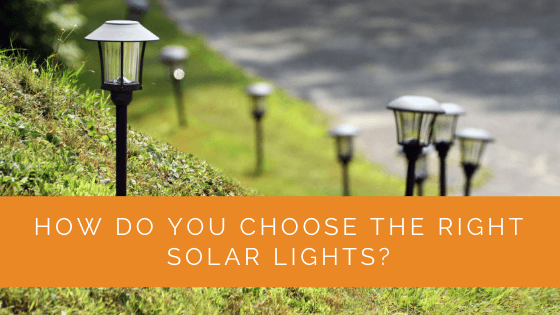
Path Lights and Garden Stakes: Small stake lights that drive into ground, typically 12–24 inches tall. Usually 0.5–1.5W with 20–60 lumens. Best for marking pathways, garden borders, and landscape features. Pros: inexpensive ($10–$30), easy to install, many styles available. Cons: low brightness not suitable for security, easily damaged by lawn equipment, easily tipped over by animals or wind.

Landscape Wall Lights: Mounted to walls, fences, or posts, typically 8–12 inches tall. Usually 1–2W with 50–120 lumens. Good for accent lighting on architectural features or general perimeter lighting. Pros: more durable than stakes, adjustable mounting, wider light distribution. Cons: cost more ($20–$60), require mounting hardware, limited brightness for security.

Flood Lights: High-brightness lights designed for area illumination, typically 5–20W with 300–800+ lumens. Best for security, task lighting, or lighting large areas. Pros: very bright, wide beam angle, many motion-sensor options. Cons: expensive ($40–$150), large and visible, require permanent mounting, significant battery and panel capacity needed.

Spotlights and Directional Lights: Focused-beam lights for highlighting specific features (trees, plants, architectural details). Usually 2–5W with 100–250 lumens. Pros: dramatic accent capability, adjustable direction. Cons: narrow beam means they don’t illuminate surrounding areas, limited security value.

Motion-Sensor Lights: Lights with built-in motion detectors that activate when movement is detected. Usually 2–15W with 200–600 lumens. Best for security and deterring intruders. Pros: conserves battery (only on when triggered), draws attention, most cost-effective security lighting. Cons: false triggers possible (animals, wind-blown branches), requires proper positioning for coverage.

String Lights: Decorative lights strung overhead or along structures. Usually 0.5–1W per bulb, multiple bulbs provide total brightness. Best for patio ambiance and entertaining spaces. Pros: attractive, flexible installation, many styles available. Cons: lower brightness unsuitable for security, typically single-sun orientation (limited to direct sunlight), require frequent cleaning.

Lantern-Style Lights: Stand-alone or hanging lanterns with 360-degree light emission. Usually 1–3W with 80–150 lumens per lantern. Good for table-top ambient lighting or hanging from pergolas. Pros: attractive design, multiple installation options, directional control by rotating lantern. Cons: lower brightness, not suitable for security, often less durable than other designs.

Evaluate Key Performance Specifications

When comparing solar lights, several specifications directly impact performance and suitability for your application.

Brightness (Lumens): Lumens measure light output. More lumens means brighter light. For reference: 20–50 lumens provides subtle accent lighting, 50–150 lumens provides pathway or ambient light, 200–500 lumens provides area or security lighting, 500+ lumens provides intense task or floodlighting. Choose lumens appropriate to your application. A 50-lumen path light is perfect for marking a walkway but inadequate for security lighting at an entryway.

Color Temperature (Kelvin): Measured in Kelvin (K), color temperature determines whether light appears warm (yellowish, 2700–3000K), neutral (4000–4500K), or cool (bluish, 5000K+). Warm light creates ambiance but appears dimmer and is less suitable for security. Cool light is brighter, appears crisper, and is better for security and task applications. Choose based on purpose: decorative lights use warm; security and task lighting use cool or neutral.

Solar Panel Size and Efficiency: Larger panels (2–5W) charge faster and in less-ideal sunlight compared to small panels (0.5–1W). Check panel size and wattage. A 5W panel charges faster than a 1W panel and is more tolerant of partial-shade locations. High-efficiency panels (using monocrystalline silicon) charge faster than lower-efficiency polycrystalline. If your site has partial shade or limited sunlight hours, choose larger, more efficient panels.

Battery Capacity (mAh): Larger batteries (1,000–3,000 mAh) store more energy than small batteries (300–600 mAh). Larger batteries support longer runtimes (8–12+ hours) compared to small batteries (4–6 hours). If you want lights to operate all night even on cloudy days, choose larger batteries. Budget lights have small batteries; quality lights have larger capacity.

Battery Type: Nickel-cadmium (NiCd) is cheap but low-capacity and lifespan. Nickel-metal hydride (NiMH) offers better capacity and lifespan. Lithium-ion (Li-ion) offers best capacity, efficiency, and lifespan but costs more. For reliability and longevity, choose NiMH or Li-ion over NiCd.

Waterproofing Rating (IP Rating): IP54 or higher indicates water and dust resistance sufficient for outdoor use. IP67 or IP68 indicates submersion protection. Most solar lights claim IP54–IP67. Verify waterproofing, especially the battery compartment and USB charging port, which are common failure points.

Materials and Durability: Quality solar lights use tempered glass (more durable, less yellowing) for the lens and aluminum or stainless steel for the body. Plastic housings and plastic lenses degrade faster in sunlight. Check materials in product descriptions; tempered glass and metal construction indicate better durability.

Assess Your Site and Sunlight Availability

Solar light performance depends entirely on available sunlight. A light placed in ideal sun performs brilliantly; the same light in shade performs poorly.

Sunlight Duration: Solar lights need minimum 6–8 hours of direct sunlight daily to charge fully. Direct sun means unobstructed, full-strength sunlight, not dappled shade. Count your intended location’s available sunlight hours. Morning sun in East-facing locations, afternoon sun in West-facing locations, and all-day sun in South-facing locations (Northern Hemisphere).

Shade Assessment: Full shade (under trees, beside buildings, under eaves) provides insufficient charging. Partial shade (morning or afternoon sun, dappled) charges slowly. Full sun (unobstructed sunlight most of day) charges optimally. If your location has less than 6 hours direct sun, choose lights with larger solar panels (5W+) and larger batteries (1,500+ mAh). Alternatively, consider repositioning the light.

Seasonal Sunlight Variation: In seasonal climates, winter sunlight is lower and sun angles are different. A location with ample summer sun might have minimal winter sun. If winter performance matters, account for this in your selection. Larger panels and batteries tolerate reduced winter charging better than undersized units.

Reflective Surfaces: Surfaces like water, light-colored pavement, or white walls reflect additional sunlight. A light positioned near a light-colored wall receives more sun than it would in open space. Leverage these reflective surfaces when possible.

Consider Budget and Long-Term Value

Solar light prices vary dramatically, from $5 budget lights to $100+ premium fixtures. Price doesn’t always correlate with performance, but there are quality tiers.

Budget Lights ($5–$20): Typically include 0.5–1W panel, 300–600 mAh NiCd battery, and 0.5–1W LED (20–60 lumens). Acceptable for path marking on well-lit sites. Expect 1–2 years of useful lifespan. Pros: cheap for experimentation. Cons: dim output, rapid battery degradation, likely to yellow or become cloudy within a year.

Mid-Range Lights ($20–$50): Usually include 2–3W panel, 1,000–1,500 mAh NiMH battery, and 2–3W LED (100–200 lumens). Good for pathway and accent lighting on average sites. Expect 3–5 years of useful life. Pros: good balance of brightness and durability, reasonable cost. Cons: battery will eventually degrade and require replacement.

Premium Lights ($50–$150+): Include 5W+ panel, 2,000+ mAh Li-ion battery, and 5W+ LED (300+ lumens). Excellent for security lighting or shaded locations. Expect 5–8+ years of lifespan. Pros: bright output, long lifespan, durable materials. Cons: high upfront cost, though cost-per-year amortized over long life is reasonable.

Calculate cost-per-year by dividing purchase price by expected lifespan. A $10 light used 2 years costs $5/year. A $50 light used 5 years costs $10/year. The premium light is more cost-effective if you value consistent long-term performance and don’t want to replace lights yearly.

Test Before Large-Scale Installation

Before purchasing lights for your entire property, buy one or two test units and evaluate real-world performance at your location.

Test Installation: Position test lights in intended locations for 2–3 weeks. Monitor brightness, runtime, battery drain, and overall reliability. Are the lights bright enough for your application? Do they operate all night? Do they remain bright on cloudy days? Does the brightness degrade significantly over the test period?

Compare Actual vs. Claimed Performance: Manufacturers claim peak brightness (often under ideal lab conditions). Real-world brightness in your climate, season, and location is likely lower. A light claimed to be 200 lumens might deliver only 120–150 lumens in your actual use case.

Evaluate Aesthetic Fit: Does the light style match your home’s aesthetic? Is the light visible during day (is that acceptable)? Does the light color match nearby fixtures? These subjective factors matter for long-term satisfaction.

Check for Defects: During the test period, look for: water infiltration (fogging inside the lens), loose connections, physical damage, rapid battery drain, or flickering. These indicate quality issues. If found, return the light and try a different model.

Plan Long-Term Maintenance

Solar lights require minimal maintenance but benefit from occasional care.

Cleaning: Clean panels and lenses quarterly or monthly depending on local soiling. Dust, pollen, and weathering reduce brightness by 5–20%. A 5-minute monthly cleaning preserves brightness and extends lifespan.

Battery Replacement: Expect to replace batteries every 2–3 years (budget lights) to 5+ years (premium lights). Budget for $10–$30 per light in battery replacement costs. Some lights have replaceable batteries; others require factory service or replacement of the entire unit.

Cover Replacement: Plastic lenses yellow over 3–5 years. Some lights have replaceable lens covers ($5–$20); others require full light replacement. When choosing lights, confirm whether lens covers are replaceable.

Physical Damage: Wind, lawn equipment, animals, and foot traffic can damage solar lights. Design your installation to minimize exposure. Stake lights in protected flower beds rather than open walkways. Wall lights are more durable than stake lights.

Frequently Asked Questions

Can I use solar lights in shady areas?

Solar lights function in shade but perform poorly. If your intended location gets less than 6 hours direct sun, choose lights with large panels (5W+), large batteries (1,500+ mAh), and consider positioning additional reflectors to concentrate sunlight. Even with optimization, shaded-location lights will be dimmer and drain faster than lights in full sun. If shade is unavoidable, wired electric lights are often more practical.

How long do solar lights last?

Lifespan depends on quality. Budget lights last 1–2 years before battery capacity fades significantly or physical degradation (yellowing, corrosion) occurs. Mid-range lights last 3–5 years. Premium lights last 5–8+ years. Lifespan varies with climate (cold climates degrade batteries faster, hot climates degrade optics faster) and maintenance (regular cleaning extends life).

What brightness do I need for security lighting?

Security lights should be 200+ lumens to deter intruders and provide clear visibility. For comparison, 50 lumens is barely adequate for marking a path, 100 lumens lights a small seating area, 200 lumens illuminates an entryway, and 500+ lumens lights a large yard. Choose cool-white color temperature (5000K+) for security; warm light appears dimmer. Motion sensors are valuable, as they draw attention and conserve battery.

Do solar lights work on cloudy days?

Solar lights charge slower on cloudy days but still charge. Overcast days provide perhaps 30–50% of full-sun charging. A light fully charged on a sunny day before a cloudy day will operate on stored energy. If many consecutive cloudy days occur, battery fully drains and lights dim or go out. Larger batteries help survive cloudy periods. In persistently cloudy climates, larger panels and batteries are essential; in sunny climates, budget lights suffice.

Can I use solar lights in winter?

Solar lights work in winter but with reduced performance. Lower sun angles and shorter daylight reduce charging. Snow covering panels completely blocks charging. Cold temperatures reduce battery efficiency. Winter performance is typically 30–50% of summer performance. If winter lighting is important, choose lights with large panels and batteries, and position them to avoid snow accumulation. Snow removal after storms restores performance.

Are all solar lights the same brightness?

No. Brightness varies from 20 lumens (subtle accent) to 800+ lumens (bright floodlight). When comparing lights, always check lumen ratings. Don’t rely on marketing terms like “super bright” or “ultra-bright”; these are subjective. Lumens provide objective comparison. For your application, choose lumens appropriate to your needs (pathway = 20–60 lumens, accent = 50–100 lumens, security = 200+ lumens).

Summing Up

Choosing the right solar lights involves identifying your lighting purpose, assessing your site’s sunlight availability, comparing specifications, and selecting light types appropriate to your application. Define whether you need security, pathway, accent, or ambiance lighting. Choose brightness and color temperature matching your goals. Evaluate solar panel size, battery capacity, and durability. Test lights before large-scale installation to confirm real-world performance in your location.

Quality solar lights cost more upfront but deliver years of reliable performance with minimal maintenance. Budget lights are cheaper but require frequent replacement. Calculate cost-per-year to evaluate true value. Plan for periodic maintenance (cleaning, battery replacement, lens/cover replacement) to maximize lifespan.

For personalized recommendations based on your specific location, sunlight conditions, and outdoor lighting goals, call (855) 427-0058 to speak with a solar expert.


Updated