
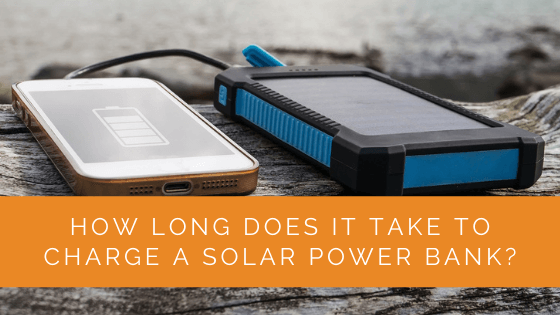
The honest answer: via USB wall adapter, most solar power banks take 4–13 hours to charge fully depending on their capacity. Via the built-in solar panel alone, it can take 15–65 hours of direct sunlight spread over multiple days. The method you use makes an enormous difference — here’s exactly what to expect for each approach.
Charging Time by Method: Quick Reference
These figures assume charging from 0% to full. Wall charging times account for the three-stage lithium charging curve (bulk, absorption, float), which slows near full capacity.
| Capacity | 5W USB Wall | 18W PD Wall | Solar Panel (rated 5W) | Solar Panel (real-world) |
|---|---|---|---|---|
| 10,000 mAh | 4–5 hr | 2–2.5 hr | 8–12 hr sun | 15–25 hr sun |
| 15,000 mAh | 6–7 hr | 3–3.5 hr | 12–18 hr sun | 22–38 hr sun |
| 20,000 mAh | 8–10 hr | 4–5 hr | 16–24 hr sun | 30–50 hr sun |
| 26,800 mAh | 11–13 hr | 5–6 hr | 21–32 hr sun | 40–65 hr sun |
| 30,000 mAh | 12–15 hr | 6–7 hr | 24–36 hr sun | 45–75 hr sun |
Important note on “hours of sun”: Solar power banks don’t charge when stored indoors or in a bag. The solar hours above refer to hours with the panel directly facing sunlight — not clock hours. In practice, you might get 4–6 peak sun hours per day outdoors, meaning a 20,000 mAh bank charged purely by solar needs 5–12 days of outdoor exposure to go from flat to full.
Why Solar Charging Takes So Long
The built-in solar panel on most power banks is intentionally small to keep the device pocketable. A typical panel on a consumer power bank measures 60–100cm² and has a rated output of 2–7W. In real conditions, several factors reduce effective output:
- Panel angle: A 30° deviation from perpendicular reduces output by ~13%. Most people lay the bank flat rather than tracking the sun.
- Temperature: Solar cell efficiency drops at high temperatures. A panel generating 5W at 25°C (77°F) might produce only 4.3W at 50°C (122°F) — common when lying on a hot surface.
- Charge controller losses: The internal PWM or MPPT charge controller introduces 5–15% conversion losses.
- Battery charging curve: Lithium cells accept current at full rate only during the “bulk” phase (roughly 0–80%). Above 80%, charging current tapers significantly, extending tail-end charging time.
- Cloud cover and air mass: Even partial cloud cover can cut output by 50–80%. Hazy conditions and low sun angles (early morning, late afternoon, winter) reduce irradiance significantly.
The cumulative effect: a bank with a “5W solar panel” typically delivers 1.5–3W of effective charging power in real-world conditions, compared to 5–18W from a USB wall charger.
How Long Does Solar Charging Add Per Day?
A more useful way to think about solar charging during a camping trip or outdoor activity is how much charge the panel adds in a day of outdoor use. Assuming the bank is clipped to a backpack and exposed to the sun for most of the day:
| Conditions | Effective Panel Output | Charge Added per Day (6hr sun exposure) | % of 20,000 mAh Restored |
|---|---|---|---|
| Clear sky, optimally angled | 3–5W | 18–30Wh → ~6,000–9,000 mAh | 30–45% |
| Clear sky, flat/suboptimal angle | 2–3W | 12–18Wh → ~4,000–6,000 mAh | 20–30% |
| Partly cloudy | 1–2W | 6–12Wh → ~2,000–4,000 mAh | 10–20% |
| Overcast / forest shade | 0.3–1W | 2–6Wh → ~600–2,000 mAh | 3–10% |
This shows why solar power banks work well as a supplement on multi-day trips but not as a standalone charging solution for heavy users. On a clear day with good sun exposure, you might gain enough charge to top off a phone once — which can meaningfully extend your power bank’s effective range.
How to Charge Faster: USB Method
When charging via USB at home or in a car, these factors determine how quickly you reach full:
Charger wattage matters most
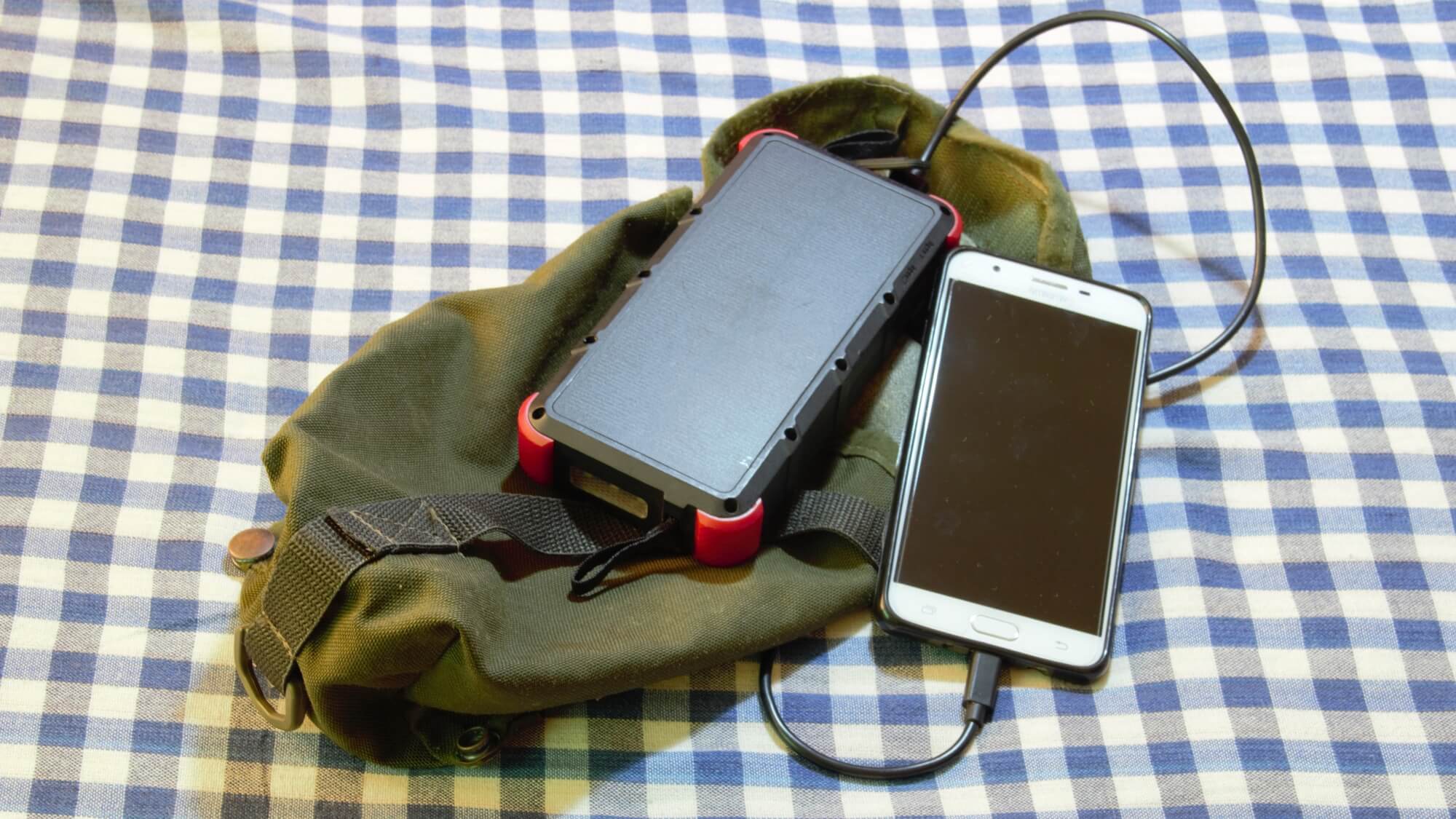
A standard 5W USB-A adapter charges a 20,000 mAh bank in roughly 8–10 hours. An 18W USB PD adapter cuts this to 4–5 hours. A 45W PD adapter won’t help unless your power bank accepts higher input — most cap at 15W or 18W input regardless of what the charger outputs. Always check the max input current listed in your bank’s spec sheet before buying a fast charger.
Cable quality affects real-world speed
A thin, data-only Micro-USB cable might deliver only 0.5A (2.5W) even when connected to a 2A adapter. For fast charging, use a cable rated for 2A or higher — charging cables specifically are marked differently from data cables on many brands. The supplied cable is usually rated correctly for the bank.
Charging in a cool environment
Lithium cells accept charge more efficiently at 15–25°C (59–77°F). In hot conditions, the battery management system throttles charge current to prevent overheating, extending charge time. Charging in a shaded, ventilated location can shave 20–30 minutes off total charge time for a large bank.
How to Charge Faster: Solar Method
When relying on solar charging during an outdoor trip, these practices maximize daily charge gain:
- Angle the panel directly at the sun. Don’t just lay it flat — prop it up or hang it on a tent, tree, or backpack facing the sun at the best angle. Even adjusting once mid-day to account for the sun’s movement helps.
- Use peak sun hours. Output between 10 a.m. and 2 p.m. is typically 2× higher than in early morning or late afternoon. Prioritize this window for active solar charging.
- Keep the panel clean. Fingerprints, sunscreen, and dust all reduce output. Wipe the panel before extended outdoor sessions with a soft dry cloth.
- Don’t leave the bank face-up on hot ground. A panel surface temperature above 60°C (140°F) can cut output by 20–25% and may trigger thermal protection, pausing charging altogether.
- Charge the bank, not your phone, during solar sessions. If your bank supports passthrough charging, resist the urge to charge your phone from it while solar charging — the bank charges faster when not simultaneously discharging. Store solar energy in the bank, then use the bank to charge your devices separately.
Estimating Your Own Charge Time
To calculate approximate charge time for your specific bank:
For USB charging:
- Find your bank’s capacity in mAh (e.g., 20,000 mAh)
- Convert to Wh: multiply mAh by 3.7V ÷ 1,000 (e.g., 20,000 × 3.7 / 1,000 = 74Wh)
- Account for 85% charging efficiency: 74 ÷ 0.85 = ~87Wh needed from the charger
- Divide by charger output in watts (e.g., 87Wh ÷ 10W = 8.7 hours)
For solar charging:
- Use the Wh figure from above (87Wh for a 20,000 mAh bank at 85% efficiency)
- Estimate real-world panel output (usually 40–60% of rated wattage in typical conditions)
- For a 5W rated panel: 5W × 0.50 = 2.5W effective
- Divide: 87Wh ÷ 2.5W = 35 hours of direct sun exposure
This is why treating solar as a supplemental top-up rather than a primary source is the right expectation to set.
Frequently Asked Questions
How long does it take to charge a 10,000 mAh solar power bank?
Via a standard 5W USB wall adapter, a 10,000 mAh bank takes approximately 4–5 hours to charge from flat. With an 18W PD fast charger (if your bank supports it), this drops to around 2–2.5 hours. Via the built-in solar panel in good outdoor conditions, expect 15–25 hours of direct sun exposure — roughly 3–6 days of outdoor use getting 4–6 peak sun hours daily.
How long does it take to charge a 20,000 mAh solar power bank?
Via a 5W USB wall adapter, roughly 8–10 hours. Via an 18W PD adapter (if supported), 4–5 hours. Via solar panel alone in good conditions, 30–50 hours of direct sunlight — or about 5–12 days of outdoor trips. This is why USB charging before a trip is strongly recommended.
Can I fully charge a solar power bank with just sunlight in one day?
Only if the bank is small and conditions are ideal. A 10,000 mAh bank needs 15–25 hours of direct sun exposure in the real world. Since you only get 4–6 peak sun hours per day in most locations, a flat battery would need 3–6 days to fully charge via solar. Partial charging of 20–40% in a good day is realistic. For full charges in one day, use a USB wall adapter.
Does cloudy weather affect how long charging takes?
Significantly. An overcast sky delivers roughly 10–25% of clear-sky irradiance, reducing effective panel output from ~3W to 0.3–0.75W. This can turn a 25-hour solar charge time into 100+ hours — making solar charging essentially impractical in prolonged overcast conditions. Keep the bank topped up via USB whenever you have access to an outlet, and use solar as a bonus source when weather cooperates.
Why is my solar power bank charging slower than expected?
The most common causes are: a dirty panel (fingerprints and dust reduce output 10–20%), a non-perpendicular panel angle (a 30° tilt from optimal costs ~13% output), high ambient temperature (hot surfaces reduce cell efficiency and may trigger thermal protection), or using a USB charger with insufficient amperage (a 0.5A adapter will take twice as long as a 1A adapter). Check each of these before assuming the bank is faulty.
Is it better to charge a solar power bank via USB or solar?
USB is almost always better for speed and efficiency. A 5W USB charger charges a 20,000 mAh bank in 8–10 hours; the same bank takes 30–50 hours of solar exposure to reach full via the built-in panel. The exception is extended off-grid use where no outlet is available — in that situation, solar charging (even slow) is better than running out of power entirely. The ideal approach: charge to full via USB before any trip, then use solar to supplement and maintain charge outdoors.
How do I know when my solar power bank is fully charged?
Most power banks use LED indicators to show charge level: all 4 LEDs solid typically means 100%, while the charging LED stops blinking and becomes solid (or turns off) when the battery is full. Some models have a single multi-color indicator that turns green at full charge. Check your specific model’s manual, as indicator behavior varies between manufacturers. If in doubt, wait until the charging LED indicator changes behavior and verify by pressing the power button to check the battery level display.
Summing Up
The fastest way to charge a solar power bank is always a USB wall adapter — preferably one that supports 18W USB Power Delivery if your bank’s input can accept it. The built-in solar panel is a useful supplement during extended outdoor trips, adding 20–45% charge on a clear day, but it cannot realistically take a large-capacity bank from flat to full in a single day.
Plan accordingly: charge to full at home before any trip. Let solar do the rest while you’re out in the field.
Interested in a full-scale solar solution for your home — panels, battery backup, or a whole-home system? Call (855) 427-0058 for a free consultation with a NABCEP-certified solar installer serving all 50 states.
Updated