
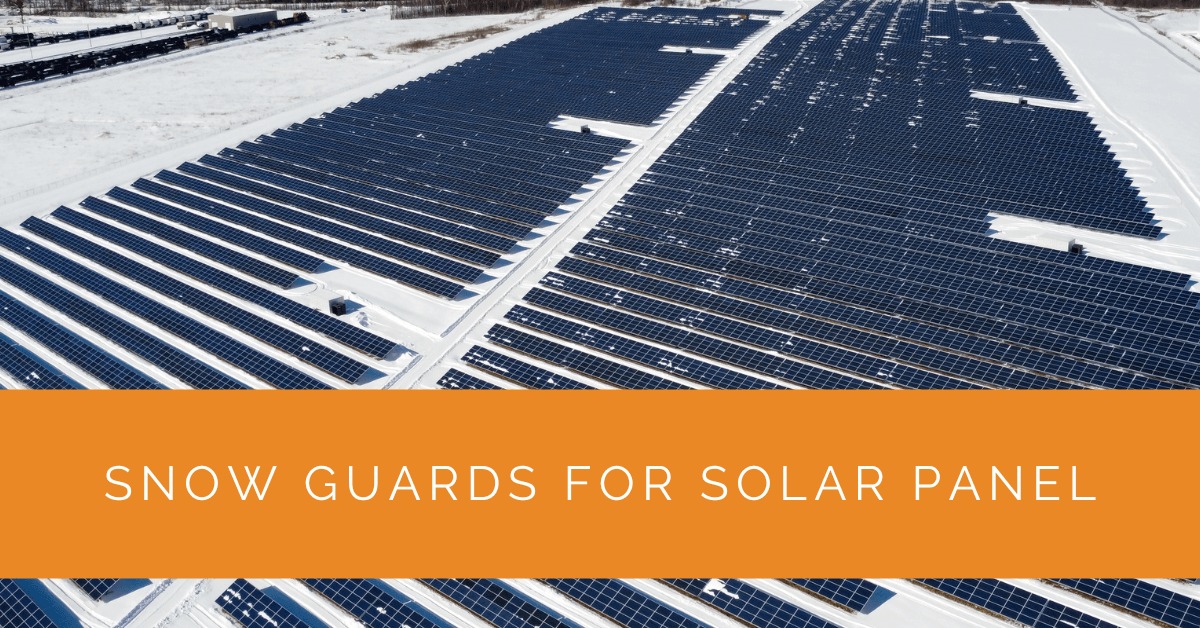
Solar panels create a specific snow hazard that standard roofs don’t have: when snow starts melting, it slides off the smooth glass surface in a single, sudden mass rather than falling gradually. This “mini-avalanche” effect can damage gutters, injure people below, bury landscaping under ice slabs, and in some cases damage the panels themselves. Snow guards prevent this by breaking the snow into smaller pieces or slowing its release so it can melt in place. Whether you need them depends heavily on your climate, roof pitch, and where the panels are installed relative to walkways and structures below.
Why Solar Panels Cause a Specific Snow Problem
Standard asphalt shingles have a textured surface that creates friction — snow grips the granules and releases gradually. Solar panel glass is smooth and often slightly angled, which is optimal for shedding water but terrible for retaining snow.
When a roof warms from below or solar gain heats the back of the panels, the bottom layer of snow melts and forms a lubrication layer between the snow mass and the glass. The entire snow load — sometimes 50–100+ pounds across a large array — then releases at once. The result is a sudden avalanche from above your entry, driveway, or walkway.
Beyond the physical hazard, sliding snow can catch on panel wiring or racking components as it goes, stressing connections and in some cases dislodging panels from poorly fastened mounts. For arrays near the eave, large snow releases can also bend or destroy gutters in a single event.
Types of Solar Panel Snow Guards
There are two main categories, each suited to different situations:
Pipe-style snow fences: Horizontal bars or rails installed across the lower edge of the array — or spanning the full length — that physically block snow from releasing until it melts. These provide the most positive retention and are preferred for high-snowfall regions (New England, the Rockies, Great Lakes). They’re typically installed on the racking rail itself, using clamps compatible with your mounting system. Popular brands include Rocky Mountain Snow Guards, Alpine SnowGuards, and S-5!, which makes clamps specifically designed for solar racking profiles including Unirac, IronRidge, and Schletter.
Pad-style or clamp-on point guards: Individual plastic or metal pads spaced across the array that introduce friction points, slowing the snow release and breaking it into smaller clumps rather than blocking it entirely. These are less effective in very heavy snowfall climates but are lower-profile and easier to retrofit on existing installations. They’re also less visually intrusive. Installation typically involves clamping directly to the panel frame — no drilling required.
For most residential applications in moderate snow climates (6–18 inches of annual snowfall), pad-style guards installed along the lower edge of the array are sufficient. For climates with frequent heavy snowfall (24+ inches annually), pipe-style snow fences that span the full array width provide more reliable protection.
When Do You Need Snow Guards?
Not every solar installation requires snow guards. The factors that make them most necessary:
Geographic location: If you’re in the northern US, Midwest, or mountain West and regularly receive 6+ inches of snow per event, snow guards are strongly advisable. New England, the Great Lakes region, Colorado, Utah, and the Pacific Northwest are the primary areas where solar installers now routinely include snow guards as standard. In warmer climates (Southeast, California, Arizona), snow events are rare enough that guards are rarely needed.
Roof pitch: Steeper roofs (above 6/12 pitch) shed snow faster and more forcefully than shallow roofs. Arrays on steep south-facing pitches in northern climates are the highest-risk scenario. Shallow pitches (under 3/12) actually tend to hold snow longer before melting — snow may stay on the array for days, which isn’t dangerous but does affect production.
What’s below the panels: If your array overhangs a frequently used walkway, driveway, deck, or HVAC equipment, the risk calculus shifts strongly toward installing guards. If panels face a landscaped area where nobody walks, the risk of injury is lower — though damage to shrubs and gutters from ice slabs is still a real concern.
Array position on the roof: Arrays installed near the eave are more likely to release snow onto gutters and walkways than arrays near the ridge. Mid-roof arrays pose less of a hazard in terms of trajectory, though the snow still needs to go somewhere.
Installing Snow Guards on Solar Panels
Snow guards are much easier to install during the original solar installation — your installers are already on the roof with all the equipment and mounting hardware accessible. Many solar installers in snow-prone regions now include snow guards as a standard component in their quotes. If you’re getting solar installed and you live in a northern climate, explicitly ask about snow guards as part of the package.
Retrofitting after installation is also straightforward for most systems. Clamp-on models attach directly to the panel frame without any drilling or penetrations. Rail-mounted pipe guards attach to your existing racking rails using manufacturer-specific clamps. Most retrofit installations take 2–4 hours for a typical residential array.
Pricing varies widely. Pad-style clamp-on guards run $5–$15 per pad, with a typical residential installation needing 20–40 pads ($100–$600 total). Pipe-style snow fence systems run $15–$30 per linear foot installed, putting a 30-foot-wide array at $450–$900. Professional installation labor adds $150–$400 depending on roof access difficulty.
Do Snow Guards Affect Panel Output?
Minimally. Snow guards occupy a small footprint on or beside the panel frame and don’t shade the cells meaningfully. Their effect on light capture is negligible. What they do affect, slightly, is how long snow stays on the array — by slowing the release, they may extend the period when snow covers the panels by a few hours on a marginal melt day. Research suggests this trade-off is almost always favorable: preventing avalanche damage and injury is worth losing a few kilowatt-hours of production on a handful of snow days per year.
Frequently Asked Questions
Are snow guards required by code for solar panels?
There is no universal building code requirement for solar panel snow guards in the US as of 2026. However, some municipalities in high-snowfall areas have adopted requirements, and some HOAs mandate them. More importantly, some insurance policies and installer warranties may require them for systems in certain climates. Check with your installer, HOA, and insurance carrier before assuming they’re optional.
Can snow guards damage my solar panels or roof?
When properly selected and installed, no. Clamp-on guards use friction or frame-specific clamps that don’t drill into the panel or roof. Rail-mounted guards attach to the racking system without roof penetration. Improperly installed guards using incompatible clamps could potentially stress panel frames — always use guards rated for your specific panel frame dimensions and racking system.
Should I remove snow from my solar panels instead of using guards?
Manual snow removal is an option but comes with significant risks: falls from roofs, damage to panels from improper tools, and the impracticality of clearing panels after every storm. A foam-tipped solar panel rake (designed specifically for panels) can be used from the ground on single-story installations. However, for most homeowners in snowy climates, snow guards that allow snow to melt naturally are a safer and more practical solution than manual clearing.
Do snow guards work on all roof types?
Clamp-on pad guards work on most panel frame profiles. Pipe-style rail guards must be compatible with your specific racking system (IronRidge, Unirac, Schletter, etc.) — most major guard manufacturers offer clamps for all common racking brands. Metal roofs (standing seam) require different clamps than asphalt-racking systems, but compatible hardware is widely available from S-5! and similar manufacturers.
My panels are already installed — is it too late to add snow guards?
No. Retrofit installation is straightforward for most clamp-on systems. You don’t need to remove panels or modify the racking — guards attach to the panel frame or existing rails. The main challenge is roof access in winter conditions; most homeowners schedule retrofit guard installation in fall before the first snowfall season.
Summing Up
Snow guards solve a problem that’s unique to solar panels: the glass surface that makes panels weather-resistant also makes them dangerously good at releasing snow as a single mass. If you’re in a northern climate with regular snowfall and your array is above a walkway, driveway, or HVAC equipment, snow guards are a straightforward investment — $100–$900 for retrofit installation, often less when added during the original install. Pipe-style fences for high-snowfall areas, pad-style guards for moderate climates. Your solar installer should be raising this conversation with you — if they’re not, ask.
To speak with a local solar professional about snow guards and the right installation approach for your property, call Solar Panels Network USA at (855) 427-0058.
Updated