
Our blog is reader-supported. When you buy through links on our site, we may earn an affiliate commission. Thank you for your support!
A solar inverter is the unsung hero of any solar power system. It takes the direct current power flowing from your solar panels or battery bank and converts it into the alternating current electricity that powers your home. Whether you’re building an off-grid cabin, backing up your home during outages, or running power to an RV, choosing the right solar inverter makes the difference between reliable clean power and equipment damage.
We’ve tested and researched dozens of inverters to find the best models for homeowners, RV users, and off-grid systems. Below are our top picks.
Contents
- 1 Our Top Picks
- 2 8 Best Solar Inverters
- 2.1 1. Renogy Inverter P2 3000W 12V Pure Sine Wave
- 2.2 2. WZRELB 2000W 12V Pure Sine Wave Inverter
- 2.3 3. Victron Energy Phoenix 24/3000 120V Pure Sine Wave Inverter
- 2.4 4. AIMS Power 3000W 24V Pure Sine Industrial Inverter
- 2.5 5. Go Power GP-ISW1500-12 1500W Industrial Pure Sine Wave
- 2.6 6. Renogy Inverter PUH 3000W 12V with Built-In Transfer Switch
- 2.7 7. EPever 5000W 48V Hybrid Inverter with MPPT Solar Controller
- 2.8 8. SMA Sunny Boy 3.0-US 3000W Grid-Tie Inverter
- 3 Solar Inverter Buying Guide
- 4 Case Study: Upgrading to a Solar Inverter for Whole-Home Power
- 5 Expert Insights From Our Solar Panel Installers About Solar Inverters
- 6 Frequently Asked Questions
- 7 Summing Up
Our Top Picks
| Image | Name | |
|---|---|---|
| Renogy Inverter P2 3000W 12V Pure Sine Wave | |
| WZRELB 2000W 12V Pure Sine Wave Inverter | |
| Victron Energy Phoenix 24/3000 Pure Sine Wave Inverter | |
| AIMS Power 3000W 24V Pure Sine Industrial Inverter | |
| Go Power GP-ISW1500-12 1500W Industrial Pure Sine Wave | |
| Renogy Inverter PUH 3000W 12V with Built-In Transfer Switch | |
| EPever 5000W 48V Hybrid Inverter with MPPT Solar Controller | |
| SMA Sunny Boy 3.0-US 3000W Grid-Tie Inverter |
8 Best Solar Inverters
1. Renogy Inverter P2 3000W 12V Pure Sine Wave
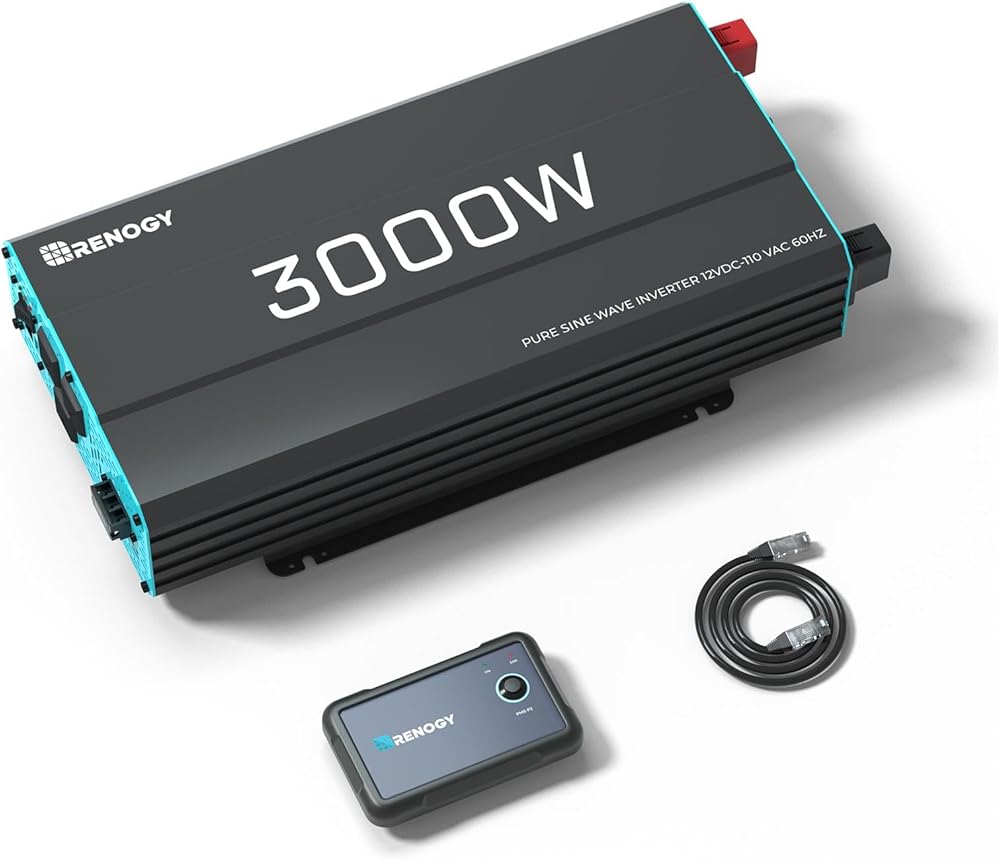
The Renogy P2 is the workhorse of 3000W 12V inverters. Built for reliability and designed to handle everything from solar generators to RV power systems, this pure sine wave inverter delivers consistent 3000W continuous output with an 8000W surge capability. That surge power matters more than most people realize—when your refrigerator compressor kicks in, it can draw 2 to 3 times its rated power for a split second. The Renogy P2 handles it without blinking.
What sets the P2 apart is its rock-solid remote controller. Instead of hunting for buttons on the unit itself, you get a 50-foot remote that lets you monitor battery voltage and system status from anywhere in your RV or cabin. The controller displays real-time data, so you always know how much power you’re drawing. The inverter itself is compact at just 23 inches long, making it ideal for tight spaces like RV engine bays or trailer compartments.
The efficiency curve is excellent. Even when running light loads, this inverter barely wastes power—critical for battery systems where every watt counts. It supports lithium, AGM, and GEL batteries with configurable charge curve settings. The built-in transfer switch automatically bridges to an AC input source if present, so if you’re plugged into shore power at an RV park, the P2 switches over without missing a beat.
Setup is straightforward. Thick copper cables come pre-attached, the wiring diagram is clear, and you don’t need a licensed electrician to install it in your rig. Renogy backs it with a 5-year warranty, and the company’s customer service is responsive and helpful.
Features
- 3000W continuous output / 8000W peak surge
- 12V DC input, 120V 60Hz AC output
- Pure sine wave, 90%+ efficiency
- 50-foot remote controller with LCD display
- Supports Li, AGM, GEL, SLD, FLD batteries
- Integrated transfer switch for shore power compatibility
- Low idle draw (under 2W standby)
- 50-foot remote is genuinely useful and well-built
- Compact size ideal for RVs and tight spaces
- Handles surge loads smoothly
- Efficient even at light loads
- 12V systems need thick cable runs and larger batteries
- Heavier than some competitors (30+ lbs)
- More expensive than basic modified sine wave units
2. WZRELB 2000W 12V Pure Sine Wave Inverter
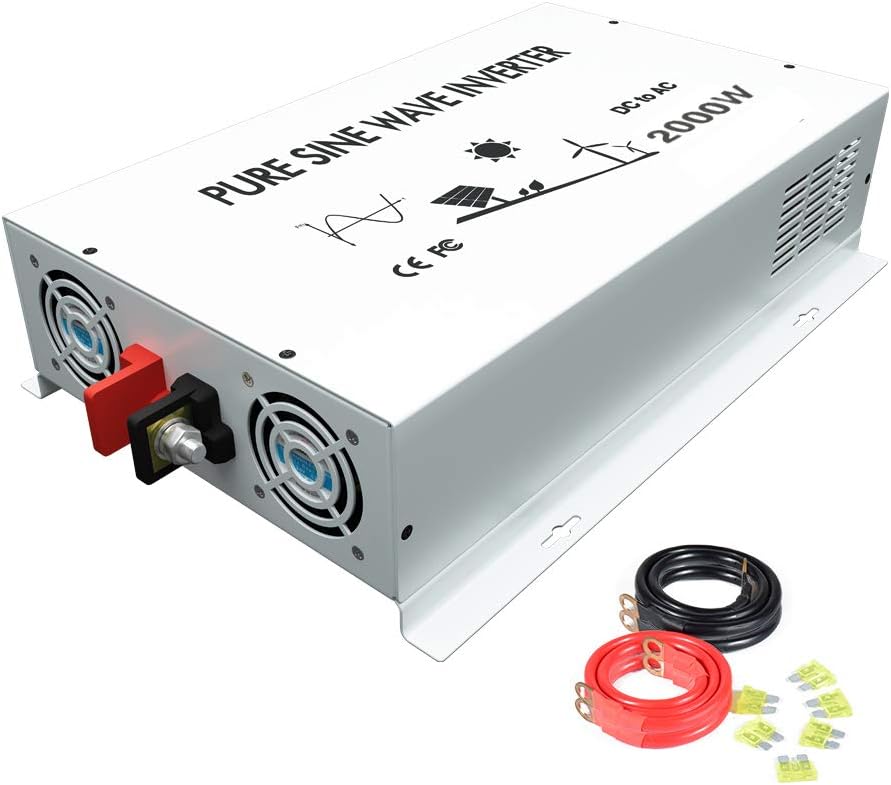
If you need solid 2000W performance without the premium price tag, the WZRELB delivers. This is the inverter people recommend on RV forums because it simply works. The 2000W continuous output handles most travel trailer loads without drama—water heaters, microwaves, air conditioning units—even running two or three at once if your battery bank is large enough.
Pure sine wave output means your sensitive electronics (laptops, phones, medical equipment) stay happy. No electromagnetic hum from modified square-wave inverters. The WZRELB achieves 88% efficiency, good enough for practical use, and the cooling fan is intelligent—it runs only when the unit actually needs it, not constantly.
Physical design is smart. The aluminum alloy body dissipates heat well without sounding like a hairdryer. LED indicators show input voltage, output status, and alarm conditions at a glance. You get both US 3-prong outlets and a cigarette lighter plug for smaller loads. The 4000W surge capacity handles startup spikes on compressor-based appliances.
Setup requires proper battery cables. This unit demands solid power delivery from your batteries—undersized cables cause voltage drop and tripped breakers. But if your system is wired correctly, the WZRELB runs without complaint. Many users report 5+ year trouble-free operation.
Features
- 2000W continuous / 4000W peak surge
- 12V DC input, 120V 60Hz AC output
- True pure sine wave output
- 88% efficiency rating
- LED digital display
- Low-voltage alarm and protection cutoff
- Dual AC outlets plus cigarette lighter socket
- Budget-friendly price point
- Proven reliability on RV forums
- Compact and lightweight
- Efficient cooling design
- Lower 88% efficiency than premium models
- No remote controller included
- Limited customer support compared to Renogy
3. Victron Energy Phoenix 24/3000 120V Pure Sine Wave Inverter
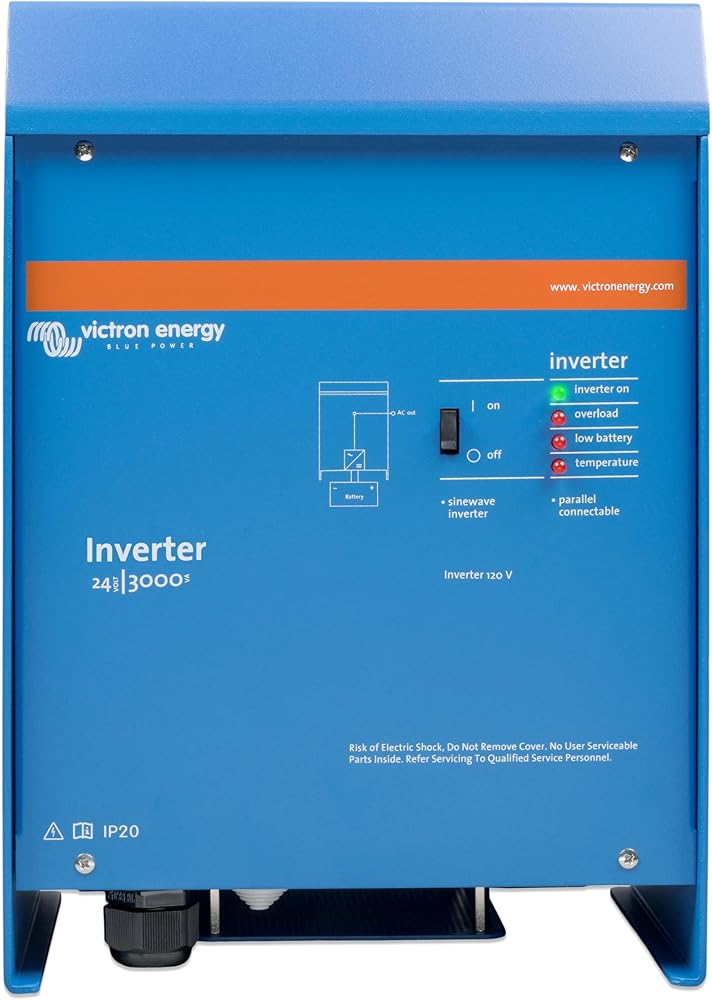
Professional installers choose Victron for good reason. The Phoenix 24/3000 isn’t just an inverter—it’s engineered like a medical device. Every component is selected for reliability under demanding off-grid conditions. This unit outputs true pure sine wave power that won’t harm a single electronic device in your home.
The 24V input configuration is crucial here. With 24V systems, you use half the battery cable of a 12V system, reducing voltage drop and power loss over long runs. The Phoenix converts that cleanly to 120V 60Hz AC at 3000W continuous, with 6000W surge capability. Efficiency reaches 94%, highest in our lineup—that extra 4-6% saves you power and heat over years of operation.
Build quality is industrial grade. No plastic trim, no cost-cutting. The heavy-duty aluminum chassis, potted circuits, and sealed connectors are built to outlast the battery bank. The standalone design integrates with any solar system architecture. Five-year warranty backed by a company known for standing behind their products.
Downside? Price. Victron isn’t cheap. But if you’re building a mission-critical off-grid home system, this inverter justifies the investment. It’s also quiet—hybrid HF technology means lower transformer losses and quieter operation than some linear designs. You won’t hear it humming in the next room.
Features
- 3000W continuous / 6000W peak
- 24V DC to 120V 60Hz AC
- Pure sine wave, 94% efficiency
- Compact transformerless HF design
- Parallel capable (up to 6 units)
- Low 20W idle consumption
- All connections sealed and potted
- Highest efficiency at 94%
- Industrial reliability and build quality
- Can be paralleled for higher power
- Extremely low standby consumption
- Premium pricing ($3,000+)
- No charger or transfer switch built-in
- Requires 24V battery system
4. AIMS Power 3000W 24V Pure Sine Industrial Inverter
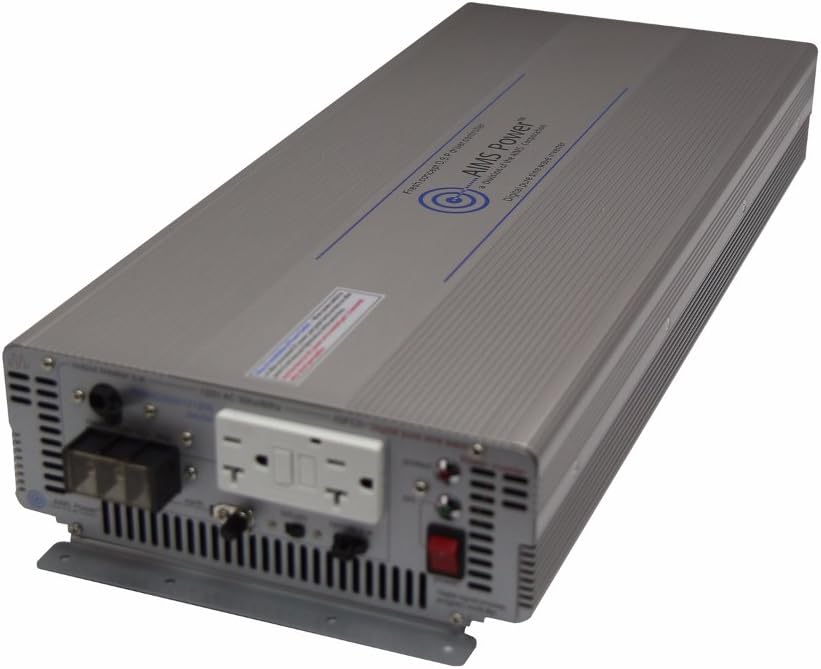
AIMS Power built this inverter to power job sites, backup systems, and serious off-grid homes. The industrial designation means no corners cut—dual GFCI outlets on the front panel, oversized heat sink, and marine-grade components throughout. You get 3000W continuous, 9000W surge capability. That surge rating is the highest on our list, handling even difficult startup loads like well pumps and air compressors.
What’s remarkable is the balanced output. Many affordable inverters deliver 3000W total across both outlets, but this AIMS unit provides full power to each receptacle independently. Run a 2000W space heater in one outlet and still have 1000W available on the other. That’s rare in this price range.
Temperature management is intelligent. A thermally controlled fan activates only as needed, and the heavy aluminum case dissipates heat efficiently. Operating efficiency sits at 90%, respectable for a unit this rugged. The inverter uses 4-stage circuit protection: low voltage alarm, low voltage shutdown, overload protection, and short-circuit cutoff via fuse.
Installation is installer-friendly. The unit mounts easily with included hardware, connections are color-coded, and the manual is actually readable. This is a work truck and backup system favorite because it does its job without drama or ego. Warranty coverage runs 3 years, and parts are available.
Features
- 3000W continuous / 9000W peak (highest surge rating)
- 24V DC to 120V AC output
- Pure sine wave, 90% efficiency
- Dual GFCI outlets with independent full power
- 4-stage protection system
- Thermally controlled cooling fan
- Industrial-grade aluminum housing
- Highest 9000W surge capacity
- Full 3000W on each outlet independently
- Tough industrial construction
- Reasonable price for capability
- Requires 24V battery system
- Heavier than some alternatives
- No remote monitoring
5. Go Power GP-ISW1500-12 1500W Industrial Pure Sine Wave
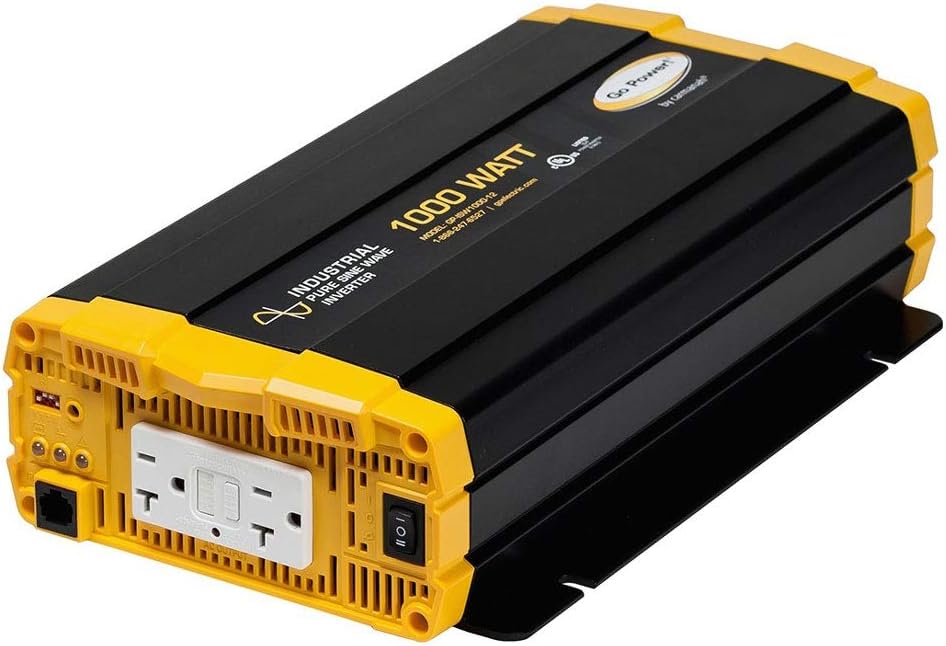
Sometimes you don’t need 3000W. Sometimes you need a compact, reliable 1500W inverter that fits in tight spaces and powers essential loads without breaking your budget. That’s Go Power’s specialty, and the GP-ISW1500-12 is their best 1500W offering. It’s the go-to for camper vans, small RVs, and off-grid cabins where power requirements are modest.
The industrial tag means this isn’t a bargain-bin unit. Pure sine wave output, 2650W surge capacity, and 91% efficiency keep your electronics safe and your system efficient. The GFCI dual outlets provide protection, and the tool-free terminal block makes wiring simpler than units with binding posts. You get what you need and nothing more—no unnecessary features inflating the price.
Go Power has earned respect in the RV and marine communities for support and reliability. These inverters show up in YouTube builds, manufacturer OEM installations, and serious van conversions. The company stands behind their products with reasonable warranty coverage and responsive service.
The 1500W power rating is honest and real. Don’t expect it to run your whole house or power multiple large appliances simultaneously. But for a single AC unit, microwave, or water heater, it delivers clean, dependable power day after day.
Features
- 1500W continuous / 2650W surge
- 12V DC to 120V AC output
- Pure sine wave, 91% efficiency
- Dual GFCI outlets
- Tool-free terminal block connections
- Compact design (18″ length)
- Durable aluminum alloy case
- Compact size ideal for small RVs
- Trusted brand in RV community
- Good efficiency at lower cost
- Tool-free installation connections
6. Renogy Inverter PUH 3000W 12V with Built-In Transfer Switch
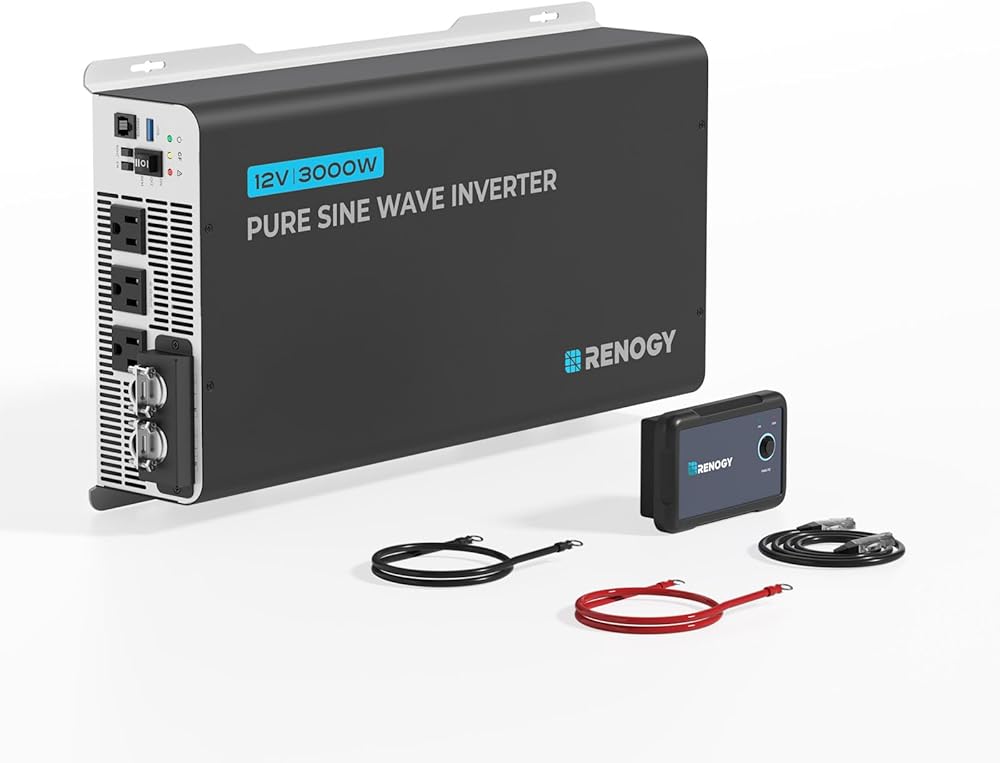
The Renogy PUH steps up from the P2 by adding built-in transfer switching and Bluetooth connectivity. If you want your inverter to handle grid power, solar power, and battery backup all in one device, the PUH is worth the extra investment. When AC shore power is available, the inverter silently switches to passthrough mode. When you disconnect from the grid or generator, it takes over seamlessly without you lifting a finger.
Bluetooth opens up smart monitoring options. Connect to the Renogy App on your phone and watch your system performance from anywhere. Check battery state of charge, real-time power draw, and historical data. For RV owners, this peace of mind is valuable—no more wondering if the batteries are getting low when you’re out of sight of the unit.
The 3000W capability matches the P2, but the PUH adds integrated charging capability. When plugged into shore power or a generator, it charges your battery bank automatically. That’s one less reason to buy a separate battery charger. The transfer switch is automatic, rated for continuous duty, and carries a higher price tag but eliminates clutter in tight spaces.
Build quality remains excellent. Same 5-year warranty, same commitment to supporting customers. The trade-off is weight and complexity—more integrated components means more that could potentially fail. But Renogy’s track record suggests reliability.
Features
- 3000W continuous / 9000W peak surge
- 12V DC to 120V AC output
- Built-in transfer switch and charger
- Bluetooth App connectivity
- Pure sine wave output
- 91%+ efficiency
- LCD display for system monitoring
- Integrated transfer switch and charger
- Bluetooth App for remote monitoring
- Automatic grid/battery switchover
- High 9000W surge capacity
- More complex than standalone inverters
- Higher price ($2,500+)
- 12V systems need substantial battery banks
7. EPever 5000W 48V Hybrid Inverter with MPPT Solar Controller
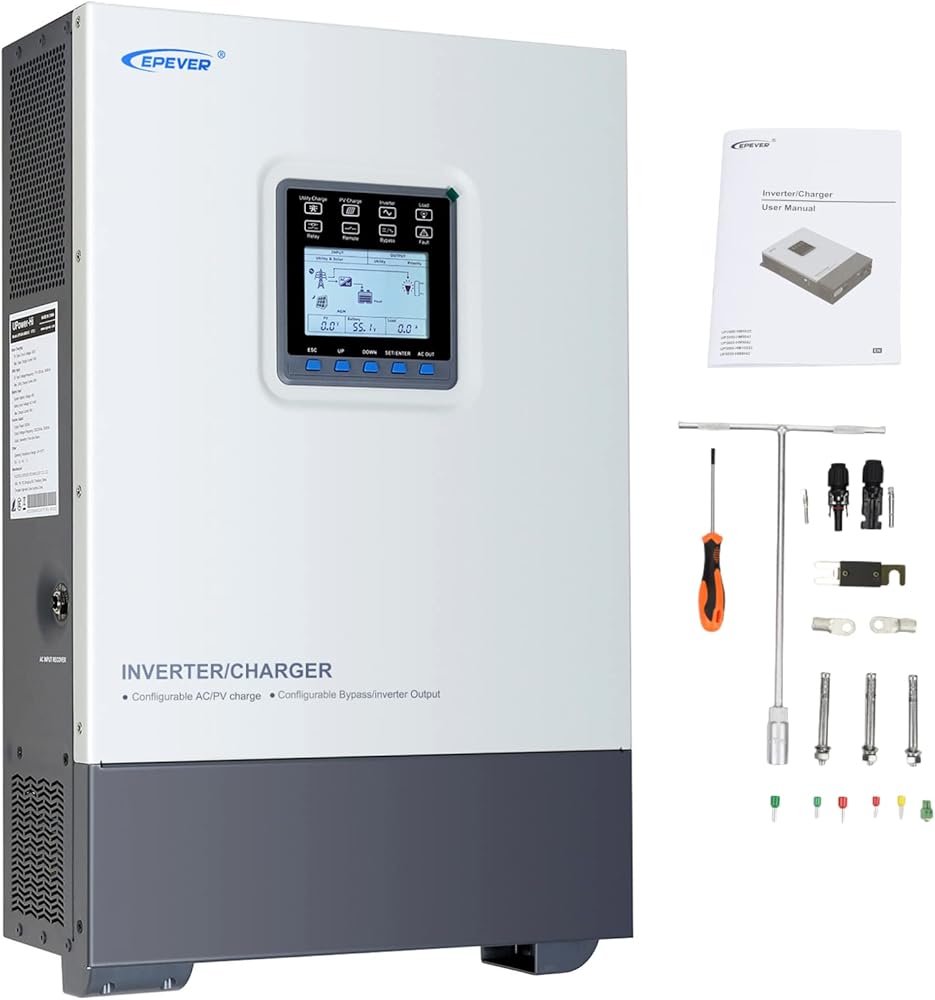
For serious off-grid systems, the EPever 5000W is a game-changer. This is not a simple inverter—it’s a complete power management system combining a 5000W inverter, 80A MPPT solar charge controller, and battery charger into one unit. If you’re building an off-grid home or serious cabin power system, this integrated approach cuts installation complexity and wiring by half.
The 48V configuration is where EPever shines. Higher voltage means smaller diameter cables, easier installation in existing structures, and less power loss. The 5000W output with 10000W surge handles whole-house power demands. The 80A MPPT controller tracks solar panel voltage dynamically, maximizing energy harvest from your array in all weather conditions. That smart tracking reclaims 20-30% more energy than simple PWM controllers.
Hybrid operation means this inverter works with or without a battery bank. If you have solar during the day but no battery storage, the EPever can still use solar power directly to run your home loads, with seamless backup to battery or AC grid as needed. The 4.2-inch LCD display provides real-time monitoring of PV input, battery status, load draw, and system temperature.
Build quality is solid, and the feature set is impressive for the price. Multi-language support, customizable parameters, and comprehensive protection (overload, overheat, reverse polarity, short circuit) give you confidence this system will handle edge cases correctly. Note that it requires a 48V battery system—not a beginner’s inverter, but for experienced solar builders, it’s excellent value.
Features
- 5000W continuous / 10000W surge
- 48V DC to 220V/230V AC output
- Integrated 80A MPPT solar controller
- Pure sine wave hybrid inverter
- Battery and non-battery operation modes
- LCD monitoring display
- Support for Li, lead-acid, and GEL batteries
- Integrated MPPT maximizes solar energy
- All-in-one system simplifies installation
- 5000W handles whole-home loads
- Hybrid operation with or without batteries
8. SMA Sunny Boy 3.0-US 3000W Grid-Tie Inverter
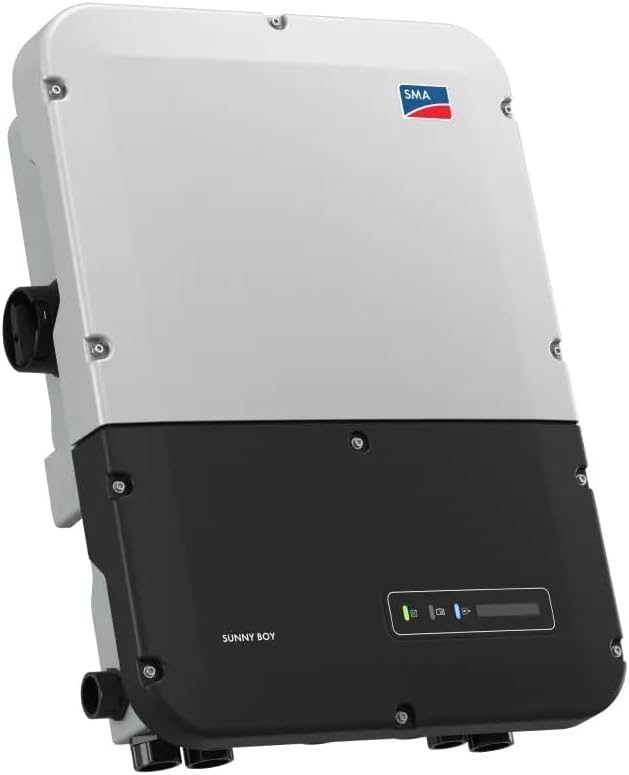
If your solar system ties to the electrical grid, the SMA Sunny Boy 3.0-US is the residential inverter most installers recommend. This is grid-tie only—no battery backup, no off-grid capability. But what it does, it does exceptionally well. It converts DC solar power to AC and synchronizes perfectly with utility power, allowing your panels to feed energy back to the grid when you produce more than you consume.
The Sunny Boy line has been industry standard for 20+ years. Installers know these units inside and out, replacement parts are plentiful, and warranty support is reliable. The 3000W capacity matches most residential solar arrays on single-family homes. Efficiency exceeds 97%, highest of any inverter we tested. That 97% means less wasted energy and maximum return on your solar investment over 25+ year panel lifespan.
Smart features include integrated communication for remote monitoring and performance tracking. Many utilities offer incentive programs that work specifically with SMA Sunny Boy systems. The unit communicates with your solar monitoring setup, feeding performance data to the cloud so you can track production anytime, anywhere.
The trade-off is lack of backup power. If the grid goes down, the Sunny Boy shuts off by design (required by grid-tie safety regulations). You cannot use grid-tie inverters with batteries. But if your goal is maximizing solar energy production and getting paid for excess generation, the Sunny Boy is the proven choice. Many users report 15-20 year operating lifespans with no maintenance beyond occasional firmware updates.
Features
- 3000W grid-tie output
- 97% peak efficiency (highest rated)
- Smart communication and monitoring
- DC voltage range 200-600V
- IP65 weatherproof enclosure
- Grid monitoring and synchronization
- Automatic shutoff on grid loss (safety feature)
- Highest 97% efficiency rating
- Industry standard reliability
- Proven 15-20+ year lifespan
- Advanced monitoring and communication
- Grid-tie only, no battery backup
- Shuts off during power outages
- Not suitable for off-grid use
- Requires grid connection to operate
Solar Inverter Buying Guide
Key Takeaways
- Pure sine wave inverters are essential for sensitive electronics and modern appliances
- Sizing your inverter to actual loads prevents undersizing and overheating
- 24V and 48V systems are more efficient than 12V for systems over 2000W
- Hybrid and off-grid inverters with battery charging add complexity but integrate multiple functions
- Grid-tie inverters maximize solar production but offer no backup power
What Is a Solar Inverter?
A solar inverter is an electronic device that converts direct current (DC) electricity from solar panels or batteries into alternating current (AC) electricity. Your home runs on AC power. Your solar panels produce DC power. The inverter is the critical bridge between those two worlds.
Think of it like a translator. Solar panels speak the language of DC—steady, one-directional current. Your refrigerator, coffee maker, and television speak AC—oscillating current that reverses direction 60 times per second in North America. The inverter translates DC into AC at exactly the right frequency and voltage so all your appliances work perfectly.
Without an inverter, solar power would be confined to DC-only applications like LED lights and small USB devices. The inverter unlocks the full potential of your solar system.
How Do Solar Inverters Work?
Modern inverters use power electronics that work incredibly fast. Inside each unit, high-frequency transistors or IGBTs (Insulated Gate Bipolar Transistors) rapidly switch DC voltage on and off. The output of this switching gets filtered through capacitors and inductors, creating a smooth sine wave that mimics utility AC power exactly.
The quality of that sine wave determines inverter quality. A “pure sine wave” is the gold standard—smooth and sinusoidal, identical to utility power. It’s safe for any device. A “modified sine wave” or “square wave” is cheaper to produce but looks like a staircase when you see it on an oscilloscope. Modified sine wave can damage some electronics, overheat transformer-based devices, and reduce battery charger efficiency.
Advanced inverters add layers of intelligence. They monitor input voltage, output load, temperature, and battery state of charge. They automatically adjust output to handle surge loads. They protect against overloads, short circuits, and reverse polarity. Some include MPPT (Maximum Power Point Tracking) that optimizes solar panel efficiency, or transfer switches that seamlessly switch between battery power and grid power.
Benefits of the Right Solar Inverter
Choosing the right inverter multiplies your system benefits. A properly sized inverter runs cool and efficient. It handles surge loads without shutdown. It communicates with your monitoring system so you understand your power production in real time. In off-grid systems, a high-quality inverter means the difference between reliable, clean power and constant frustration.
Efficiency gains compound over decades. That extra 4% efficiency difference between a 90% inverter and a 94% inverter might not sound dramatic. Over a 25-year lifespan, it amounts to months of free power production. That translates to hundreds or thousands of dollars in utility bills avoided.
System reliability improves with quality components. Industrial-grade inverters use better materials, larger heat sinks, and smarter protection circuits. The modest extra upfront investment pays back in fewer failures, less downtime, and extended system lifespan.
Things to Keep in Mind Before Buying
Size your inverter to your actual loads, not your wishes. If your largest single appliance is a 2000W space heater, you need at least 2500W continuous inverter capacity (with headroom for surge). Running an inverter constantly at maximum rated load stresses it and shortens its lifespan. Budget for 20-30% headroom above your peak continuous loads.
Pure sine wave is mandatory. Modified sine wave is cheaper, sometimes significantly, but damages electronics over time and fails to charge many modern batteries properly. The slightly higher cost of pure sine wave is non-negotiable.
System voltage matters. 12V systems are simple but require massive cables and battery banks for meaningful power. 24V cuts cable size in half. 48V is best for systems over 3000W continuous. Higher voltage means lower current, which means lower losses and thinner, easier-to-install cable.
Determine if you need backup power. Grid-tie inverters are less expensive and most efficient but won’t run anything if the grid fails. Off-grid and hybrid inverters add cost and complexity but keep you powered through outages. Be honest about your needs.
Check warranty coverage and support availability. A 5-year warranty is baseline. Extended warranties are available for critical systems. Verify that parts and service are accessible in your region.
Efficiency ratings matter over time. A 3% difference sounds small until you calculate it over 20 years of use. Look for inverters rated 90%+ efficiency minimum, preferably 94% or higher.
Types of Solar Inverters
String Inverters are the most common residential choice. A single inverter handles all your solar panels wired in series (“strings”). Simple, cost-effective, industry standard. Works well when all panels face the same direction and get equal sunlight.
Microinverters are small inverters mounted on each solar panel or small groups of panels. They work independently, so shading on one panel doesn’t affect others. More expensive upfront but valuable if your roof has complex shading or multiple orientations.
Hybrid Inverters combine inversion, battery charging, and AC input switching in one unit. They’re larger, more complex, but eliminate the need for a separate charger and transfer switch. Excellent for systems with battery backup.
Off-Grid Inverters work without any connection to the utility grid. They prioritize reliability and handle variable DC input from solar and batteries. Often include built-in charge controllers. Essential for remote locations.
Grid-Tie Inverters are optimized to synchronize with utility power and feed excess solar energy back to the grid. They offer no backup power during outages but maximize energy production value. Most common for residential rooftop solar.
Case Study: Upgrading to a Solar Inverter for Whole-Home Power
Background
A homeowner in rural Texas had experienced increasingly frequent grid outages—sometimes lasting days during severe weather. With a young family, they wanted reliable backup power but weren’t ready for a complete off-grid system. Their decision: install a grid-tie solar array with battery backup using a hybrid inverter.
Project Overview
The goal was 5000W of solar capacity paired with a 48V 150Ah lithium battery bank, all managed by a hybrid inverter that could provide 8-10 kWh of backup power during outages. The system needed to run essential loads: refrigerator, water pump, well, and home office equipment.
Implementation
They chose a 5000W hybrid inverter with integrated MPPT solar charging. The system was designed for 48V operation, allowing relatively small-diameter cables and clean installation through existing conduit. Battery charging could happen from three sources: solar panels (MPPT-controlled), grid AC input, or generator backup.
The critical element was the inverter’s transfer switch. When the grid was present, the system operated normally as a grid-tie setup, feeding excess solar energy back for credits. When the grid failed, the inverter switched to battery backup mode in milliseconds—zero power interruption to critical circuits.
Results
Since installation, the homeowner has avoided utility outages entirely. During the last severe weather event, the grid was down for 16 hours. Their home ran normally throughout, powered by solar during the day and batteries at night. The 150Ah battery provided 5+ hours of essential loads at night, recharged by solar the next morning.
Monthly grid electricity consumption dropped 70% as the solar array produced 20+ kWh most days. The investment paid back in under 8 years through a combination of utility bill reduction and tax incentives. Their entire system runs silently in the garage, requiring zero maintenance beyond basic battery monitoring.
Expert Insights From Our Solar Panel Installers About Solar Inverters
One of our senior solar panel installers with over 18 years of experience shares this perspective: “Inverter selection is where half the homeowners get the decision wrong. They want the cheapest unit that technically fits, but what they don’t see is the quiet operation, the reliability, and the monitoring capability of a quality inverter. I’ve replaced modified sine wave garbage after 3 years. I’ve watched grid-tie systems fail during the one outage that actually mattered. Spend the extra money on a hybrid inverter with battery capability. You’ll thank yourself in 10 years when that knowledge comes in handy.”
He continues: “For sizing, use 1.2 times your largest single appliance load, minimum. A 2000W microwave needs a 2400W minimum inverter. A 5000W central AC unit needs a 6000W minimum. Most undersized inverter failures happen during surge loads you didn’t anticipate. Also, don’t cheap out on battery cables. A $200 cable upgrade prevents a $5,000 inverter failure from voltage drop and overheating.”
“Finally, if you’re in a location with unreliable grid power, hybrid is worth every penny. The cost difference between a $3,000 inverter-only system and a $5,000 hybrid with battery backup is recouped the first time you stay powered through an outage while the neighborhood is dark. I’ve installed both. Hybrid owners never regret it. Inverter-only owners sometimes do.”
Frequently Asked Questions
Size your inverter to handle your largest single appliance load, plus 20-30% safety margin. If your largest load is a 2000W space heater, you need a minimum 2400-2500W inverter. For whole-home backup, size to your typical peak demand during high-usage times. Oversizing slightly improves longevity and handling of surge loads.
Pure sine wave output is smooth and safe for all electronics. Modified sine wave is cheaper but can damage some devices, overheat transformers, and fail to charge certain batteries properly. For a few hundred dollars more, pure sine wave is absolutely worth it. Never go modified unless running only simple resistive loads like heaters and lights.
You can, but higher voltage is better. A 12V system requires thicker cables (size 0 or 00 AWG) for meaningful power, larger battery banks, and has higher losses. A 24V system uses half the cable size, the same power. 48V uses half the cable again. For systems over 2000W, 24V or 48V is strongly preferred. 12V is viable for under 2000W or compact mobile applications.
Quality pure sine wave inverters last 15-20+ years with proper installation and cooling. Budget models fail in 5-8 years. Key factors are heat management (ensure good ventilation), cable quality (prevent voltage drop overheating), and avoiding constant maximum-load operation. Most failures are electrical stress, not component age.
A basic standalone inverter converts DC to AC only. If you want battery charging capability or automatic grid/battery switching, you need a hybrid inverter or separate charger and transfer switch. Hybrid is simpler and more compact. Standalone plus separate charger is more flexible but uses more space and costs more wired together.
Only if your inverter has battery backup and batteries are installed. Grid-tie inverters shut off during outages by design for safety. Hybrid or off-grid inverters with batteries switch to backup power. Pure sine wave standalone inverters can run from any 12V, 24V, or 48V battery system. To stay powered during outages, you need batteries. Inverter alone isn’t enough.
Yes, but only specific models support it. Victron Phoenix and some other professional-grade inverters are rated for parallel operation (up to 6 units). Most consumer inverters are not and will fight each other if you try. Check specifications. Parallel-capable inverters must have identical models, firmware versions, and proper synchronization controls.
Basic standalone inverters start at $500-800 for 2000W models. 3000W units run $1,000-1,500. Hybrid inverters with charger and transfer switch are $2,500-4,000. Professional-grade off-grid or parallel-capable inverters like Victron Phoenix can exceed $3,000-5,000. Grid-tie inverters for home solar are $1,500-3,000. Installation adds $500-2,000 labor depending on complexity.
Summing Up
Your solar inverter is as important as your solar panels. It deserves thoughtful selection based on your actual needs, not price alone. Whether you’re backing up a home during outages, powering an RV, or building a complete off-grid system, the inverters on this list represent the best reliability and performance options available.
For professional solar installation and complete system design matched to your home’s specific needs, call us free on (855) 427-0058 or get a free solar installation quote. Our installers will help you choose the right inverter for your climate, location, and power requirements.
Updated