

Our blog is reader-supported. When you buy through links on our site, we may earn an affiliate commission. Thank you for your support!
A solar battery charger for your car keeps your battery topped off during long storage periods, prevents the slow discharge that kills batteries over winter, and can rescue a low battery using nothing but sunlight. The best solar car battery chargers are compact, weatherproof, and produce enough current to maintain a full charge without overcharging. Here are the best options available.
Our Top Picks
| Image | Name | |
|---|---|---|
| Battery Tender 5W Solar Charger 5W trickle charger keeps 12V batteries topped off during storage — no garage outlet needed. Read more | |
| SUNER POWER 10W Solar Trickle Charger 10W output handles most car and motorcycle batteries faster than basic trickle units. Read more | |
| Noco Genius Boost Solar (2W Maintenance) NOCO’s smart solar charger works with the Genius charging algorithm to condition as it charges. Read more | |
| Solarizer Optimate Solar Duo 6W Dual-bank charger handles two 12V batteries simultaneously — ideal for classic car collectors. Read more | |
| Eco-Worthy 20W Solar Car Charger Kit 20W panel with a built-in charge controller handles larger 12V AGM and lithium batteries. Read more | |
| POWOXI Upgraded 8W Solar Trickle Charger Compact 8W unit fits on dashboards with a suction cup mount for year-round trickle charging. Read more | |
| Deltran Battery Tender 2.5W (Best for Motorcycles) 25W powerhouse from Battery Tender suits trucks, RVs, and larger 12V battery banks. Read more | |
| Ring RSC608 Solar Battery Charger (Budget Pick) Budget-friendly pick with a simple 5-stage controller — reliable for basic seasonal storage. Read more |
8 Best Solar Battery Chargers for Cars
1. Battery Tender 5W Solar Charger
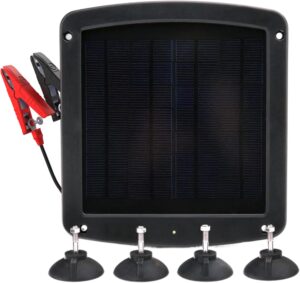
Battery Tender is the most trusted name in automotive battery maintenance, and their solar charger earns that trust. The 5W monocrystalline panel produces enough current to offset typical vehicle self-discharge and maintain a full charge through weeks of storage. The built-in PWM charge controller prevents overcharging, and the integrated blocking diode prevents the panel from discharging the battery at night.
Connection options include a SAE quick-connect plug (compatible with existing Battery Tender harnesses), alligator clips, and an OBD port adapter. The weather-resistant construction handles outdoor exposure without complaint. If your vehicle already has a Battery Tender harness (most motorcycles and classic car owners do), this panel plugs right in.
It won’t charge a fully dead battery in reasonable time, and that’s not what it’s designed for. This is a trickle charger and maintainer first. At that job, it’s excellent.
Features
- 5W monocrystalline panel
- Built-in PWM controller and blocking diode
- SAE, alligator clip, and OBD connection options
- Weather-resistant housing
- Works with 12V batteries
Pros:
- Trusted brand, well-supported
- Multiple connection options
- Prevents overnight discharge
- Compatible with existing Battery Tender harnesses
Cons:
- Too slow to recover deeply discharged batteries
- Higher price than generic alternatives
2. SUNER POWER 10W Solar Trickle Charger
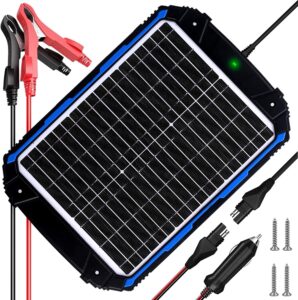
SUNER POWER makes the upgrade argument clearly: 10W of monocrystalline panel delivers twice the current of a 5W unit, which means faster recovery from a partially discharged battery and a bigger buffer on cloudy days. The waterproof construction is genuinely outdoor-rated, not just splash resistant, and the built-in intelligent controller monitors battery voltage continuously, preventing overcharge while maximizing charging efficiency.
The panel mounts via suction cups to the windshield for visible placement or via grommets for permanent roof or dash mounting. Both SAE and alligator clip connections are included. For trucks, RVs, boats, and vehicles that sit unused for weeks at a time, the 10W output provides meaningful charging capacity beyond simple maintenance.
Features
- 10W monocrystalline panel
- Waterproof housing (IP65)
- Intelligent charge controller included
- Suction cup and grommet mounting options
- SAE and alligator clip connections
Pros:
- Higher wattage for faster charging
- Genuinely waterproof
- Includes controller
Cons:
- Larger panel is harder to position discreetly
- Suction cups can fail in high heat
3. Noco Genius Boost Solar (2W Maintenance)
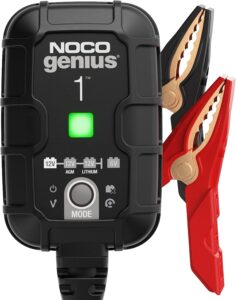
Noco makes the best jump starters on the market, and their solar maintenance panel pairs perfectly with any Noco GB series portable battery. The 2W amorphous panel is designed for vehicles that sit a week or two at a time, not months. It’s small enough to lay flat on the dashboard and doesn’t draw attention. For daily drivers that spend weekends at the airport or commuters who work from home and rarely drive, a 2W maintainer is all you need to ensure the battery never falls below starting capacity.
Noco’s SAE connector is standard across their product line, making this a natural choice for anyone already in the Noco ecosystem. The price-to-value ratio is excellent for light-duty applications.
Features
- 2W amorphous thin-film panel
- Dashboard-mount design
- SAE connection
- Compact and discreet
Pros:
- Very compact and discreet
- Perfect for occasional-use vehicles
- Compatible with Noco ecosystem
Cons:
- Too small for extended storage
- Amorphous panels less efficient than monocrystalline
4. Solarizer Optimate Solar Duo 6W
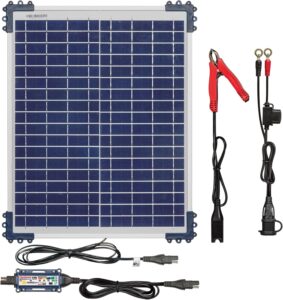
The Optimate Solar Duo is the choice for households with two vehicles to maintain simultaneously. The 6W panel splits into two 3W outputs, each with its own SAE connection for simultaneous charging of two separate 12V batteries. If you have a daily driver and a weekend car, a boat and a motorcycle, or any two vehicles in shared storage, this panel handles both without buying two separate chargers.
Optimate’s battery recovery technology is a genuine differentiator. The controller actively attempts to recover sulfated batteries that won’t accept a charge from standard chargers, using conditioning pulses that break down lead sulfate buildup. It won’t save every dead battery, but it recovers some that others write off.
Features
- 6W total, dual 3W outputs
- Two simultaneous SAE connections
- Battery conditioning and recovery technology
- 12V and 24V compatible
Pros:
- Charges two batteries simultaneously
- Battery conditioning technology
- Works on 12V and 24V
Cons:
- Higher price for the dual feature
- 3W per output is modest for quick recovery
5. Eco-Worthy 20W Solar Car Charger Kit
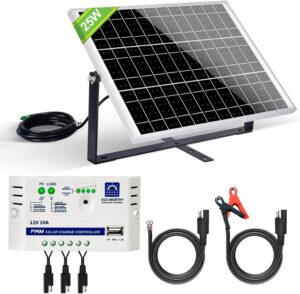
If you need a solar panel capable of meaningfully charging a discharged battery (not just maintaining a full one), the Eco-Worthy 20W kit is the entry point that makes sense. Twenty watts produces enough current to restore a partially discharged battery in a day of good sun and to maintain a healthy battery indefinitely through extended storage.
The kit includes a 10A charge controller, which is more than capable of managing the panel’s output. The panel is semi-flexible, making it useful for curved mounting surfaces where a rigid panel won’t work. Boats, RV roof curves, and curved car hoods all accommodate this panel better than standard rigid alternatives.
Features
- 20W monocrystalline panel
- Semi-flexible construction
- 10A charge controller included
- USB and 12V DC outputs on controller
Pros:
- Enough power for meaningful charging
- Semi-flexible for curved surfaces
- Controller included
Cons:
- Larger panel requires more planning for placement
- Semi-flexible panels wear faster than rigid glass
6. POWOXI Upgraded 8W Solar Trickle Charger
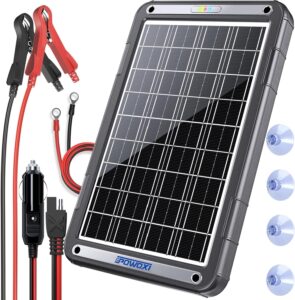
The POWOXI 8W is the most popular mid-range solar car charger on this list, and the reviews bear out its reputation for reliability. The monocrystalline panel is housed in weatherproof casing with proper IP65 waterproofing, the built-in blocking diode prevents reverse drain, and the charging cable is long enough (8 feet) to route from a windshield-mounted panel to the battery without awkward positioning.
The suction cup mounting hardware holds well in temperatures below 95°F. In hotter climates or vehicles parked in direct sun, suction cups can fail. The instruction manual recommends dashboard mounting via the suction cups, not roof or hood mounting in high-heat environments.
Features
- 8W monocrystalline panel
- IP65 waterproof rating
- Built-in blocking diode
- 8-foot charging cable
- Suction cup and alligator clip mounting
Pros:
- Good value for 8W output
- Long cable for flexible positioning
- IP65 waterproof
Cons:
- Suction cups fail in extreme heat
- No intelligent charge controller
7. Deltran Battery Tender 2.5W (Best for Motorcycles)
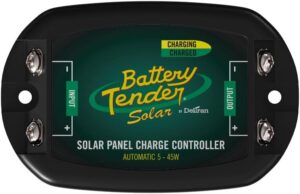
Motorcycle batteries are small and vulnerable to the self-discharge that kills them over winter storage. The Deltran 2.5W solar panel is sized appropriately: small enough to fit easily on a motorcycle seat, saddlebag, or windshield, producing just enough current to maintain a motorcycle battery indefinitely without overcharging it. The SAE quick-connect is standard on Deltran’s entire ecosystem, which means most motorcycle owners already have the matching harness plugged into their battery.
For seasonal storage of motorcycles, ATVs, snowmobiles, or other small powersport vehicles, this is the cleanest solution. No need to run an extension cord to the garage, no need to remember to plug in a conventional charger. Set the panel in a window or outdoors and forget it until spring.
Features
- 2.5W monocrystalline panel
- SAE quick-connect standard
- Compact size for small vehicles
- Built-in blocking diode
Pros:
- Perfect size for motorcycles
- SAE quick-connect compatibility
- Reliable winter storage solution
Cons:
- Too small for car batteries in long storage
- Minimal charging capacity beyond maintenance
8. Ring RSC608 Solar Battery Charger (Budget Pick)
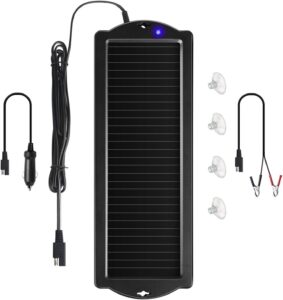
The Ring RSC608 is the value option: inexpensive, functional, and basic. The 4W panel produces adequate maintenance current for most car batteries, the crocodile clip connections are simple and universal, and the voltage protection circuit prevents overcharging. It doesn’t have the brand reputation of Battery Tender or the advanced features of Optimate, but for occasional use or as a backup charger, it does the job at a price that’s hard to argue with.
Build quality is adequate rather than excellent. The housing feels less robust than premium alternatives. For long-term outdoor exposure in harsh climates, you’d want to step up. For occasional use in milder conditions, the Ring delivers solid value.
Features
- 4W solar panel
- Voltage protection circuit
- Crocodile clip and ring terminal connections
- LED charge indicator
Pros:
- Very affordable
- Simple, no-fuss operation
- LED status indicator
Cons:
- Budget build quality
- No SAE connection
- Not for harsh outdoor climates
Buying Guide: Solar Car Battery Chargers
Key Takeaways
- Match wattage to use case: 2W to 5W for maintenance, 10W+ for actual charging.
- Always choose panels with a blocking diode to prevent overnight discharge.
- SAE connectors are the most versatile and work with existing battery maintenance harnesses.
- IP65 waterproofing or better is the minimum for permanent outdoor mounting.
What Are Solar Car Battery Chargers?
A solar car battery charger is a compact solar panel with integrated or accessory charge controller that connects directly to a vehicle’s 12V battery and uses sunlight to maintain or restore the battery’s charge. They are most commonly used as trickle chargers for vehicles in storage — classic cars, RVs, boats, motorcycles, and seasonal equipment — preventing the battery from going flat during weeks or months without use.
Unlike a full solar array, these are small portable panels — typically 5 to 30 watts — designed to supplement or maintain a battery rather than to fully charge one from flat. Most are flexible or semi-flexible panels with a simple suction-cup dashboard mount, or rigid framed panels that can be placed on a vehicle roof or hood. They connect via the cigarette lighter socket, OBD2 port, or direct alligator clips to the battery terminals.
Benefits of Using a Solar Car Battery Charger
The headline benefit is battery preservation during storage. A car left parked for three months without charging will typically have a dead battery when you return to it — modern vehicles draw 20–50mA continuously even when parked, draining a standard 45Ah battery completely in 4–8 weeks. A solar trickle charger offsets that drain indefinitely, so you come back to a ready battery every time.
Solar chargers also extend battery life overall. Batteries that repeatedly deep-discharge have shorter lifespans — each full discharge cycle accelerates sulfation on lead-acid batteries. Keeping the battery consistently at or near full charge with a solar maintainer means the battery spends its life in the condition it was designed to operate in, often doubling its service life compared to a battery that regularly sits discharged.
Types of Solar Car Battery Chargers
Dashboard trickle chargers are the most compact and beginner-friendly type. They sit on the dashboard behind the windshield and connect via the cigarette lighter socket or OBD2 port. Typical output is 5–10W. Setup takes two minutes and they are fully self-contained — no permanent installation needed.
Higher-wattage portable panels (15–30W) are semi-rigid or folding units that you drape over the hood or place on the roof for maximum sun exposure. These provide faster charging and are more useful for partially depleted batteries, not just maintenance. Hardwired solar maintainers are a third type — permanently wired to the battery with weather-resistant cables and a panel that mounts permanently to the vehicle or garage roof, used primarily for boats, RVs, and farm equipment parked in fixed locations.
How Do Solar Car Battery Chargers Work?
A solar car battery charger converts sunlight into DC electricity and delivers it to your 12V vehicle battery. The panel produces current proportional to sunlight intensity. A charge controller or blocking diode regulates this current to prevent overcharging and prevents the panel from drawing power from the battery after dark. For vehicles in storage, the panel continuously tops up the battery, offsetting the natural self-discharge that causes batteries to go flat over weeks or months.
Things to Keep in Mind Before Buying
Wattage is the most important spec. A 5W panel in full sun produces roughly 0.3–0.4 amps — enough to offset the parasitic drain of a modern car’s alarm and memory systems, but not enough to charge a significantly depleted battery in a reasonable timeframe. For maintenance use on stored vehicles, 5–10W is fine. For regular top-up charging on a daily driver parked outside, 15–25W gives more meaningful daily input.
Voltage compatibility matters too. Most solar car chargers output 12V and work with standard lead-acid, AGM, and gel car batteries. Some also support 24V for trucks and larger vehicles. Check your vehicle’s battery voltage before buying, and confirm the charger includes a built-in charge controller — without one, the panel can overcharge and damage the battery if connected for extended periods in direct sun.
Wattage, Compatibility, and Charging Speed
A helpful rule of thumb: 1W of solar input per 10Ah of battery capacity maintains a healthy float charge on a stored battery. A typical car battery is 45–70Ah, so a 5–7W panel handles maintenance duty. If you want to add meaningful charge to a partially depleted battery in a few hours of sun, you need 20W or more.
Connector compatibility affects how conveniently you can use the charger. Most models include both OBD2 port plugs, cigarette lighter adapters, and direct battery alligator clips. The OBD2 and cigarette lighter connections are convenient but only work when the car’s circuits are active in accessory mode — for stored vehicles, direct alligator clip connections to the battery terminals are more reliable.
How to Use a Solar Car Battery Charger
Connect the charger to your battery using the alligator clips (red to positive, black to negative) or plug into the cigarette lighter socket if your vehicle supports it. Position the panel on the dashboard facing the windshield, or drape it over the hood or roof with the cable routed through a window if you want maximum sun exposure. Most chargers with a charge controller can be left connected indefinitely — they switch to float mode once the battery is full.
For best results, clean the panel surface periodically — dust and film build-up reduces efficiency noticeably over weeks of use on a car dashboard. Also avoid covering the panel even partially; a shadow across 20% of the panel’s surface can reduce output by 50% or more depending on the cell design. Position the panel to get the most unobstructed sun during the hours the car is parked.
Frequently Asked Questions
Can a solar charger fully charge a dead car battery?
A small solar charger (under 10W) will eventually charge a dead 12V battery, but it takes a very long time. A completely discharged 60Ah battery needs about 60Ah of charge, which at 5W (about 0.4A) takes 150 hours of full sun. For emergency recovery, a conventional charger or jump starter is more practical. Solar is best for prevention and maintenance.
Will a solar charger damage my car battery?
Not if it has a proper charge controller or blocking diode. Without protection circuitry, a solar panel can overcharge a battery if left connected indefinitely in strong sun. All quality solar car chargers include either a PWM controller or a simple blocking diode to prevent this. Never use a bare solar panel connected directly to a battery without any protection.
Can I leave a solar car charger connected all the time?
Yes, that’s exactly how they’re designed to be used. Solar trickle chargers with proper charge control can remain connected indefinitely without overcharging the battery. In fact, continuous connection is the point: they maintain a full charge so the battery never depletes during storage.
What is the difference between a solar trickle charger and a solar maintainer?
Functionally, these terms are often used interchangeably for small solar panels designed to keep vehicle batteries topped up. A “trickle charger” implies slow charging, while a “maintainer” implies keeping a fully charged battery at full charge. Both describe the same category of product in most marketing contexts.
Do solar car battery chargers work through glass?
Yes, but with some efficiency loss. Standard automotive glass reduces solar panel output by 10 to 25 percent. Tinted glass reduces it more. For dashboard-mounted chargers inside a vehicle, output is sufficient for maintenance charging but lower than the panel’s rated output. Clear glass and direct south-facing placement minimize the loss.
Summing Up
A solar trickle charger is one of the most practical solar products you can buy for a car — a 5–20W panel connected to the battery prevents self-discharge during storage without any wiring complexity.
If you’re also thinking about solar panels for your home, call (855) 427-0058 for a free quote — it takes just a few minutes to find out what installation would cost and save you in your area.
Updated