Shading is one of the most significant factors affecting solar panel output — and one that’s often underestimated during the buying process. Even partial shading covering 5–10% of a panel’s surface can reduce system output by 20–30% in systems with traditional string inverters, due to how panels and inverters interact. Understanding how shading works and what technologies mitigate it helps you make better decisions when designing or troubleshooting a solar system.
Why Shading Hits Solar Systems So Hard
Solar panels are typically wired in series — like a chain of batteries — into “strings.” In a series circuit, the same current must flow through every panel. When one panel is partially shaded, it can only pass as much current as the shaded cell allows — which is much less than an unshaded panel. Every other panel in that string is forced down to match the weakest link.
The classic analogy: imagine a series of water hoses connected end to end. If you partially block one hose, the entire flow through the chain is limited by that restriction.
A real-world example: an 8-panel string where one panel is 50% shaded might produce only 60–70% of what the other 7 unshaded panels could produce alone. That’s potentially 30–40% production loss from shading a single panel — affecting the entire string.
This is the “string inverter weak link” problem, and it’s why shading analysis is critical during system design. Systems on roofs with any shading risk need either careful layout planning, microinverters, or power optimizers to mitigate this effect.
Common Sources of Solar Panel Shading
Trees: The most common shading issue in residential solar. Deciduous trees that lose leaves in winter shade less during winter but may be irrelevant to summer production. Evergreen trees shade year-round. Nearby trees that currently don’t cause shading may grow to shade panels within 5–10 years of installation — check the mature height and location of trees relative to your array.
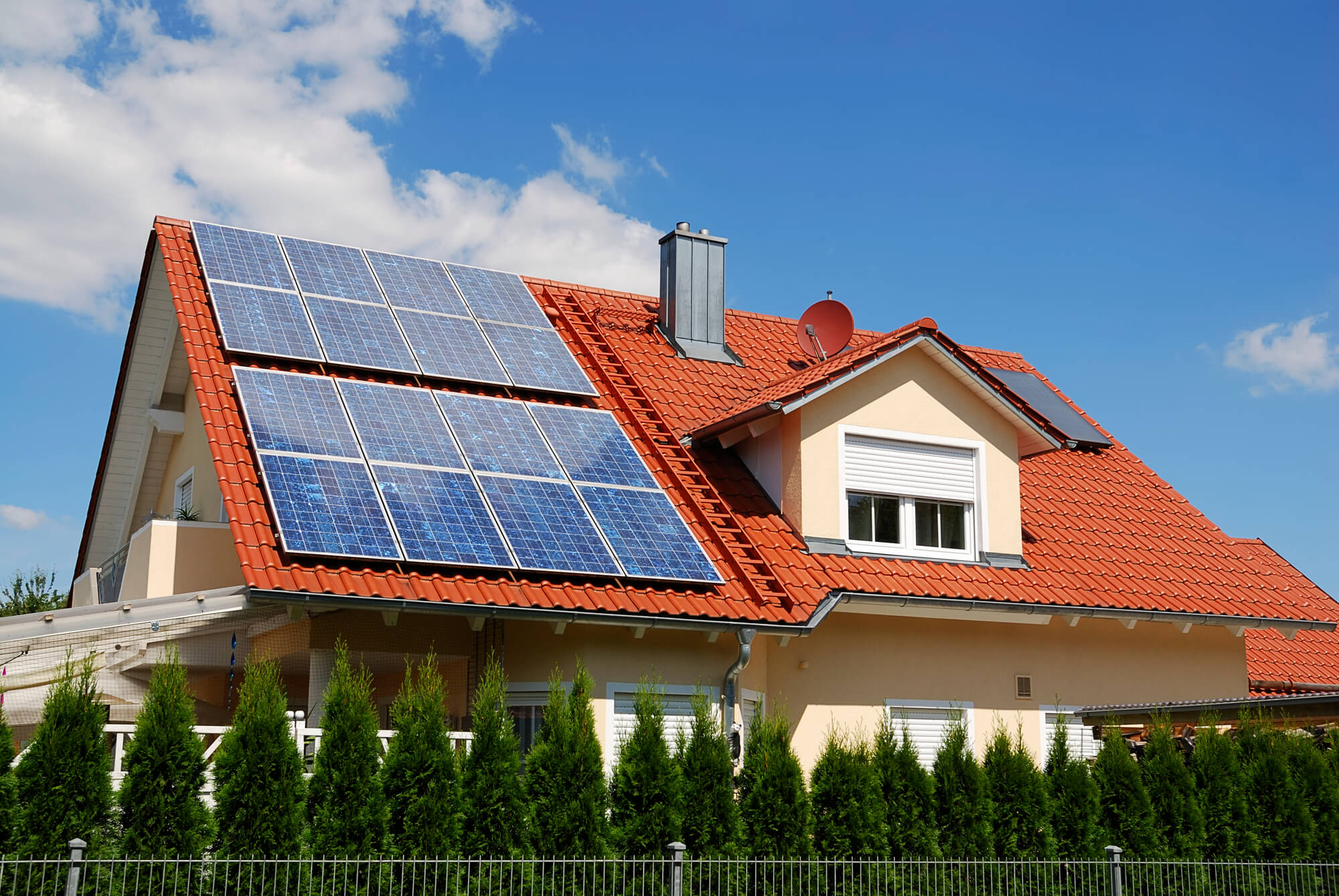
Chimneys and dormers: These roof features cast a shadow that moves throughout the day. Even a chimney that’s never directly on your panel array may shade one panel for 1–2 hours each morning or afternoon, producing significant string-level losses during those hours.
Adjacent buildings: Neighboring homes or commercial buildings can shade rooftop arrays, particularly in the morning (east-facing shading) or afternoon (west-facing shading). High-density urban installations are especially susceptible.
Roof penetrations: Vent pipes, satellite dishes, HVAC units, and other roof features cast small but significant shadows. A poorly positioned HVAC unit shadow can shade one panel for several hours midday — exactly when production should be highest.
Soiling: Bird droppings, leaves, and dirt on panel surfaces create localized “shading” that causes the same string-level losses as structural shading. A patch of bird droppings the size of your hand can affect the entire string. This is why regular cleaning matters more than many homeowners expect.
Snow accumulation: Snow doesn’t slide off all panels equally. Partial snow coverage of some panels while others are clear creates the same weak-link effect. Steeper panel tilts help shed snow faster and reduce this seasonal shading impact.
Technologies That Reduce Shading Impact
Microinverters: Microinverters (Enphase IQ8 series being the dominant product) attach one inverter to each individual panel. Each panel operates independently on its own MPPT (maximum power point tracking) circuit. A shaded panel produces less, but doesn’t pull down other panels in the array. Microinverters are the most effective solution for shading-prone roofs and add approximately $0.25–$0.50/W in system cost.
Power optimizers (DC optimizers): SolarEdge is the dominant provider. Power optimizers attach to each panel and perform per-panel MPPT, similar to microinverters. Optimized strings are more tolerant of shading than simple series strings. SolarEdge uses a central inverter plus per-panel optimizers — the inverter converts DC to AC, while optimizers prevent the weak-link effect. Cost premium is slightly less than microinverters, typically $0.10–$0.30/W over standard string systems.
String inverters with module-level shade tolerance: Some modern string inverters include partial shade tolerance features, though they’re generally less effective than per-panel optimization.
Half-cut and multi-cell panel technologies: Panels that split each cell in half (half-cut cells) or divide the panel into multiple independent sections are inherently more shade-tolerant than standard panels. A half-cut panel has two independent circuits — shading one row of cells only affects one circuit, not the whole panel. Half-cut cell panels are now standard in most quality residential panels (Qcells, REC, Panasonic, LONGi, etc.).
System layout optimization: Even with a string inverter and no optimization hardware, a skilled installer can minimize shading impact by grouping similarly-shaded panels into the same strings and keeping unshaded panels in separate strings. This won’t eliminate the weak-link problem within a string, but prevents cross-contamination between shaded and unshaded sections of the array.
How Installers Model Shading During System Design
Reputable installers use software tools to model shading before installation:
Aurora Solar: The industry-standard tool for US residential solar design. Uses LiDAR (laser-mapped) roof data and 3D shade modeling to simulate shade impact hour-by-hour throughout the year, generating a “shade loss” percentage for each proposed panel placement. Aurora produces the “shade impact” percentages often quoted in proposals.
PVWatts: NREL’s free online tool includes shading and tilt calculations. Less detailed than Aurora but useful for independent verification.
HelioScope: Another professional tool widely used for commercial and utility-scale design, with detailed shade modeling.
When reviewing a solar proposal, look for a site-specific shading analysis. An installer who hasn’t performed shade modeling for your specific roof is leaving significant uncertainty in their production estimate. Demand to see the shading loss percentage for each panel placement — anything above 10–15% shading loss on a panel position warrants discussion about placement adjustment or adding optimization hardware.
Diagnosing Shading Problems in Existing Systems
If your solar system is underperforming relative to the installer’s estimate, shading may be the cause. Diagnostic steps:
Check monitoring data by time of day: If production is particularly low in morning or afternoon hours (rather than only on cloudy days), that suggests directional shading from a building or tree that affects panels during certain sun angles.
Panel-level monitoring: Microinverter and power optimizer systems (Enphase, SolarEdge) provide panel-level production data. This makes it immediately visible which panels are underperforming and when — the digital fingerprint of a shade problem.
Physical inspection: Walk around your array and look for new shading sources: a tree that’s grown, a neighbor’s new roof addition, a satellite dish someone moved, or accumulated bird droppings on specific panels.
Seasonal variation: Solar output is normally lower in winter due to shorter days and lower sun angle, but a sudden change in seasonal patterns (system that used to produce X% of summer output in winter now produces less) may indicate a new shading source at low winter sun angles.
Frequently Asked Questions
How much does shading reduce solar panel output?
This depends heavily on the system’s inverter technology and the degree of shading. In a traditional string inverter system, shading one panel 50% can reduce the entire string’s output by 25–40%. With microinverters or power optimizers, the same shading scenario reduces output only by the shaded panel’s proportional contribution to the system — roughly 5–15% for one panel in an 8-panel array. This is why the choice of inverter technology matters enormously for shading-affected installations.
Is solar worth it if my roof has some shading?
Yes, in most cases — with the right equipment. If shading is moderate (less than 20% annual shading loss) and you use microinverters or power optimizers, a solar system can still produce excellent savings. Systems with more than 30–40% annual shading loss start to have difficult economics unless high electricity rates compensate. A good installer will model your specific situation and tell you honestly whether solar is viable and what equipment minimizes shading losses.
Should I cut down trees for better solar production?
Tree removal can significantly increase solar production from a shaded system. The question is whether the production value of the improved solar output justifies the tree removal cost ($500–$5,000 depending on tree size and location) and the loss of the tree’s value (shade, property aesthetics, carbon sequestration, cooling effects in summer). In most cases where trees cause greater than 20% annual production loss, it’s worth at least getting a quote for selective pruning or removal of the most impactful branches.
Summing Up
Shading is the single most common design problem that leads to underperforming solar systems. The weak-link effect of string inverters amplifies even small shading events into large production losses. Modern microinverters, power optimizers, and half-cut cell panels largely solve this problem — but only if you choose them intentionally as part of your design. If your roof has any trees, chimneys, dormers, or neighboring obstructions, ask your installer specifically about shading analysis and shade-mitigation technology before signing a contract. For a free site assessment by licensed installers experienced in shading-prone roofs, call (855) 427-0058.
Updated