
The right solar panel system size depends on how much electricity your household uses, how many peak sun hours your location receives, and how much of your bill you want to offset. The average US home uses 10,500 kWh/year and needs an 8–10 kW solar system to offset most of its consumption — but the actual number varies widely from 5 kW to 20+ kW depending on energy use, climate, and goals. This guide walks you through the complete sizing calculation.
Step 1: Know Your Annual Energy Consumption
Every solar sizing calculation starts with your electricity usage. Pull 12 months of electricity bills and total the kilowatt-hours (kWh) consumed — not the dollar amounts, which fluctuate with rates.
The US average residential consumption is approximately 10,500 kWh/year (about 875 kWh/month). But individual households vary dramatically:
Small home or apartment (under 1,000 sq ft, 1–2 residents): 4,000–7,000 kWh/year
Average home (1,500–2,500 sq ft, family): 8,000–14,000 kWh/year
Large home or high-use household (AC-heavy climate, pool, EV): 15,000–25,000+ kWh/year
Your 12-month actual usage is far more accurate than any rule of thumb. If you’ve recently added an EV or plan to, add your estimated annual EV charging demand (typically 2,500–4,500 kWh/year for average EV driving) to your baseline.
Step 2: Find Your Peak Sun Hours
Peak sun hours (PSH) measure solar irradiance — the effective number of hours per day that solar radiation is equivalent to 1,000 W/m² (standard test conditions). A location with 5 PSH/day receives enough solar energy in those 5 hours to equal 5,000 W/m² of energy, which is used to calculate what your panels will actually produce at your location.
Peak sun hours vary significantly by location:
Southwest (Phoenix, Las Vegas, Los Angeles): 5.5–6.5 PSH/day
Southeast (Atlanta, Charlotte, Dallas): 4.5–5.5 PSH/day
Midwest (Chicago, Denver, Kansas City): 4.5–5.0 PSH/day
Pacific Northwest (Seattle, Portland): 3.5–4.5 PSH/day
Northeast (Boston, New York, Philadelphia): 4.0–4.5 PSH/day
Mountain West (Salt Lake City, Albuquerque): 5.0–6.0 PSH/day
NREL’s PVWatts calculator (pvwatts.nrel.gov) gives precise, location-specific peak sun hours based on actual historical solar data. Using PVWatts or your installer’s solar design software is more accurate than any generic table.
Step 3: Calculate Required System Size
The basic sizing formula:
System size (kW) = Annual kWh ÷ (365 × PSH/day × System efficiency)
System efficiency accounts for real-world losses: inverter efficiency (96–98%), wiring losses, panel temperature losses, and soiling. A typical efficiency factor is 0.80 (80%), meaning 80% of the DC power your panels could theoretically produce makes it into your home as usable AC electricity.
Worked example — Boston, MA:
Annual usage: 10,500 kWh | PSH: 4.0 hours/day
System size = 10,500 ÷ (365 × 4.0 × 0.80) = 10,500 ÷ 1,168 = 8.99 kW → round up to 9 kW
Worked example — Phoenix, AZ:
Annual usage: 14,000 kWh (high AC load) | PSH: 5.8 hours/day
System size = 14,000 ÷ (365 × 5.8 × 0.80) = 14,000 ÷ 1,694 = 8.26 kW → round up to 8.5 kW
The Phoenix home uses 33% more electricity but needs a smaller system because of more sunshine. This illustrates why peak sun hours are as important as consumption in sizing.
How Many Panels Is That?
Once you have your target system size in kW, divide by the wattage of the panels you’re using to get panel count:
Panel count = System kW × 1,000 ÷ Panel wattage
Standard residential panels in 2026 are typically 380–430W (budget to mid-range) or 440–500W (premium panels). Using 400W panels as a typical example:
6 kW system: 15 panels
8 kW system: 20 panels
10 kW system: 25 panels
12 kW system: 30 panels
Higher-wattage panels (440–500W) produce the same power in fewer panels — useful if roof space is limited. Premium 500W panels might produce a 10 kW system in only 20 panels rather than 25.
How Much Roof Space Do I Need?
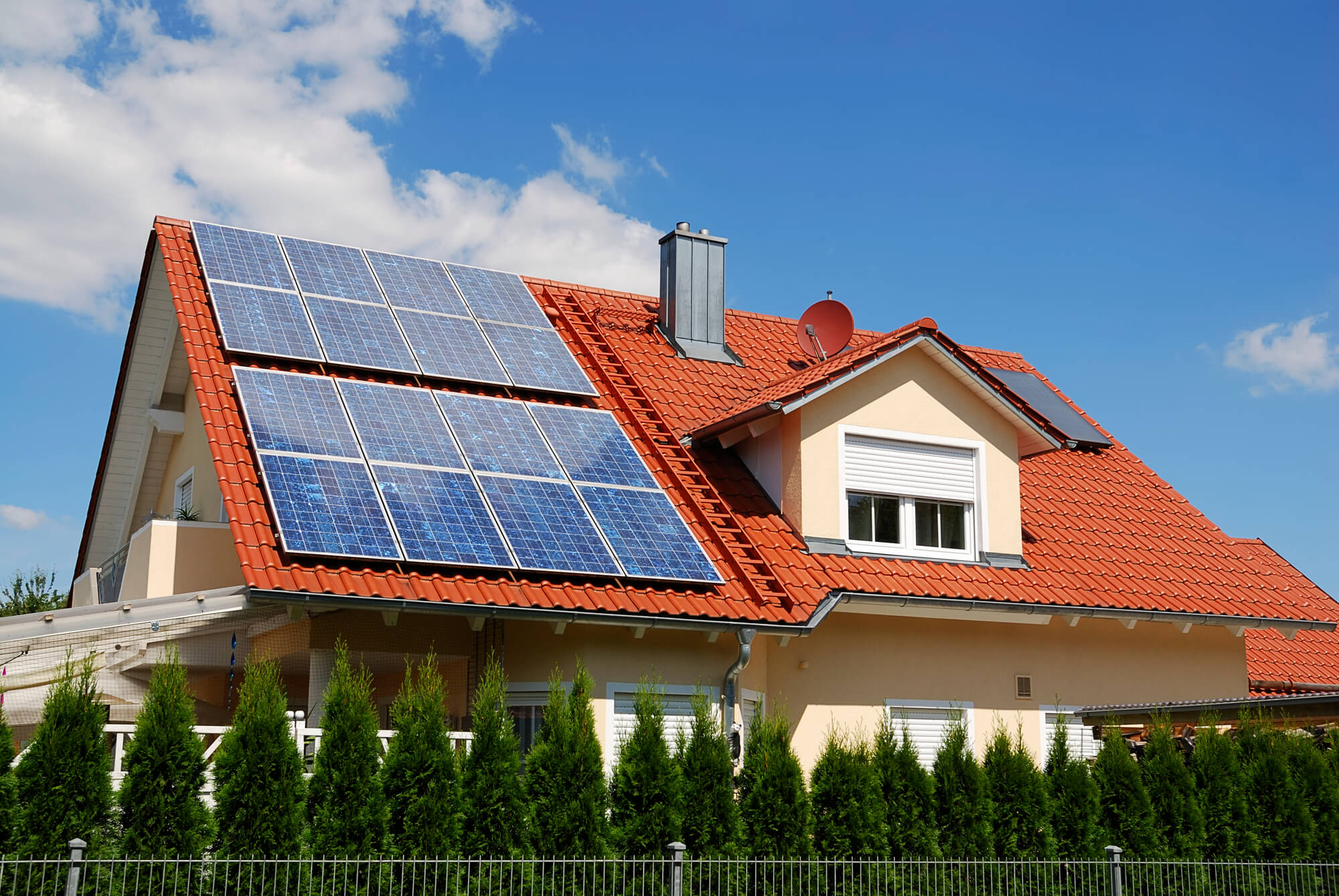
A standard 400W panel measures approximately 68″ × 40″ (5.7 ft × 3.3 ft) and covers about 18–20 square feet. For common system sizes:
6 kW (15 panels): 270–300 sq ft of usable roof space
8 kW (20 panels): 360–400 sq ft
10 kW (25 panels): 450–500 sq ft
12 kW (30 panels): 540–600 sq ft
“Usable” roof space excludes areas within 3 feet of the roof edge (code requirement), valleys, areas obstructed by chimneys/vents, and sections that don’t face within 45° of south. Most 1,500–2,500 sq ft homes have adequate roof space for 8–12 kW systems if at least one roof section faces south or southwest.
Should You Size for 100% Offset?
Most homeowners aim to offset 80–100% of their annual electricity consumption. But whether to size for 100% depends on your situation:
In states with full retail net metering: Oversizing can make sense — excess production earns full retail credit on your bill. A 10% oversize costs about 10% more in system cost but may be worth it to completely eliminate the grid portion of your bill.
In California (NEM 3.0) and similar states: Significant oversizing is often counterproductive. Export credit is only 5–8 cents/kWh, while the additional panels cost $2.50–$3.50/W to install. Oversizing wastes money unless you’re planning to add an EV or battery soon.
Adding an EV or battery in the future: If you’re getting an EV in 2–3 years, sizing your initial solar installation to include that future load avoids a second permit and project cost. Your installer can model both current and anticipated future loads.

Typical System Sizes by Home Type
Small home or apartment (4,000–6,000 kWh/year): 4–6 kW (10–15 panels), 200–350 sq ft of roof space
Average 3-bedroom home (8,000–12,000 kWh/year): 6–10 kW (15–25 panels), 300–500 sq ft of roof space
Larger home with pool or spa (12,000–18,000 kWh/year): 9–14 kW (22–35 panels), 450–700 sq ft of roof space
Home with EV(s) (add 2,500–4,500 kWh/EV/year): 10–16 kW (25–40 panels)
All-electric home (heat pump HVAC, heat pump water heater, no gas): 12–20 kW (30–50 panels) — all-electric homes use significantly more electricity but pay no gas bill, changing the economics of the payback calculation.
Frequently Asked Questions
What is the right size solar system for a 2,000 square foot house?
Home size alone doesn’t determine solar system size — electricity consumption does. A 2,000 sq ft home in Massachusetts with gas heating might use 8,000 kWh/year and need a 7.5 kW system. The same size home in Florida with electric AC might use 14,000 kWh/year and need an 11 kW system. Review your 12-month electricity bills and use the sizing formula: Annual kWh ÷ (365 × PSH × 0.80) = required kW.
Is it better to oversize or undersize a solar system?
In states with retail net metering: slight oversizing (5–10%) is often worthwhile to ensure you reach 100% offset even in lower-than-average production years. In NEM 3.0 states (California) and areas with poor buyback rates: size closer to 90–95% of consumption to avoid exporting low-value power. Never undersize significantly — the cost difference between 8 kW and 10 kW systems is modest ($5,000–$7,000 out of a $25,000 project) relative to the 25-year production difference.
How do I know if my roof has enough space for the system I need?
Multiply your target panel count by 20 sq ft to get approximate roof space needed. A site assessment from a qualified installer will confirm whether your specific south-facing roof area can accommodate the required panels, accounting for setbacks, obstructions, and structural capacity. If roof space is insufficient, a ground mount may be the solution.
Summing Up
Sizing a solar system correctly requires knowing your annual kWh consumption, your location’s peak sun hours, and your offset goal. For most US homes, the answer falls in the 6–12 kW range (15–30 panels, 300–600 sq ft of roof space). An installer’s site assessment using professional modeling software like Aurora Solar will give you a more precise estimate than any rule of thumb. For a free, site-specific sizing analysis by licensed installers in your area, call (855) 427-0058 or visit us.solarpanelsnetwork.com.
Updated