
Solar panel warranties cover three distinct things — the panel’s physical product, its long-term power output, and the installation workmanship — and understanding each matters when comparing quotes. A 25-year linear power warranty from a financially stable Tier 1 manufacturer is worth more than a 30-year warranty from an unknown brand that may not exist in 10 years. This guide explains what solar warranties actually cover, what they don’t cover, and how to evaluate them when reviewing installer proposals.
The Three Types of Solar Warranties
Every complete solar installation involves three separate warranty layers:
1. Panel product warranty (equipment/materials warranty): Covers defects in materials and manufacturing workmanship that cause the panel to fail or degrade abnormally. If a panel delaminate, cracks, experiences junction box failure, or shows another manufacturing defect, the product warranty requires the manufacturer to repair or replace it. Typical duration: 12–25 years.
2. Panel performance warranty (power warranty): Guarantees that the panel will produce at least a specified percentage of its rated power output for the warranty period. This protects against excessive degradation — the gradual decline in panel efficiency over time. Typical duration: 25–30 years. Minimum guaranteed output at end of term: 80–92% depending on the warranty tier.
3. Inverter warranty: Covers the inverter (the box that converts DC electricity from panels to AC electricity for your home) against defects and failure. Inverters are the component most likely to need replacement during a system’s life. Typical duration: 10–25 years depending on inverter type.
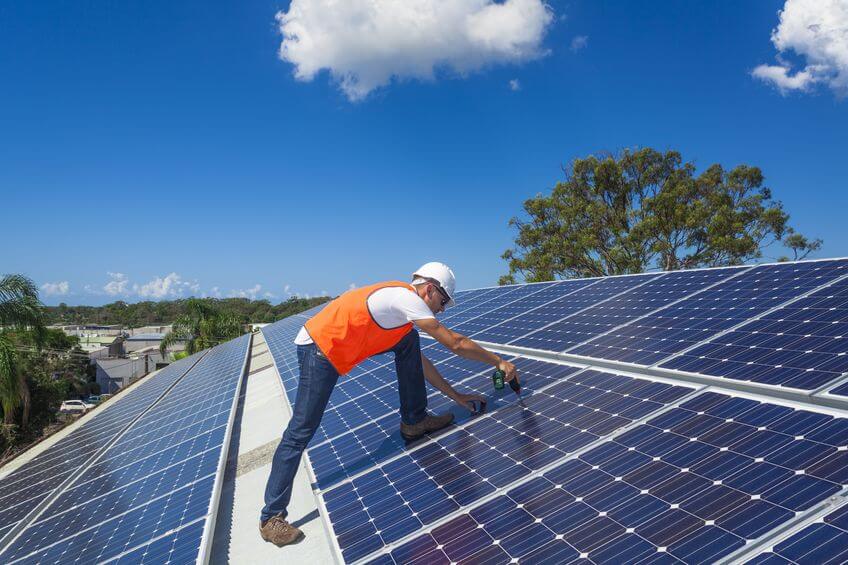
4. Installation/workmanship warranty: From your installer — not the manufacturer. Covers issues arising from how the system was installed: roof leaks from improper flashing, wiring errors, racking problems, connection failures. Typical duration: 5–10 years. This is the warranty most people don’t ask about but should.
Panel Performance Warranty: What to Look For
Performance warranties come in two structures:
Step warranty (older, less desirable): Guarantees output drops by a maximum fixed percentage each year for the first few years, then a larger allowed drop thereafter. For example: max 2.5% drop in year 1, then no more than 0.7%/year thereafter, with a minimum 80% of rated output at year 25. The problem with step warranties is that the first-year allowed drop (often 2–3%) accounts for initial Light-Induced Degradation (LID) and front-loads the degradation allowance.
Linear warranty (current standard, preferred): Guarantees a maximum degradation per year throughout the entire warranty period. For example: no more than 0.55%/year degradation, with a minimum 86.6% output at year 25 (100% − 25 × 0.55%). Linear warranties are stricter and more transparent — each year’s allowed degradation is equal and capped.
Compare these two warranty types by looking at the guaranteed minimum output at year 25 and the degradation rate per year:
Standard (PERC/TOPCon): Year 1 max drop 2–3%, then 0.45–0.55%/year. Year 25 minimum: 80–86%. Annual degradation rate: 0.45–0.55%/year
Premium HJT/IBC: Max 0.25–0.30%/year (no step). Year 25 minimum: 92–94%. Annual degradation: 0.25–0.30%/year
SunPower Maxeon panels offer a 40-year combined product and performance warranty — the longest in the industry — with 88.2% output guaranteed at year 40. This is possible because IBC cell technology (no metal contacts on the front face) virtually eliminates the most common failure mode in conventional cells.

Panel Product Warranty Duration by Brand (2026)
Product warranty (covers physical defects in materials and manufacturing):
SunPower Maxeon: 40 years (combined with performance warranty)
REC Group: 25 years product, 25 years performance
Panasonic EverVolt: 25 years product, 25 years performance
Canadian Solar: 12 years product, 25–30 years performance (linear)
Jinko Tiger Neo N-Type: 15 years product, 30 years performance (linear)
Longi Hi-MO 6: 12 years product, 30 years performance (linear)
Trina Vertex N: 15 years product, 30 years performance (linear)
Q CELLS (Hanwha): 25 years product, 25 years performance
Silfab Solar: 30 years product, 30 years performance (US-manufactured)
Note the distinction: a 12-year product warranty and a 30-year performance warranty don’t provide the same protection. The product warranty covers manufacturing defects; the performance warranty covers degradation. A panel could fail due to a manufacturing defect in year 15 — covered by a 30-year performance warranty but NOT by a 12-year product warranty. In this scenario, the manufacturer owes you proof of degradation below threshold, not automatic replacement from a product defect claim.
Inverter Warranties
Inverter type strongly determines the warranty duration and risk profile:
String inverters: Standard warranty 10 years, often extendable to 20 years for a fee. Extended warranties from SMA and SolarEdge run $500–$1,500. At 10 years, most string inverters are approaching end of warranty — and statistically, the failure rate increases around this time. Budget for an inverter replacement around year 12–15 if you have a string inverter.
Enphase microinverters (IQ7, IQ8 series): 25-year limited warranty — one of the most compelling value propositions in solar. Because each panel has its own small microinverter, a single failure affects only one panel, not the entire system. The 25-year warranty matches the panel warranty, eliminating the mid-life inverter replacement risk entirely for Enphase systems.
SolarEdge HD-Wave with optimizers: Inverter: 12 years standard, extendable to 25 years for a fee. Power optimizers: 25 years. The SolarEdge system uses one central inverter with per-panel DC optimizers; the inverter itself still carries the standard 12-year risk, even though the optimizers are warrantied longer.
Hybrid inverters (for battery storage): Vary by manufacturer. Enphase IQ8 with IQ Battery: 10-year battery warranty, 25-year microinverter warranty. Powerwall 3: 10-year battery warranty (70% capacity retention), infinite cycle warranty. Franklin aGate: 10 years.
Installer Workmanship Warranty
The installer workmanship warranty is the coverage most frequently overlooked — and the one most likely to matter in the first 10 years of system ownership. This warranty covers:
Roof penetration sealing (the single most common installation-related claim — improper flashing allows water intrusion)
Wiring connections and conduit installation
Racking and mounting security
Proper electrical code compliance
System commissioning and interconnection work
Standard workmanship warranty: 5 years. Better installers: 10 years. A few premium installers offer 25-year workmanship warranties that parallel the panel warranty term.
The catch: workmanship warranties are only as good as the installer’s continued existence. If the company you bought from goes out of business in year 3, your 10-year workmanship warranty is unenforceable. This is a real concern in the solar industry, which has experienced significant consolidation and business failures. Strategies to mitigate this risk: choose installers who have been in business at least 5 years, verify financial stability, and understand that some states have contractor bonding requirements that may provide recourse even if a contractor fails.
What Solar Warranties Do NOT Cover
Key exclusions found in most solar panel warranties:
Physical damage: Hail impact (unless the panel carries an IEC hail certification for the specific hail size), hurricane force winds beyond rated limits, falling debris, fire, and vandalism are typically excluded from panel product warranties. These should be covered by your homeowner’s insurance instead — make sure your insurer knows you have solar panels installed.
Normal degradation above threshold: If a panel degrades at 0.5%/year but the warranty only guarantees max 0.55%/year degradation, the degradation is “normal” and not a warranty claim — even if you’re disappointed with performance. Only degradation exceeding the warranty threshold is claimable.
Cosmetic issues: Discoloration, minor surface blemishes, and aesthetic issues that don’t affect power output are typically excluded from performance and product warranties.
Failed system due to third-party components: If a panel fails because of a charge controller or inverter problem (overvoltage, for example), the panel manufacturer may deny the warranty claim as damage caused by external factors, not panel manufacturing defects.
Systems not installed per manufacturer specifications: Improper installation can void manufacturer warranties. This is one reason using certified installers matters — warranty claims can be denied if the installation deviated from the manufacturer’s installation manual.
How to File a Solar Warranty Claim
If you believe a panel or inverter has failed under warranty:
Step 1: Document the issue through your monitoring system. Screenshot or download production data showing the underperformance and when it began. Panel-level monitoring (Enphase, SolarEdge) makes this straightforward. System-level monitoring (basic string inverter monitoring) makes panel-specific claims harder to substantiate.
Step 2: Contact your installer first. Installer workmanship warranties should be your first call for any system issue — they’re responsible for the installation and should diagnose the problem. They can also initiate manufacturer warranty claims on your behalf.
Step 3: Contact the manufacturer directly if the installer can’t resolve it or has gone out of business. Panel manufacturer warranty claims require: proof of purchase (installer invoice), system commissioning documentation, monitoring data showing underperformance, and often photos of the affected panel.
Step 4: Understand what the warranty provides. Performance warranty claims typically result in replacement panels of comparable or better specification — not necessarily the same model (which may be discontinued). Product warranty claims may result in the same.
Frequently Asked Questions
Is a 25-year solar panel warranty actually meaningful?
Yes, but with caveats. The warranty is only as good as the manufacturer’s ability to honor it 25 years from now. Tier 1 manufacturers (Longi, Canadian Solar, Jinko, Trina, REC, Panasonic) have the scale and financial stability that makes multi-decade warranty honoring plausible. Unknown brands offering generous warranties may not exist long enough to honor them. Check the manufacturer’s financial health and market standing when evaluating warranties.
What happens to my warranty if my installer goes out of business?
Panel manufacturer warranties survive independently of the installer — they’re between you and the panel manufacturer. If the manufacturer is still in business, your performance warranty remains valid even if your installer closed. Inverter warranties are similarly between you and the inverter manufacturer. Only the installer workmanship warranty is lost if the installer closes — which is why installer longevity and financial stability matter.
Can I transfer solar warranties to a new homeowner when I sell?
Most panel manufacturer warranties are transferable to subsequent homeowners — this is a key value point for solar on home sales. Inverter warranties vary: some are transferable, some are not. Installer workmanship warranties are generally transferable within the warranty term. Verify the transfer process with each manufacturer — some require formal notice of transfer to keep the warranty valid.
How do I know if my solar panels are underperforming under warranty?
Compare your actual production against your installer’s production estimate adjusted for local weather conditions. A quick benchmark: run your system specs through NREL’s PVWatts calculator (pvwatts.nrel.gov) for your address. If actual annual production falls more than 10–15% below PVWatts estimates and shading/soiling don’t explain the gap, contact your installer and request a system inspection. Some third-party monitoring services will flag underperformance automatically.
Summing Up
A solid solar installation should carry three warranted layers: a 25-year linear performance warranty on the panels from a financially stable Tier 1 manufacturer, a 25-year microinverter warranty (Enphase) or extended inverter warranty (SolarEdge), and at minimum a 10-year workmanship warranty from your installer. Short product warranties (under 12 years) and step-degradation performance warranties are red flags that warrant closer scrutiny. The best warranties in the industry today — SunPower’s 40-year combined warranty and Enphase’s 25-year microinverter warranty — offer genuine peace of mind, not just numbers on paper. To get proposals with full warranty terms from qualified local installers, call (855) 427-0058.
Updated