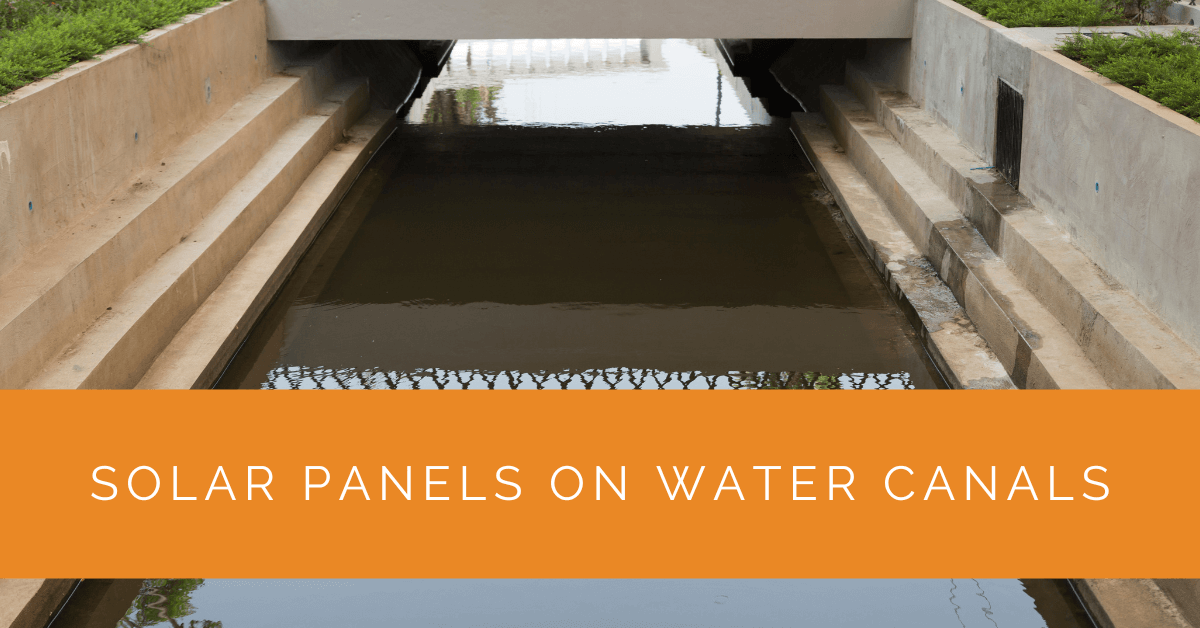
Solar panels installed on top of irrigation canals — floating above the water rather than on rooftops or land — represent one of the more elegant multi-use concepts in renewable energy. Canal-top solar, sometimes called canal solar or canal covering, simultaneously generates electricity, reduces water evaporation from the canal, cools the panels (improving efficiency), and avoids the land use conflicts that make utility-scale solar controversial in agricultural regions. Projects have been deployed in India, the Netherlands, and California, with a particularly well-publicized UC Merced study demonstrating dramatic water savings in the California water system. This guide explains how canal-top solar works, what the real-world data shows, and where the technology is being deployed.

How Canal-Top Solar Works

Canal-top solar systems mount photovoltaic panels on elevated frames spanning irrigation canals, typically 10–20 feet above the water surface. The panels generate electricity from sunlight while the structure covering the canal produces three secondary benefits: reduced evaporation from the shaded water surface, reduced algae growth in the shaded canal water, and improved panel cooling from the moisture evaporating below (which lowers air temperature around the panel underside).

The basic infrastructure concept is straightforward: the same elevated structure used to support panels provides physical coverage of the canal. The canal’s water supply provides a cooling microclimate for the panels. The canal right-of-way (typically already cleared and owned by irrigation districts) provides a linear land area for solar development without requiring new land acquisition or agricultural displacement.

Canal-top solar panels connect to inverters and electrical infrastructure at canal crossing points or alongside the canal easement, feeding electricity into the local grid or directly to irrigation pumping loads. In some configurations, the electricity generated by the canal panels is used to power the electric pumps that move water through the irrigation system — an elegant self-powering loop.

The UC Merced Study and California Water Savings

The most-cited research on canal solar potential comes from a 2021 study by UC Merced researchers published in Nature Sustainability. The study modeled the potential impact of covering California’s 4,000 miles of public water canals with solar panels. Key findings:

Solar generation potential: Covering all California canals could generate approximately 13 gigawatts (GW) of solar capacity — roughly equivalent to all of California’s large hydroelectric capacity and enough to power millions of homes.

Water conservation: Shading the canals could reduce water evaporation by approximately 63 billion gallons per year — enough to irrigate 50,000 acres of farmland or supply the water needs of approximately 2 million people. Water scarcity is a critical issue in California; the Colorado River compact allocations and Sierra Nevada snowpack reduction from climate change have made every gallon of conservation economically significant.

Energy efficiency gain: Canal-mounted panels ran approximately 3°C (5.4°F) cooler than equivalent ground-mounted panels due to evaporative cooling from the canal surface, increasing electrical output by an estimated 3% compared to land-based alternatives.

Weed suppression: Covering canals reduces bank vegetation maintenance requirements, since less sunlight reaches the bank and canal edge vegetation.

The UC Merced study was theoretical modeling; subsequent pilot projects have begun to validate these findings at small scales.

Real-World Canal Solar Projects

Project Nexus — California (Turlock Irrigation District)

The United States’ first canal-top solar installation, Project Nexus, completed its initial phase in 2023 on the Turlock Irrigation District’s Borden Canal in California’s Central Valley. The 1.2 MW project covers approximately 500 meters of canal with solar panels mounted on aluminum frames spanning the canal.

Early monitoring data from Project Nexus validated the UC Merced study projections: water evaporation was significantly reduced from the covered section, panel temperatures were measurably lower than comparable ground-mounted systems nearby, and the project generated electricity without requiring any agricultural land conversion. The Turlock Irrigation District plans to expand coverage based on initial results.

India — Gujarat Solar Canal Projects

India deployed the world’s first canal-top solar projects beginning in 2012 in Gujarat state, covering sections of the Sardar Sarovar irrigation canal network. The initial 1 MW pilot demonstrated the concept’s viability; subsequent phases have expanded coverage across several canal segments in the Gujarat network.

The Gujarat projects face operational challenges including: maintaining panel cleaning access over water, managing bird nesting under panels (which can reduce output and create maintenance challenges), and coordinating canal maintenance operations with solar infrastructure. These operational learnings have informed subsequent project designs, including Project Nexus.

Netherlands — Canal-Floating Solar

The Netherlands has deployed floating solar platforms on canals, ponds, and reservoirs rather than elevated above canals. Dutch projects like those at Andijk reservoir use floating pontoon structures that allow the panels to follow water level changes while covering the water surface. The Netherlands’ limited available land makes floating and canal solar particularly relevant compared to larger land-abundant countries.

Technical Challenges and Considerations

Canal-top solar faces several technical and operational challenges that have slowed deployment relative to conventional ground-mounted solar:

Structural engineering over water: The spanning structure must withstand wind loads, asymmetric loading from snow or workers, and the specific load conditions of a structure anchored on canal banks rather than driven piles in open soil. Structural engineering costs are higher than for standard ground mounts.

Canal maintenance access: Irrigation canals require periodic maintenance — dredging, lining repair, gate and structure inspection. The solar canopy must either be designed to allow equipment access or include provisions for panel lifting or temporary structure disassembly. Project Nexus specifically addressed this by designing access panels and spacing requirements compatible with maintenance equipment dimensions.

Electrical infrastructure in wet environments: All wiring, inverters, and junction boxes must be rated for high-humidity environments. Salt or mineral deposition from canal water vapor requires corrosion-resistant materials and careful sealing. Inverters are typically placed on elevated structures alongside the canal rather than directly above the water.

Panel cleaning: Bird droppings, pollen, and dust accumulate on canal-top panels as on any installation, but cleaning access over water requires specialized equipment or periodic drawdown of the canal section. Automated cleaning systems and self-cleaning anti-soiling coatings are more valuable in canal configurations than in easily accessible ground-mount installations.

Economics and Land Use Advantages

Canal-top solar offers a compelling land use advantage over conventional utility-scale solar: it uses existing rights-of-way that are already owned, cleared, and maintained by irrigation districts. The land acquisition costs, environmental review costs, and agricultural displacement concerns that add time and expense to utility-scale solar projects on open land are largely avoided.

In California’s Central Valley — where irrigation district water rights, agricultural land values, and solar resource quality converge — canal-top solar has genuine economic potential beyond demonstration projects. The water conservation value (avoided water purchases, reduced pumping costs) and potential weed management savings add economic benefit that doesn’t appear in conventional solar project pro formas.

The additional structural cost of spanning a canal (versus a simple ground mount) is partially offset by the avoided land lease cost and the panel efficiency gain from evaporative cooling. Project Nexus economic analysis suggested total lifecycle costs comparable to land-based solar in the Central Valley market.

US Canal Solar Potential

The US has extensive irrigation canal infrastructure beyond California. The Bureau of Reclamation operates over 8,000 miles of canals across the Western US, serving irrigation districts in Arizona, Nevada, Colorado, Utah, Idaho, Oregon, Washington, and Montana. The Columbia Basin Project, the Central Arizona Project, and the Colorado-Big Thompson Project all represent potential canal-top solar development opportunities.

The Inflation Reduction Act‘s expanded ITC and production tax credits — combined with drought-driven interest in water conservation — have increased federal and state agency interest in canal solar as both an energy production and water management strategy.

Frequently Asked Questions

How much water does canal solar save?

Real-world data from Project Nexus and the Gujarat projects validate the UC Merced study’s modeling. Shading canals reduces evaporation by 40–90% depending on local climate, solar angle, and canal geometry. In arid climates like California’s Central Valley, where evaporation losses from unshaded irrigation canals can reach several feet per year, the water savings are significant. Project Nexus measured approximately 65–80% reduction in evaporation from the covered canal section in its first year of operation.

Is canal solar more efficient than regular solar?

Canal-mounted panels typically produce 3–5% more electricity than equivalent ground-mounted panels in similar locations due to the evaporative cooling effect of the canal surface below. Panel efficiency decreases approximately 0.3–0.5% per degree Celsius above 25°C standard test conditions, so the 2–5°C temperature reduction from canal placement translates to a measurable production gain. This efficiency advantage is consistent with laboratory and field measurements from both California and Indian canal projects.

Why isn’t canal solar deployed more widely?

The primary barriers are higher structural costs than ground-mounted solar, operational complexity of maintaining solar infrastructure above active canals, and institutional complexity of coordinating between solar developers and irrigation district operators. The technology is proven — the Gujarat and Turlock projects demonstrate operational feasibility — but the institutional and economic barriers require careful project-specific analysis and alignment between water and energy interests. As water scarcity intensifies and solar economics improve, the value proposition is strengthening.

Summing Up

Solar panels on water canals combine electricity generation with meaningful water conservation — a rare case where a renewable energy deployment also directly addresses another critical resource constraint. The UC Merced study’s projection of 13 GW of solar potential and 63 billion gallons of annual water savings from California canals alone has sparked serious project development, with Project Nexus providing the first real-world US validation of these projections. Technical and operational challenges are real but manageable, as demonstrated by projects in California, India, and the Netherlands. As Western US water scarcity intensifies and the Inflation Reduction Act’s incentives make renewable energy investment more attractive, canal-top solar is a technology that will see increasing deployment across irrigation districts throughout the US West.

Contact Solar Panels Network USA at (855) 427-0058 to discuss commercial and utility solar options for your property or project. Our specialists work with property owners and businesses across the US to design solar systems that maximize both energy production and site-specific advantages.

Updated