Parking lots cover an estimated 17,000 square miles of the continental United States — more than the state of Connecticut — and until recently generated nothing but heat, stormwater runoff, and maintenance costs. Solar canopies over parking lots turn this underutilized real estate into productive energy infrastructure, generating electricity while providing shade that makes vehicles more comfortable and reduces urban heat island effects.
This guide covers solar parking canopy types, costs, ROI, federal incentives, and how to evaluate whether a parking lot solar installation makes sense for your commercial, municipal, or campus property.
Contents
- 1 Types of Solar Parking Lot Systems
- 2 Costs: What Solar Parking Canopies Actually Cost in 2026
- 3 Federal Incentives and Tax Credits
- 4 ROI and Payback Period
- 5 Design and Structural Considerations
- 6 Solar Parking Lot Case Examples
- 7 Frequently Asked Questions
- 7.1 How much electricity does a solar parking canopy generate?
- 7.2 Do solar parking canopies qualify for the 30% federal tax credit?
- 7.3 How long does it take to install a solar parking canopy?
- 7.4 Can I add EV charging to a solar parking canopy?
- 7.5 What is the best solar carport system for a commercial parking lot?
- 8 Summing Up
Types of Solar Parking Lot Systems
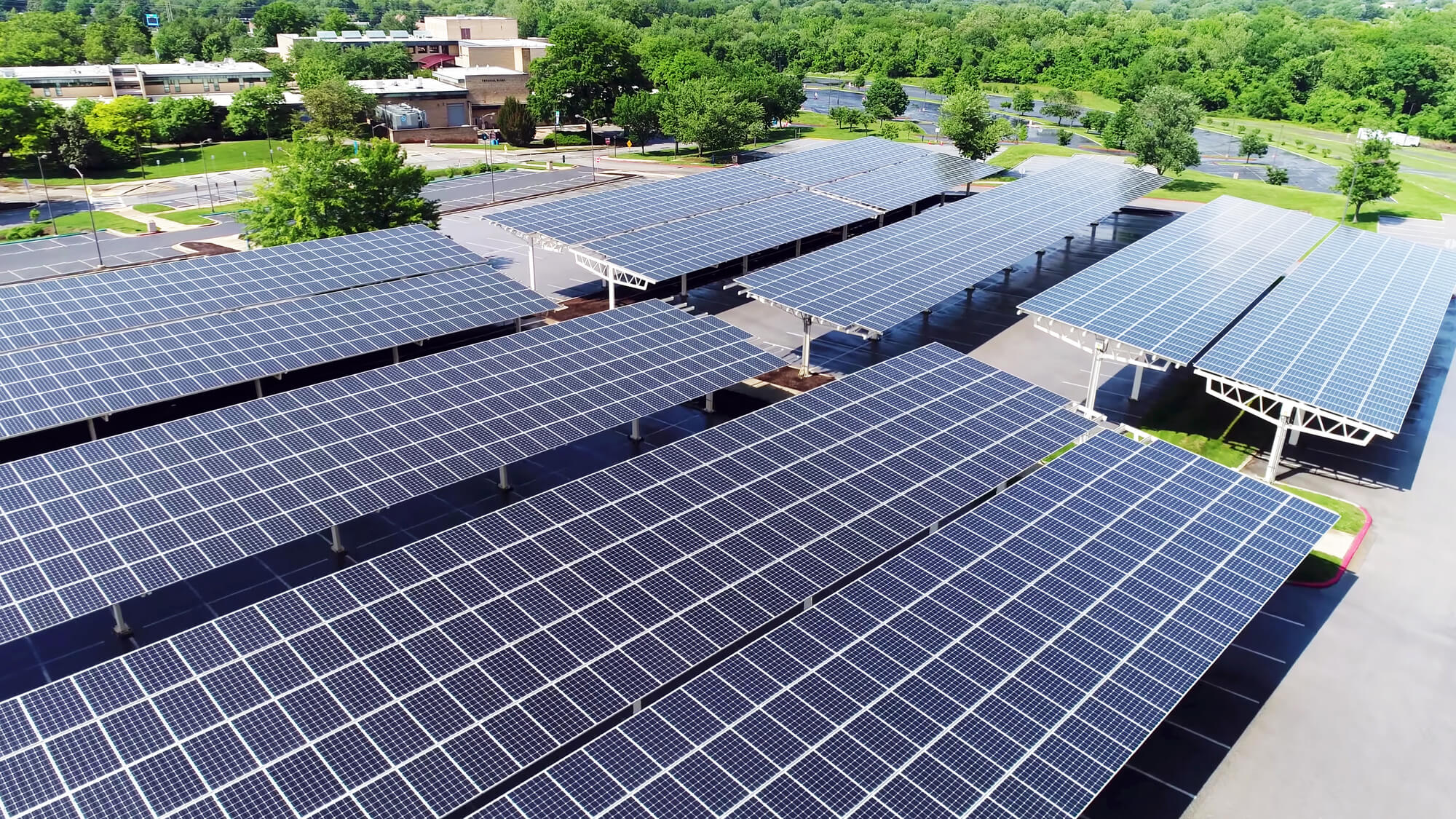
Solar Carports are the most common configuration for commercial and municipal parking lots. Steel or aluminum canopy structures support solar panels 10–15 feet above parking spaces, providing weather protection for vehicles and generating electricity from a surface that was previously unproductive. Single-row carports cover one lane of vehicles; double-cantilever designs span two rows without center posts that would interfere with parking. Standard commercial systems range from 50 kW to several MW depending on lot size.
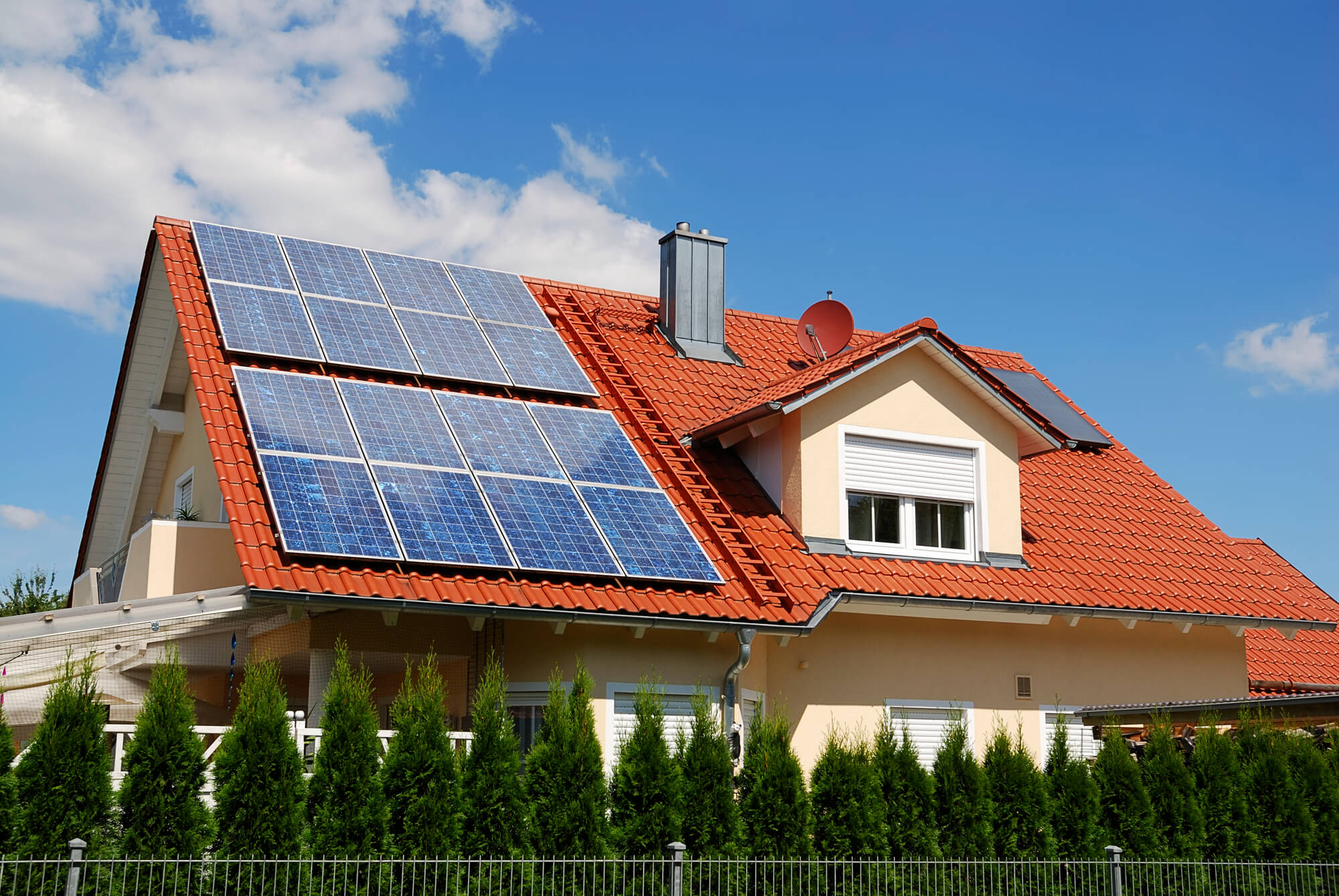
Residential Solar Carports cover one or two parking spaces adjacent to a home, typically producing 5–10 kW. They offer an alternative to rooftop solar for homes with shaded, unsuitable, or insufficient roof space. Residential carports can be freestanding or attached to a garage, and most connect to the home’s electrical panel through a standard inverter.
EV Charging Canopies integrate electric vehicle charging stations directly under the solar canopy structure, allowing solar-generated electricity to charge vehicles on-site. This EV+solar integration is particularly valuable for commercial properties seeking to attract EV-driving employees or customers and for fleets transitioning to electric vehicles. Level 2 chargers (7–22 kW) and DC fast chargers can both be integrated into canopy designs.
Tensile Shade Structures use fabric or polycarbonate membranes with integrated thin-film solar panels rather than rigid racking. These architecturally distinctive structures are popular for airports, transit stations, and premium commercial developments where aesthetics matter. They generate less electricity per square foot than conventional panel canopies but offer design flexibility.
Costs: What Solar Parking Canopies Actually Cost in 2026
Solar carport systems are more expensive than equivalent rooftop systems because of the structural steel, foundation work, and engineering required to span parking spaces at vehicular height. Expect to pay a 20–30% premium over rooftop solar on a per-watt basis.
| System Type | Installed Cost (per watt) | Typical System Size | Estimated Total Cost |
|---|---|---|---|
| Residential carport (1–2 cars) | $3.50–$4.50/W | 5–10 kW | $17,500–$45,000 |
| Small commercial carport | $3.15–$4.00/W | 50–200 kW | $157,500–$800,000 |
| Large commercial / municipal | $2.80–$3.50/W | 200 kW–2 MW | $560,000–$7,000,000+ |
| EV charging integration (add-on) | $5,000–$15,000 per port | Varies | Varies |
Costs vary significantly by geographic region (labor and permitting costs), structural requirements (soil conditions, wind/snow loads), number of EV charging outlets, panel type (bifacial panels on canopies can boost output 10–15%), and whether the project qualifies for prevailing wage incentives under the IRA.
Federal Incentives and Tax Credits
Solar parking canopies qualify for the 30% federal Investment Tax Credit (ITC) under the Inflation Reduction Act, which runs through 2032. For commercial and tax-exempt entities, this includes:
Business Energy Investment Tax Credit (ITC, Section 48): Commercial property owners can claim a 30% federal tax credit on the full installed cost of solar carport systems. A $500,000 carport installation generates a $150,000 tax credit directly reducing federal tax liability. The IRA also introduced a domestic content bonus (10% additional) for systems using US-manufactured panels and racking, and a prevailing wage/apprenticeship bonus (an additional 10%) for systems built by workers paid at federal prevailing wage rates.
MACRS Accelerated Depreciation: Commercial solar installations qualify for 5-year Modified Accelerated Cost Recovery System (MACRS) depreciation, which allows businesses to recover the full cost of the solar system over 5 years. Combined with the ITC’s basis reduction rules, this provides substantial first-year tax benefits. When ITC and MACRS are combined, some commercial installations achieve 40–50% of total cost recovery in Year 1.
Bonus Depreciation: The IRA extended 60% bonus depreciation for qualifying equipment placed in service in 2024, stepping down to 40% in 2025 and 20% in 2026. Consult a tax professional to model the combined ITC + MACRS + bonus depreciation benefit for your specific situation.
State and Local Incentives: Many states offer additional sales tax exemptions on solar equipment, property tax exclusions for solar improvements, and state-level business energy credits. California, New Jersey, Massachusetts, New York, and Colorado are among the most incentive-rich states for commercial solar.
ROI and Payback Period
Parking lot solar ROI depends on three primary factors: local electricity rates, how much of the solar output is consumed on-site (versus exported to the grid), and available incentives.
Commercial installations in high-electricity-cost markets (California, Hawaii, Northeast) typically achieve payback in 5–8 years, with 25-year net savings of $300,000–$1,000,000+ for large systems. Properties that consume most of their solar generation on-site at retail electricity rates ($0.15–0.30/kWh) achieve faster payback than those that export to the grid at lower wholesale rates.
Additional value drivers include reduced demand charges (solar production during peak hours cuts utility demand peaks that drive commercial demand charges), increased property value (solar carports add demonstrable value to commercial real estate), EV charging revenue (EVSE operators can charge for charging services, creating a new revenue stream), and marketing value (visible solar infrastructure communicates sustainability commitment to employees, customers, and investors).
Residential carports in high-cost states typically pay back in 9–13 years, similar to rooftop solar, though the higher upfront cost extends the timeline compared to equivalent-wattage rooftop installations.
Design and Structural Considerations
Foundation Requirements: Canopy columns require engineered concrete footings sized for local wind and snow loads. Soil conditions affect footing depth and cost; expansive clay soils or high water tables require specialized foundation designs. Structural engineering fees are included in most contractor quotes but should be verified.
Panel Orientation: Carport canopies can be designed with south-facing tilt, east-west tilt (for morning/afternoon production), or flat (minimal production difference for high-latitude locations). Bifacial panels on canopies can capture albedo (reflected light) from the concrete or asphalt below, boosting output by 10–20%.
ADA and Fire Code Compliance: Canopy structures must maintain ADA-required vehicle clearance heights and accessible parking space dimensions. Fire codes require clearance around standpipes and fire apparatus access. Local permitting authorities may require fire sprinklers integrated into canopy structures above certain sizes.
Permitting Timeline: Commercial canopy permits involve building permits, electrical permits, and utility interconnection. In most jurisdictions, permitting takes 2–6 months. Projects over 1 MW may require environmental review and longer utility interconnection timelines.
Solar Parking Lot Case Examples
Universities: Rutgers University, University of Massachusetts Amherst, and dozens of other campuses have installed multi-MW carport systems covering thousands of parking spaces. These systems serve dual roles as educational demonstrations and meaningful decarbonization measures, often financed through Power Purchase Agreements (PPAs) that require no upfront capital.
Municipalities: Cities from Los Angeles to Boston have installed carport systems over municipal lots, generating revenue through electricity savings and sometimes EV charging fees while improving urban tree canopy equivalent (panels reduce surface heat absorption). Municipal projects often use PPA or lease structures to avoid capital outlay.
Corporate Campuses: Apple, Google, Amazon, and hundreds of other companies have used parking canopies as part of their sustainability commitments. Corporate procurement increasingly requires on-site renewable generation that solar carports deliver visibly.
Frequently Asked Questions
How much electricity does a solar parking canopy generate?
A standard 100 kW commercial canopy covering approximately 50 cars produces 120,000–160,000 kWh annually, depending on location. At $0.15/kWh, that represents $18,000–$24,000 in annual electricity value. A large 1 MW installation covering 500 cars generates 1.2–1.6 million kWh annually, enough to power 110–145 average US homes.
Do solar parking canopies qualify for the 30% federal tax credit?
Yes. Commercial solar parking canopies qualify for the 30% ITC under Section 48 of the tax code through 2032. Residential carports qualify for the 30% Residential Clean Energy Credit. Both are part of the Inflation Reduction Act incentive package. Tax-exempt entities (cities, nonprofits, schools) can claim the ITC as a direct cash payment (elective pay/transferability provisions of the IRA).
How long does it take to install a solar parking canopy?
Construction typically takes 6–16 weeks after permitting is approved. Permitting itself takes 2–6 months for most commercial projects. From contract signing to energization, most projects complete in 6–12 months. EV charging integration, utility interconnection complexity, and structural complexity (existing underground utilities, proximity to buildings) are the most common factors extending timelines.
Can I add EV charging to a solar parking canopy?
Yes, and this combination is increasingly common. The solar canopy generates electricity; EV chargers deliver it directly to vehicles, often without touching the utility grid. For commercial properties, the IRA’s Alternative Fuel Vehicle Refueling Property Credit (Section 30C) provides a 30% tax credit on EV charging equipment, stackable with the solar ITC. Integrating both in a single structure reduces civil and electrical installation costs compared to separate systems.
What is the best solar carport system for a commercial parking lot?
The best system depends on lot size, electricity rates, EV charging needs, structural constraints, and financing preferences. Most large commercial projects use PPA or lease financing (no upfront cost, fixed electricity rate) rather than direct ownership. Ownership makes sense for taxable entities with sufficient tax appetite to monetize the ITC and MACRS depreciation. Contact a commercial solar developer who can model both ownership and PPA options for your specific property.
Summing Up
Solar parking canopies represent one of the most financially compelling solar opportunities for commercial and institutional property owners. They convert unproductive pavement into electricity-generating, shade-providing infrastructure, generate meaningful ROI through electricity savings and federal incentives, and increasingly double as EV charging hubs. The 30% ITC through 2032 and MACRS depreciation make commercial economics particularly attractive for taxable entities. For properties with large parking areas and high electricity costs, the case for solar canopy installation has never been stronger.
Contact Solar Panels Network USA at (855) 427-0058 to connect with commercial solar specialists who can evaluate your parking lot’s solar potential, model ROI across ownership and PPA structures, and identify state and local incentives in your region.
Updated