
Solar panels come in several distinct types, differentiated by cell technology, manufacturing process, and the trade-offs between efficiency, cost, and application suitability. In 2026, the solar market has consolidated significantly: monocrystalline silicon dominates residential and commercial markets, with TOPCon and HJT emerging as the premium efficiency leaders. Understanding the differences helps you interpret panel specifications, compare products, and choose the right panel type for your application.
Monocrystalline Silicon Panels
Monocrystalline silicon (mono-Si) panels use solar cells cut from a single crystal of silicon grown by the Czochralski process. The uniform crystal structure allows electrons to move more freely than in polycrystalline silicon, resulting in higher efficiency. Monocrystalline panels are identifiable by their uniform black or dark blue appearance and octagonal or rounded-corner cell shapes (reflecting the circular cross-section of the silicon ingot before squaring).
Efficiency range: 18–24.5% depending on cell architecture (standard BSF monocrystalline at the low end, premium IBC at the high end).
Lifespan: 25–30+ years with 0.3–0.5% annual degradation rate for premium mono panels.
Within monocrystalline, several cell architectures exist with meaningfully different efficiency levels:
Standard monocrystalline (Al-BSF): Aluminum back surface field — the original monocrystalline architecture. Efficiency 17–19%. Largely superseded by PERC in new production.
PERC (Passivated Emitter and Rear Cell): Adds a passivation layer on the rear of the cell that reflects unabsorbed light back through the cell for a second pass. PERC reached 22% efficiency in mass production. Was the dominant residential panel technology 2018–2022. Still widely produced but increasingly replaced by TOPCon.
TOPCon (Tunnel Oxide Passivated Contact): n-type silicon with a thin tunnel oxide and phosphorus-doped polysilicon layer on the rear. Achieves 22–24% efficiency in mass production (2026). Lower degradation rate than PERC (typically 0.3–0.4%/year vs. 0.4–0.55% for PERC). No light-induced degradation (LID) because n-type silicon doesn’t exhibit the boron-oxygen defect responsible for LID in p-type. The dominant premium residential panel technology in 2026. Major producers: LONGi (Hi-MO 9), Jinko (Tiger Neo), Canadian Solar (HiHero), JA Solar (DeepBlue 4.0 Pro).
HJT (Heterojunction Technology): Combines crystalline silicon with amorphous silicon layers on both front and rear surfaces. Achieves 22–25% efficiency. Better temperature coefficient (−0.24 to −0.30%/°C vs. −0.35 to −0.45%/°C for TOPCon and PERC) — superior performance in hot climates. Bifacial by design — captures reflected light from rear. Higher manufacturing cost than TOPCon. Major producers: Panasonic (licensed), REC Group (Alpha series), Huasun, Risen.
IBC (Interdigitated Back Contact): All electrical contacts on the rear of the cell, eliminating front-side metal shading. Achieves 23–25.2% efficiency — the highest mass-produced efficiency available. Used by SunPower (Maxeon cells) and a few other manufacturers. Premium price; primarily for space-constrained residential installations where maximum output per square foot is priority.
Polycrystalline Silicon Panels
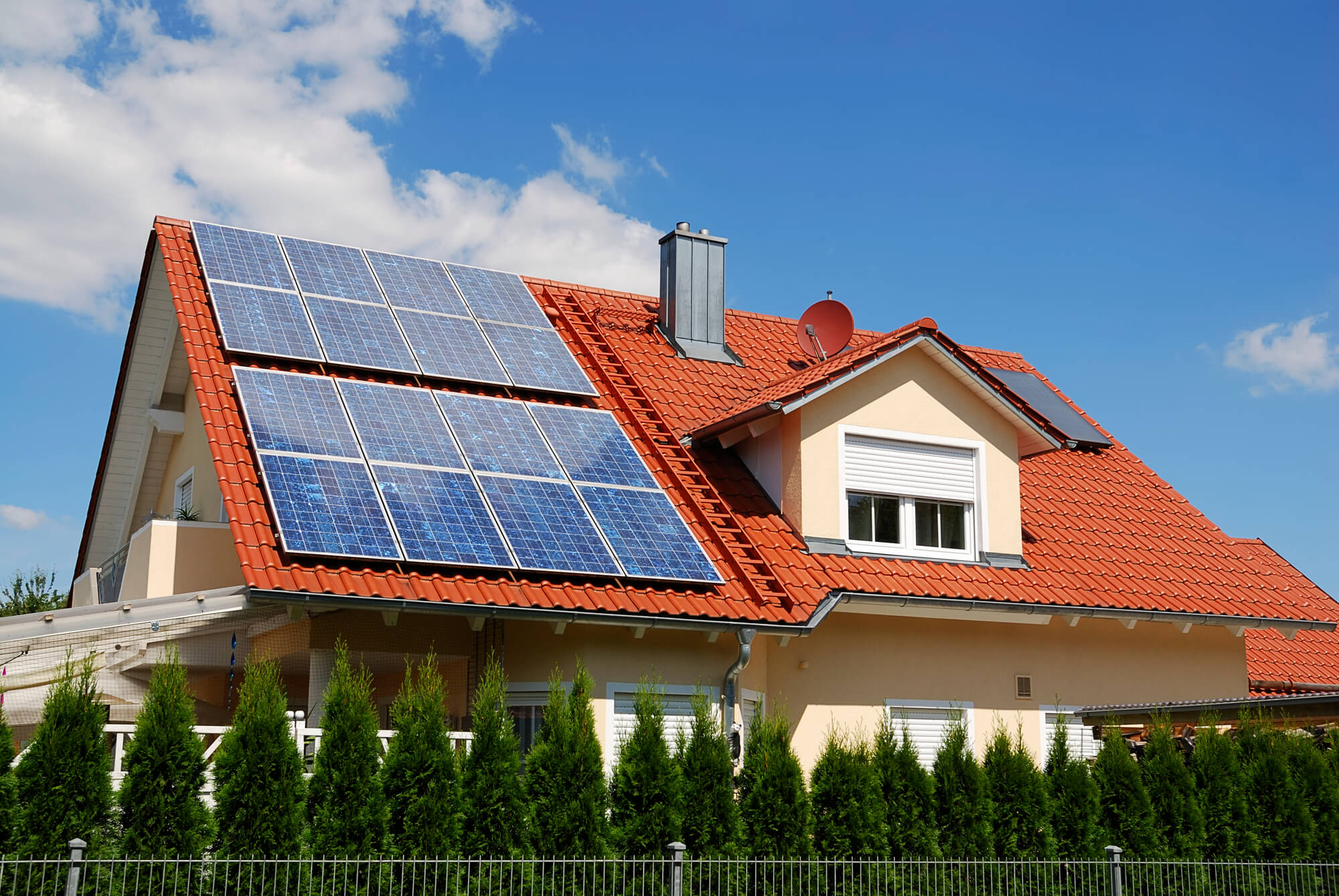
Polycrystalline silicon panels use cells cast from multiple silicon crystals — a simpler manufacturing process but less uniform crystal structure than monocrystalline. Identifiable by their speckled blue appearance (caused by light reflecting differently off the many crystal grain boundaries).
Efficiency range: 15–17.5%
Cost: Lower manufacturing cost than mono, but the efficiency gap means larger panels are needed for the same output — often eliminating the cost advantage in installed $/W terms.
Market status (2026): Essentially discontinued in new production. The price gap between mono and poly has closed to near zero while efficiency differences remain significant. No major manufacturer is introducing new polycrystalline products for the residential or commercial market. Existing polycrystalline panels continue operating in installed systems globally, but new purchases in the US market are virtually all monocrystalline.
Thin-Film Solar Panels
Thin-film panels deposit light-absorbing semiconductor material in very thin layers onto a substrate (glass, metal, or flexible film) — dramatically reducing material use compared to silicon wafer panels. Several thin-film technologies exist:
CdTe (Cadmium Telluride): The dominant commercial thin-film technology. First Solar is the primary manufacturer, producing utility-scale panels with 19–22% efficiency in their latest Series 7 modules. CdTe panels have excellent performance in diffuse light and high temperatures, making them valuable for large-scale desert installations. Not sold in the residential market. Cadmium content is encapsulated and safe during service life; First Solar has a comprehensive panel recycling program for end-of-life management.
CIGS (Copper Indium Gallium Selenide): Achieved 23.35% cell efficiency in laboratory conditions (world record for thin-film). Commercial modules: 13–17% efficiency. Produced in flexible form factors for building-integrated and specialty applications. Companies: Solar Frontier (Japan), MiaSolé, Global Solar. Niche market — not widely available in US residential market.
Amorphous Silicon (a-Si): The thin-film technology in solar-powered calculators, garden lights, and watches. Very low efficiency (5–10%) and high light-induced degradation. Not used in residential or commercial panel applications. The technology of solar-powered consumer electronics rather than energy system panels.
Bifacial Solar Panels
Bifacial panels capture sunlight on both the front (direct sunlight) and rear (reflected light from the ground or surface below) surfaces. Bifacial designs are available in monocrystalline (PERC, TOPCon, HJT, IBC) and thin-film (CdTe utility modules) technologies.
Bifacial gain depends on the albedo (reflectivity) of the ground surface beneath the panels and the installation height above the ground. Typical bifacial production gains: 5–15% for rooftop installations (limited reflected light from roof surface), 10–25% for ground-mount systems with light-colored soil, gravel, or snow cover. Most new TOPCon and HJT panels are bifacial by design.
How to Choose the Right Panel Type
For standard residential rooftop: TOPCon monocrystalline (22–24% efficiency) at $0.25–$0.40/W (2026 panel cost). Best balance of efficiency, cost, and longevity. HJT is the premium upgrade for hot climates (+$0.05–$0.10/W premium).
For space-constrained rooftop: IBC (SunPower Maxeon, 23–25%) maximizes output per square foot at premium cost. HJT is a more available alternative at 22–24.5%.
For utility-scale ground-mount: TOPCon large-format panels (500–600W) from LONGi, Jinko, JA Solar, or Canadian Solar for most applications. First Solar CdTe for specific high-temperature or diffuse-light utility applications.
For RV and off-grid portable: Flexible ETFE monocrystalline for curved-surface mounting; rigid monocrystalline for ground or roof rack mounts where maximum output per weight is important.
Frequently Asked Questions
What are the 3 main types of solar panels?
The three main categories are: (1) Monocrystalline silicon — highest efficiency (18–25%), longest lifespan, dominant in residential and commercial markets. Cell architectures include PERC, TOPCon, HJT, and IBC; (2) Polycrystalline silicon — lower efficiency (15–17.5%), lower cost per panel but comparable $/W installed. Essentially discontinued in new production as of 2026; (3) Thin-film — semiconductor material deposited in thin layers on substrate. Types include CdTe (First Solar, utility-scale), CIGS (specialty), and amorphous silicon (consumer electronics). Each category has distinct efficiency, cost, and application trade-offs.
What is the difference between monocrystalline and polycrystalline solar panels?
Monocrystalline panels use cells from a single crystal of silicon — uniform structure, higher electron mobility, higher efficiency (18–25%), uniform black appearance. Polycrystalline panels use cells cast from multiple silicon crystals — simpler manufacturing, lower efficiency (15–17.5%), speckled blue appearance. The efficiency gap makes monocrystalline the better value in most applications, and polycrystalline is no longer produced in new volume. All residential panels sold in the US market today are effectively monocrystalline.
What is TOPCon vs. HJT solar panels?
Both are premium monocrystalline technologies offering higher efficiency than PERC. TOPCon (Tunnel Oxide Passivated Contact) uses n-type silicon with a tunnel oxide passivation layer on the rear — 22–24% efficiency, lower annual degradation than PERC, no LID, lower manufacturing cost than HJT. HJT (Heterojunction Technology) adds amorphous silicon layers on both front and rear surfaces — 22–25% efficiency, lower temperature coefficient (−0.24%/°C vs. −0.35%/°C for TOPCon), better hot-climate performance, higher manufacturing cost. TOPCon is the dominant premium residential panel in 2026; HJT is the preferred choice for very hot climates.
Are thin-film solar panels any good?
It depends on the application. First Solar’s CdTe thin-film panels are excellent for large-scale utility solar — they perform well in high temperatures and diffuse light, and First Solar is a major US manufacturer of utility-scale panels. CIGS thin-film panels in flexible form are used in specialty BIPV and aerospace applications. For residential rooftop solar, thin-film panels are not practical — their lower efficiency requires more roof space for equivalent output, and monocrystalline silicon panels have become so affordable that thin-film offers no cost advantage in residential-scale applications.
What is the most efficient type of solar panel?
IBC (Interdigitated Back Contact) monocrystalline panels have the highest mass-production efficiency at 23–25.2% — SunPower Maxeon is the leading commercial example. HJT panels achieve 22–25% efficiency. In research settings, multijunction concentrator cells exceed 47% efficiency, and perovskite-silicon tandem cells have achieved 33.9% in the lab (as of 2025). For residential applications, the practical choice between IBC and HJT depends on cost tolerance and available roof space — the efficiency difference translates to approximately 3–8% more panels for the same system capacity with TOPCon vs. IBC.
Summing Up
Solar panel types range from standard monocrystalline (18–22% efficiency) to premium TOPCon (22–24%), HJT (22–25%), and IBC (23–25%) technologies, with thin-film options (CdTe, CIGS) serving utility-scale and specialty markets. Polycrystalline silicon is essentially discontinued in new production. For residential solar in 2026, TOPCon monocrystalline provides the best value balance of efficiency, cost, and longevity — HJT is the premium choice for hot climates, and IBC (SunPower Maxeon) for premium space-constrained applications. Panel technology improvements continue to push efficiency higher and costs lower — the practical guidance is to choose from established manufacturers using TOPCon or HJT architecture and at least a 25-year product warranty.
Updated