
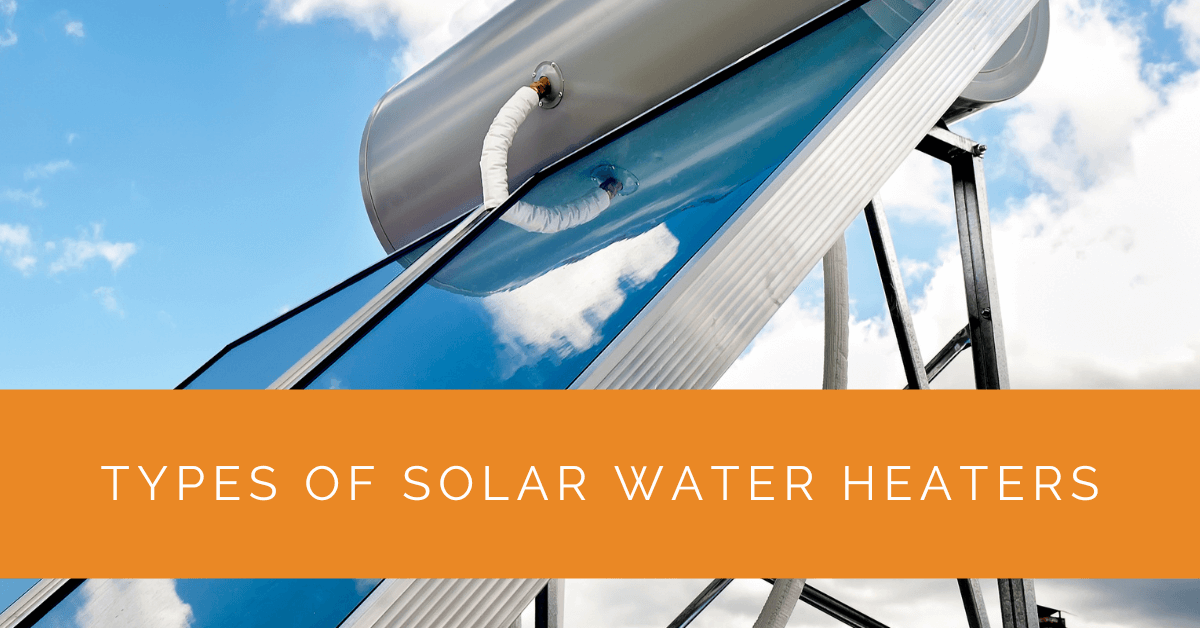
Solar water heaters are one of the most cost-effective solar energy investments for most US homes — with payback periods of 5–10 years, they offset 50–80% of domestic hot water costs using free solar energy. Unlike photovoltaic panels that convert sunlight into electricity, solar water heaters capture solar heat directly using collectors on the roof and transfer that heat to the domestic hot water supply. The type of system you need depends on your climate, water quality, and how your existing water heater is configured.
This guide covers every type of solar water heater — active and passive, direct and indirect, glazed and unglazed — with cost estimates, performance comparisons, and guidance on which system fits which climate.
Active vs Passive Solar Water Heaters
The first distinction in solar water heating is whether the system uses a pump to circulate fluid (active) or relies on natural convection (passive):
Active solar water heaters use a circulation pump (powered by a small PV panel or the home’s electricity supply) to move water or heat-transfer fluid through the collector and into the storage tank. Active systems can be installed with the tank indoors and collectors on the roof in any orientation, making them more flexible and typically more efficient than passive systems.
Passive solar water heaters rely on the natural tendency of heated fluid to rise (thermosiphon effect). They require the storage tank to be positioned above or adjacent to the collector — typically with both on the roof. Passive systems have no moving parts, no controls, and lower maintenance requirements, but they’re more limited in placement flexibility and work best in mild to warm climates where freezing is not a concern.
Active systems dominate the US residential market due to their flexibility, performance across climates, and compatibility with existing plumbing. Passive systems (particularly thermosiphon) are common in warm-climate states (Florida, Hawaii, California) and in many international markets where they’re the primary solar water heating technology.
Active Direct (Open Loop) Systems
In a direct active system, household water flows through the solar collectors and is heated directly before returning to the storage tank. The same water that flows through the collector is the water that comes out of the tap.
How it works: A differential controller monitors the temperature difference between the collector and the storage tank. When the collector is warmer than the tank (typically by 10–15°F), the pump turns on and circulates water through the collector. When the temperature difference drops below a threshold, the pump stops. A backup electric or gas heating element in the tank maintains temperature during cloudy periods.
Best for: Warm climates where freezing is not a concern (most of Florida, Hawaii, southern California, Gulf Coast states). Cannot be used where collector freezing is possible — water in the collector would freeze and rupture the pipes.
Advantages: Simplest active design, no heat exchanger (higher efficiency), lower installation cost than indirect systems. Mineral scale can form in hard-water areas if water chemistry is not managed.
Active Indirect (Closed Loop) Systems
In an indirect active system, a freeze-resistant heat-transfer fluid (propylene glycol antifreeze solution, or in some systems, silicone oil) circulates through the collectors instead of household water. The heated fluid passes through a heat exchanger inside the storage tank, transferring heat to the domestic water supply without the two fluids mixing.
How it works: Same differential controller as a direct system, but the circulation loop contains antifreeze rather than water. The heat exchanger is typically a coil immersed in the tank or a brazed-plate heat exchanger on the tank exterior.
Best for: Climates where freezing occurs — any US location outside the frost-free Gulf Coast and deep South. This is the most common active solar water heater type in the continental US.
Advantages: Freeze protection inherent in the system design; also protects against corrosion in hard-water areas since collector water never mixes with the domestic supply. Antifreeze solution must be replaced or recharged every 3–5 years as propylene glycol degrades. Heat exchanger adds a small efficiency penalty (5–15%) compared to direct systems.
Drainback Systems
Drainback is a variation of active indirect design that achieves freeze protection without antifreeze. Instead of filling the collector loop with antifreeze, the system drains all water out of the collectors and connecting pipes when the pump stops — into a drainback reservoir tank inside the building. When the pump is off (at night or on cloudy days), there’s no fluid in the external collector pipes to freeze.
How it works: When the differential controller calls for circulation, the pump draws water from the drainback reservoir, pushes it up through the roof collector, and returns hot water to the reservoir, which exchanges heat with the main storage tank. When the pump stops, gravity drains all the collector piping back into the indoor reservoir.
Advantages: No antifreeze to maintain; distilled or deionized water used as the working fluid minimizes mineral buildup. No risk of overheating stagnation damage (a risk with glycol systems in summer if no load is drawn for extended periods). Considered the most durable and lowest-maintenance active design.
Disadvantages: Requires careful plumbing to ensure gravity drains correctly; collector and piping must be positioned and pitched to drain completely. Not suitable for all roof configurations. Pump must overcome the head pressure of lifting water to the collector height on each start — requires a larger pump than glycol systems.
Passive Thermosiphon Systems
Thermosiphon systems use the density difference between hot and cold water to drive natural circulation — no pump required. Hot water rises, cold water sinks, and a closed loop forms between the collector (below) and the tank (above). The tank is mounted directly above the collector on the roof.
How it works: Cold water at the bottom of the storage tank flows down into the collector inlet. The collector heats it. Hot water rises into the top of the tank. Cold water from the tank bottom replaces it. This convective loop continues as long as the collector is warmer than the tank water.
Best for: Warm climates without freezing risk (Florida, Hawaii, southern California, Caribbean); rural areas or locations where electrical reliability is poor; homeowners wanting maximum simplicity and minimum maintenance.
Advantages: No electricity required (fully passive), no controls, no pump to fail or maintain, lowest maintenance of any solar water heating type.
Disadvantages: Tank must be above the collector — both are typically on the roof, creating a heavy combined load (150–300 lbs filled). Aesthetically prominent. No freeze protection. Not suitable for cold climates.
Batch (Integral Collector-Storage) Systems
Batch systems (also called ICS — integral collector-storage) combine the collector and storage tank in a single unit. A large black storage tank is enclosed in an insulated, glazed box on the roof. Water is stored and heated in the same vessel that captures solar energy.
How it works: Cold water enters the unit, is stored in the tank, and is heated by sunlight. When hot water is needed, it flows directly from the rooftop unit through the supply system. As hot water is drawn, cold water from the main supply enters at the bottom of the tank.
Best for: Warm climates where overnight temperature drop is modest — the water cools in the rooftop tank overnight, so the system is most efficient where minimum nighttime temperatures are above 40–50°F. Common in Hawaii, Florida, and the Southwest.
Advantages: Simplest possible system — no pump, no controller, no separate tank. Low initial cost. Long-term maintenance is minimal.
Disadvantages: Significant heat loss overnight in the rooftop tank. Not freeze-protected. Storage capacity is limited to what fits on the roof. Heavy roof load (100–200+ gallons of water). Structural assessment required before installation.
Flat Plate Collectors vs Evacuated Tube Collectors
Active solar water heater systems can use either flat plate or evacuated tube collectors — these are the two primary collector technologies in 2026:
Flat plate collectors: A rectangular insulated box with a glass cover, absorber plate (black-coated copper or aluminum), and fluid tubes. Simple, durable, cost-effective. Efficiency 40–70% in warm conditions. More susceptible to heat loss in cold or windy conditions because the glass cover still loses heat to the outside air. Dominant in most residential installations globally. Cost: $600–$1,000 per panel (60 sq ft).
Evacuated tube collectors: Arrays of parallel glass tubes, each containing an inner absorber tube surrounded by vacuum-insulated glass. The vacuum eliminates convective heat loss, allowing collection at much higher temperatures and better performance in cold weather. Efficiency 50–80%, superior in cold or overcast conditions. More expensive and fragile (glass tubes break) but outperform flat plate in cold climates. Cost: $900–$1,500 per panel equivalent.
For US homeowners: flat plate collectors are the better choice in warm climates (South, Southwest) where their cost advantage over evacuated tubes is significant and performance is comparable. Evacuated tubes are the better choice in cold-climate states (New England, Midwest, Mountain states) where their cold-weather performance advantage justifies the premium.
Solar Water Heater Costs and Payback
Installed costs for residential solar water heaters in 2026:
Passive thermosiphon (warm climates): $1,500–$3,500 installed. Lowest cost option. Best ROI where insolation is high and installation simple.
Active direct (warm climates): $2,000–$4,500 installed. Higher performance and tank placement flexibility than thermosiphon.
Active indirect/glycol (continental US): $3,000–$6,500 installed. Most common system type in cold-climate states. Higher cost than direct due to heat exchanger, antifreeze, and more complex installation.
Drainback systems: $3,500–$7,000 installed. Premium for the simplicity of no antifreeze and long-term durability.
Evacuated tube systems: $5,000–$9,000 installed. Premium for cold-climate performance.
Annual water heating savings depend on location and existing fuel type. A 2-panel system (80-gallon storage) in a sunny climate (4.5+ peak sun hours) saves 60–80 gallons of equivalent propane or 1,500–2,500 kWh of electrical water heating annually. At $0.18/kWh electricity or $2.50/gallon propane, annual savings range from $270–$450 (electric) to $450–$750 (propane). Payback periods: 5–10 years in warm climates; 7–14 years in cold climates.
Frequently Asked Questions
What is the most efficient type of solar water heater?
Active indirect closed-loop systems with evacuated tube collectors achieve the highest solar fraction (percentage of water heating demand met by solar) in cold climates — typically 60–75% annually. In warm climates, active direct flat plate systems approach the same solar fraction at lower cost. Drainback systems with evacuated tubes offer the best combination of performance, reliability, and low maintenance in cold climates but at the highest initial cost.
Do solar water heaters work in cold climates?
Yes — active indirect (closed-loop glycol) and drainback systems provide freeze protection and work in any US climate. Evacuated tube collectors further improve cold-climate performance by reducing heat loss from the collector in cold or windy conditions. A well-designed system in Minnesota or Maine can meet 40–60% of annual water heating demand from solar.
How long do solar water heaters last?
Solar water heater collectors typically last 20–30 years with proper maintenance. Storage tanks have 10–15 year lifespans similar to conventional water heaters and usually need one replacement over the system’s lifetime. Active system pumps and controllers last 10–15 years. Flat plate collector glazing and drainback reservoirs can last 25+ years. Overall system lifespan with proper maintenance: 20–25 years.
Can a solar water heater also heat my home?
Solar thermal systems can be designed for combined domestic hot water and space heating — called solar combi systems. These require larger collector arrays (4–8 panels vs 2–3 for hot water only), larger storage tanks (200–500 gallons vs 80–120 gallons), and heat distribution through radiant floor heating or fan coil units. Solar combi systems are common in Europe and cold-climate US regions with high heating loads. They require a larger upfront investment but can meet 20–40% of a well-insulated home’s space heating demand.
Is a solar water heater worth it?
For most US homeowners in climates with reasonable solar resource (most of the country), a solar water heater offers a solid ROI with payback periods of 5–12 years and 20+ year system lifespans. The financial case is strongest for: high-electricity-cost states (Hawaii, California, Massachusetts); homes that use a lot of hot water (large families, homes with pools or spa); propane-heated water (propane at $2.50/gallon vs solar); and homeowners planning to stay in the home long-term to capture the full payback.
Summing Up
Solar water heaters fall into two main categories — active (pump-driven) and passive (convection-driven) — and within active systems, direct (open loop) for warm climates and indirect/closed loop for cold climates. Flat plate collectors are cost-effective for warm climates; evacuated tube collectors outperform in cold conditions. A 2-panel active indirect system costs $3,000–$6,500 installed and typically pays back in 7–12 years in most US markets. For most homes, the combination of solar fraction (50–80% of annual hot water needs), long lifespan, and falling equipment costs make solar water heating a financially sound investment.
To find out which solar water heater type makes sense for your home and climate — call (855) 427-0058 for a free consultation. Local solar professionals can assess your hot water demand, roof, and local solar resource at no cost.
Updated